By Bill Sanservino
Miguel Jimenez-Vergara is like most other 13-year-old boys. He likes to play video games, watch a lot of television and eat junk food — especially ice cream.
Differentiating the Ewing teen from other kids his age is the fact that he is one of the best athletes in the country, winning numerous gold medals in multiple sports.
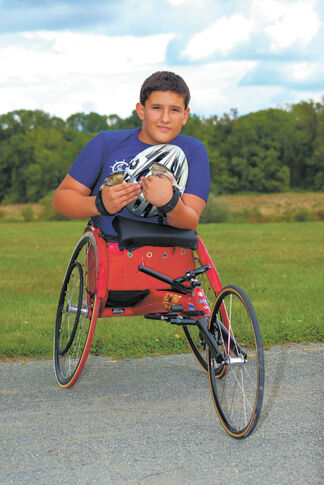
What makes him amazing is the fact that he was born without legs.
In the recent National Junior Disability Championships held in Rochester, Minn., this summer, Miguel won 18 medals: 17 gold and 1 silver.
Miguel, a student at Incarnation – St. James Parish School, has lived in Ewing since he was adopted at three years old by his mother, Tulia, a single mother who is a teacher of Spanish at The College of New Jersey. He has no siblings.
Tulia, a native of Columbia like Miguel, had been living in America for many years when she went to Columbia to visit her sick father.
“My grandfather told my mother that she should adopt a child, and so my mom adopted me,” said Miguel.
In reality, it wasn’t quite that easy.
“I have a big family in Columbia, including 14 uncles, and I was used to having many people around,” Tulia said. “I had been in America for a long time and had only focused on studying and working. Eventually, I decided I wanted to adopt a child.”
Based on her father’s advice, Tulia went to an orphanage in Columbia and initally chose a six-month-old baby who has been discarded in a garbage can. She had been carrying the child around all afternoon and was getting ready to leave when two-year-old Miguel came up and started talking to her.
“Someone had put little horns on his head,” she said. “I looked at him and knew he was special. It was meant to be.”
“I could have chosen one of the other children,” she added, “but I knew it would be easier for them to get adopted. Because Miguel had no legs, it would be more difficult for him. I had to take him.”
But it would be a half year before she could become Miguel’s mother. International adoptions are expensive, and she was only just a student at the time. It took her six months to raise the money, which she did by holding fundraisers, taking out loans, and pooling together donations from family and friends.”
A decade later, it seems that Tulia’s premonition was correct. Miguel is special.
The teen competes as a member of a North Jersey-based team called the New Jersey Navigators. He learned about the team at age six when he was visiting a wheelchair expo in North Jersey that was recommended by his physical therapist.
“We went there and I met another guy who was exactly like me — born with no legs whatsoever,” said Miguel. “He told me about a sports team based in the state called the Navigators. Well, a little while later I was running around the food court and I saw members of the team. I started talking to them and yelling at them. That’s how how I met them and became involved with the team.”
Miguel started out with track and swimming but was attracted to field events after watching other athletes practice and compete in those sports.
“I saw some other kids throwing really heavy implements and I was like, ‘I want to do that!’,” he said. “At first my mom was like, ‘Did you see the size of that javelin?’ It was so much bigger than me. But I really wanted to try it. I literally begged her until she finally agreed to let me throw the javelin, discus and shot put.”
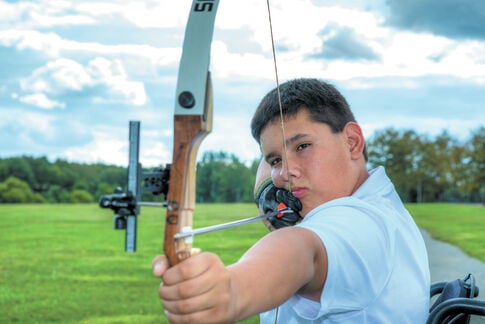
Getting involved in archery was also Miguel’s idea. “We got a sticker showing all the sports that were available to compete in. I was like, ‘I can’t do scuba diving and I can’t do wrestling.’ But then I saw archery on the list and thought it would be cool to be able to hunt. So I went to my coach and begged her until she said I could try archery.”
Miguel excelled in all of those sports at this year’s NJDC.
In swimming, Miguel captured first place in the 100-meter backstroke, 25-yard butterfly, 50-yard backstroke, 50-yard breaststroke, 50-yard freestyle, the 4×25-yard intermediate medley, and the 4×25-yard medley relay.
In wheelchair racing, he took first in multiple distances including 100 meters, 800 meters, 400 meters, 1500 meters, the 4×100-meter relay, and the 4×800-meter relay. He won silver in the 200-meter race.
Miguel also won gold in archery for the recurve bow, discus, javelin, and shot put.
“Wheelchair sports are great and they make me feel like a regular kid,” said Miguel. “It’s the best thing that ever happened to me. I could play sports and compete just like everyone else.”
The NJDC is an annual Olympic-style sports competition for physically disabled kids between 7 and 21 years old, including those with spina bifida, cerebral palsy, amputees, visually impaired/blind, dwarfism, and any other similar physical disabilities that impede movement or the ability to participate in non-adapted sports.
The NJDC began in 1984, with only three events and since then has grown to include more than 250 athletes.
Miguel’s success in the this year’s NJDC came, in part, thanks to a new racing wheelchair — donated to him by Philadelphia Insurance Companies a few weeks before the competition.
According to a news release by Philadelphia Insurance, Miguel was coming off an NJDC in 2012 that saw him win 14 gold and two silver medals, but he realized that he would need a high-end racing wheelchair to continue competing at a high level in the 2013 NJDC. In response, Philadelphia Insurance presented him with a custom-built EagleSports Soaring racing wheelchair valued at $3,500.
Miguel, whose favorite sports are swimming and track, said that although he is competitive, it’s more about achieving personal bests.
“To me it’s not about beating the other people. It’s about beating yourself,” he said. “If you feel that you left everything out there on the field, then its okay because you did your best.”
He said his favorite moment of a competition is the adrenaline rush at the beginning of an event. “I love those split seconds before the starting buzzer goes off. I feel like my heart slows down and then, when it goes ‘bang,’ my heart goes ‘bang’ too.”
Miguel said the next step for him is to compete outside the United States.
“I want to go international,” he said. “I want to see the rest of the world. I would like to see Columbia again or go to the Summer Paralypic Games in Rio de Janeiro (Brazil, in 2016).”
The teen, whose idol is Olympic gold medal winning swimmer Michael Phelps, said his ultimate dream is to compete in the Paralympics. In order to do that he would have to make the national team, and then qualify for and do well in the International Wheelchair Amputee Sports Junior Games.
Norm Swenson, Miguel’s swimming coach, is confident that the teen can succeed at a higher level.
“He’s got a ton of talent. He’s got some gifts and the potential is there,” said Swenson, who has worked with Miguel for about five years. “I’m very optimistic for his future.”
The coach adds that swimming is a good cross-training regimen for track. “It provides him a lot of endurance and aerobic training and muscle building. It really helps to stretch out the muscles.”
Miguel’s mother also helps play the role of coach, as well as being his biggest fan.
“I have to push him a lot, but I know his potential and that he will be very successful,” Tulia said. “But only if he puts his mind to it. Sometimes I feel bad that he has to make such an effort but at the same time I see how happy it makes him.”
Like his hero Phelps, Miguel was diagnosed with ADHD when he was very young, said Tulia. Competing in sports has helped him on that front, allowing him to funnel his excess energy into physical activities.
Tulia said that some teachers suggested that Miguel take medication for his ADHD, but she opted not to. “I find that sports and all of the activities that he does to be the medicine that he needs,” she said.
According to Tulia, Miguel had some difficulty in Ewing public schools and she decided that he would do better in an environment where there were less kids.
“I put him in a school with smaller classes where they could pay more attention to him, and he just blossomed like a flower.,” she said. “He needs a family. He doesn’t need to be isolated in the middle of 1,000 students.”
Despite his great success to this point in his athletic career, Miguel remains realistic about what the future might hold. Part of that may come down to dedicating himself to just one sport. “The officials and coaches are already telling me that I have to specialize. Usually someone makes a choice by age 14.”
Miguel said that part of his success comes from believing in himself. When doubt enters your mind it can lead to failure, he said.
He cites the 200 meters wheelchair race — the only race where he finished second — in the NJDC as an example.
“I got nervous because in the 100 there was a guy who was with me the entire race. They had to use a slow motion camera to determine the result,” Miguel said. “It made me worried about what was going to happen against him in the 200. I started putting myself down, and I’m guessing that’s why I got second place.”
Tulia said that Miguel needs to believe in himself and his abilities. “I always tell him not to compare himself to others and just do his best.”
“I want him to be able to understand that he’s doing better and better all the time and to not look in the past,” she added. “He needs to leave the mistakes behind, learn from them and move on. Sometimes he doesn’t give himself the credit he deserves for what he’s doing. He judges himself too harshly. To me he’s excellent.”
And his mother isn’t the only one who feels that way. Although she didn’t go to the NJDC competition with Miguel, she got regular updates from members of the Navigators on Miguel’s progress in the competition.
“The other members on the team were sending me messages saying, ‘He’s amazing, and he doesn’t even realize how amazing he is.’”
Miguel said that something he heard on a television show when he was young stuck with him. “The person said, ‘Believe in what you can do.’ That’s something that has really stuck with me.”
,