It was the scooters at Disney World that convinced Dr. Louis G. Fares that if he started practicing weight loss surgery, business would be good.
It was around the turn of the millennium, and Fares was returning to Disney World after a vacation there in the 1980s. That previous time, he had spoken with park officials and found out that they had three electric scooters available for use by disabled park-goers.
It was a different story when he came back in 2000.
“They said, ‘We have a whole fleet of them,’” Fares recalled.
The scooters were mostly for people who were too overweight to get around the parks under their own power. The extra pounds carried by morbidly obese patients damage their joints and prevent them from moving well, Fares said.
That’s about when Fares, already a surgeon, decided to learn how to perform bariatric surgery.
Bariatric surgery is not for people who merely need to lose a few pounds. It is for people whose obesity is so bad it has caused other health problems, and who have tried everything else to lose weight.
Bariatric surgery includes procedures such as Lap Band-type surgeries, where a flexible band is wrapped around a patient’s stomach to constrict the flow of food, or a bypass surgery, where the surgeon rearranges the intestines to divert food around the stomach.
Such drastic measures are serious, but Fares said bariatric surgery can help patients recover from extremely severe health problems. Most of Fares’s patients are 100 pounds or more overweight. The list of problems caused by those extra pounds is endless: diabetes, joint pain, sleep apnea, heart and breathing disorders are common, not to mention that ordinary tasks like sitting on a plane, climbing stairs or playing with children become difficult or impossible.
Bariatric surgery is often an instant cure for diabetes, and can help alleviate the other problems too.
Fares, who has an office in Pennington and operates at several local hospitals, said he has taken a standardized procedure and gotten excellent results for his patients. Since becoming a bariatric surgeon in 2003, he has operated on more than 800 patients. He said 85 percent of the gastric bypass patients he operates on are home within 24 hours, with a very low re-admission rate.
Fares formerly practiced with a group of surgeons at St. Francis, and opened his own office and became independent in June of last year.
Fares has been a surgeon for 27 years, performing about 500 surgeries each year, including gall bladder, hernia, breast and vascular surgery. He is the chairman of the department of surgery at St. Francis Medical Center and operates at St. Francis, Robert Wood Johnson University Hospital at Hamilton, St. Lawrence Rehab Center, and Capital Health Center at Hopewell. He went to medical school at the University of Santo Tomas in Manila. In 1990, he performed the county’s first minimally invasive gall bladder surgery.
Fares is gratified that his work has been able to help so many people.
“It is quite possible that patients not only lose weight, but resume normal lives that they have been missing out on,” he said.
Fares’ heaviest patient was around 700 pounds, he said. His office is built to accommodate morbidly obese clients. There are extra-wide chairs in the waiting room. The toilet is reinforced and the hallways are wider than normal.
Physicians classify obesity by body mass index, a formula that takes into account height and body weight. A BMI of 30 or more indicates obesity. Morbid obesity begins at a BMI of 35. Super obesity is 45 or more. More than 60 is super super obese. Fares once had a patient whose BMI was more than 100.
“We don’t have a classification for someone like that,” Fares said.
It’s not as simple as walking into Fares’ office and getting scheduled for surgery. Patients must complete a six-month education process to prepare, and to make sure they are good candidates for the surgery.
Fares also wants to make sure patients have tried diet and exercise before resorting to surgery.
“Surgery is not the easy answer. It’s supposed to be the last answer,” Fares said.
Fares’ office provides support for patients long after the surgery is over. He has dieticians on staff to help patients eat right, and support groups are also available.
Fares’ office is located at 116 Washington Road, Suite 1 in Pennington. Phone: (609) 737-2223.
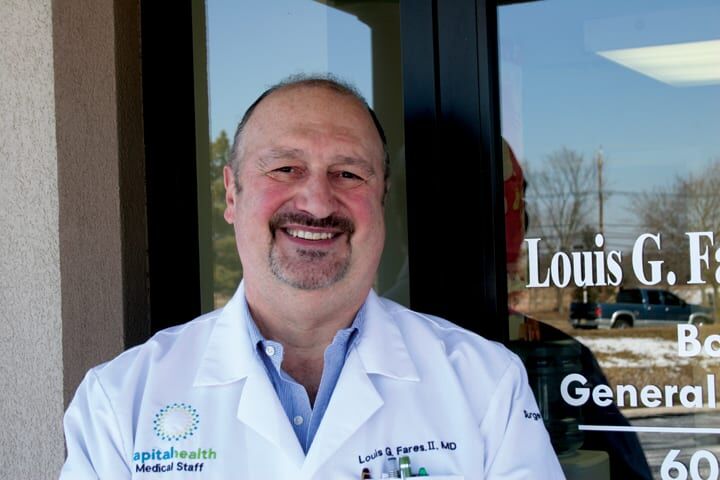
Dr. Louis G. Fares has been practicing bariatric surgery since 2003. (Staff photo by Diccon Hyatt.)

