Two West Windsor residents have filed a lawsuit against the township in an effort to stop construction of a large warehouse and distribution complex on the former American Cyanamid site.
The project, named Bridge Point 8, calls for the construction of seven warehouses totaling more than 5.5 million square feet on the 653-acre tract located at the corner of Clarksville and Quakerbridge Roads. The project was approved by the West Windsor Planning Board in June 2022.
Also named as defendants the in the court filing were: the West Windsor Planning Board; site operator Bridge Development Partners of Itasca, Illinois, via its subsidiary the Bridge Point West Windsor LLC; and land owner Atlantic Realty Development Corp. of Woodbridge, via its subsidiary, Clarksville Center LLC. The case will be heard by state Superior Court Judge Robert T. Lougy.
In the lawsuit, residents Justino Gonzalez and Stacey Joy are challenging the validity of an ordinance approved in November 2020 by Township Council that rezoned the tract for warehousing and all subsequent approvals by the Planning Board.
The plaintiffs are being represented by Robert F. Simon of the Warren Township-based law firm Herold Law.
The lawsuit seeks to invalidate the ordinance’s rezoning, the Planning Board’s approval and to halt all activity at the site.
The 37-page complaint seeks relief on a number of counts, including:
• The township failed to provide required notices to neighboring property owners, as required by state law, prior to holding hearings on the rezoning ordinance.
• The property is not appropriate for warehouse and distribution center uses, the rezoning ordinance was improperly adopted without evidence that the property was appropriate for such uses, and there was no zoning or planning justification to adopt the ordinance to permit such development on the property.
• The agreement between the township and the developer is an impermissible and illegal quid pro quo to award favorable zoning requirements at the property in exchange for agreements unrelated to the development of the property. This includes the fact that the developer is not required to build any affordable housing.
• The rezoning ordinance was “spot zoning,” which is illegal under state law. Spot zoning is defined as the process of singling out a parcel of land for a use classification totally different from that of the surrounding area for the benefit of the owner and to the detriment of other owners.
• The Planning Board did not provide “any meaningful opportunity for public participation” during its consistency review of the rezoning ordinance, because it failed to provide any opportunity for remote access to the hearing.
The complaint argues that although 10 out of 11 township boards and agencies provided for remote public participation at their meetings during the pandemic via online services such as Zoom, the Planning Board did not, and required physical attendance by the public throughout the pandemic.
• The planning board’s approval of the project was “arbitrary and capricious.” The suit alleges: the Planning Board did not sufficiently consider the lack of studies done on the tract; the application failed to obtain all necessary exception and variance relief required by law; and the Board improperly failed to consider testimony and evidence presented by members of the public and their experts prior to approving the application.
• The public notice provided by the developer of the Planning Board hearings on the application was “materially defective” because it failed to meet the minimum requirements for public notice as required by state law.
The complaint states that the public notice failed to inform the public of the nature of the matters to be considered, it failed to identify all required relief and the identified relief sought, and it failed to contain all information required by law.
• The developer failed to obtain a review by the West Windsor Environmental Commission for the completeness of its Environmental Impact Statement, as required by state law. The Planning Board also did not grant a waiver of that review in its approval.
Chicago-based Bridge Development Partners, the parent company of Bridge Point WW LLC, is focused on the development and acquisition of industrial properties in the United States and United Kingdom. Bridge is leasing the site from Atlantic Realty, which purchased the property from the Howard Hughes Corporation in 2019 for $40 million.
In 2020, the township reached a settlement agreement with Atlantic Realty to resolve pending litigation that had been filed by Howard Hughes.
The corporation challenged the zoning of the property, and the developer was pushing a plan to build a mixed-use project, featuring retail businesses, commercial offices and up to 2,000 residential units.
Township residents and officials had long been opposed to building residences on the property, due to the impact they would have on municipal services and schools.
West Windsor Mayor Hemant Marathe, who helped negotiate the deal with Bridgepoint, has argued that the project will boost township tax revenues by about $15 million a year, and would not add to municipal costs such as building roads and sewers if the land were instead developed residentially.
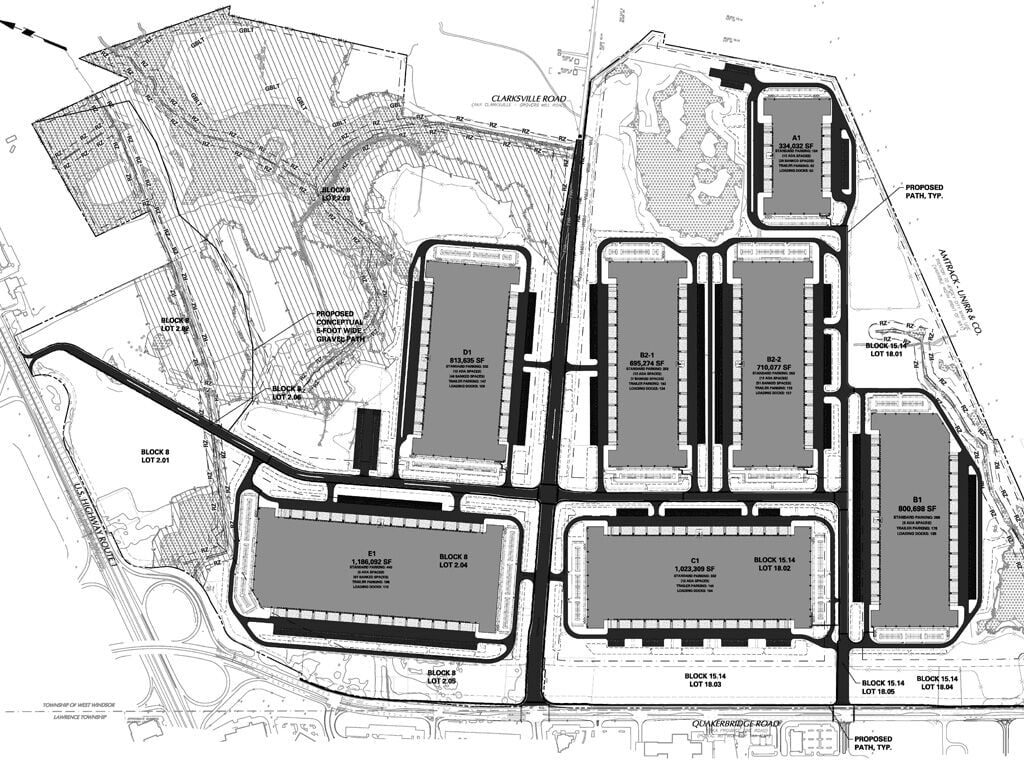
The Bridge Point 8 project calls for seven warehouses totaling more than 5.5 million square feet.,

