West Windsor officials last year were faced with one of the most controversial development applications in decades.
In July, the township ultimately approved the Bridge Point 8 project over the objections of numerous township residents.
The approval allowed for the construction of seven warehouses totaling 5.5 million square feet on the 653-acre property located at the corner of Clarksville and Quakerbridge Roads.
The project is being developed by Chicago-based Bridge Development Partners, the parent company of Bridge Point WW LLC.
Bridge is leasing the site from Atlantic Realty, which purchased the property from the Howard Hughes Corporation in 2019 for $40 million.
In 2020, the township reached a settlement agreement with Atlantic Realty to resolve litigation that had been filed by Howard Hughes.
The lawsuit challenged the zoning of the property and argued that the township had not provided its fair share of affordable housing.
The developer was pushing a plan to build a mixed-use project featuring retail businesses, commercial offices and some 1,900 residential homes, including low- and moderate-income affordable units.
The settlement agreement with Atlantic Realty ultimately resulted in the Bridge Point 8 warehouse development.
For township officials, the issue created a Hobson’s choice—allow the warehouse development or be faced with a massive housing complex that would have created an influx of thousands of students into the school district.
Currently the district’s per-pupil cost is more than $19,000 and increasing every year. Adding that number of school kids could ultimately result in tens of millions of dollars in costs to the district.
The warehouse project, on the other hand, could boost township tax revenues by about $15 million a year, township officials have estimated.
Although township residents and officials had historically been opposed to building residences on the property, there were some who argued during the Bridge Point 8 application process that housing would be preferable to the truck traffic and pollution caused by the development.
In January, two West Windsor residents filed a lawsuit against the township in an effort to stop construction of the warehouse complex. The litigation, which was filed by Justino Gonzalez and Stacey Joy Fox, challenges the planning board’s approvals of the development and also the validity of an ordinance approved in Nov, 2020 by Township Council that rezoned the tract to allow the warehouses.
In an effort to help clarify the township’s thinking on the issue, West Windsor & Plainsboro News editor Bill Sanservino—a veteran of West Windsor news coverage since 1987—sat down with Marathe to discuss the approval and complex issues associated with the issue.
An edited version of that discussion appears below.
WWP News: I know that to some extent the town was limited in it’s options, because the property owner had filed an affordable housing lawsuit that, if successful, would have allowed them to build a huge number of residential units to subsidize the affordable housing. What are your thoughts about the situation?
Hemant Marathe: I mean, I’ve been really honest. Even when I ran for reelection, I told people that (warehouses over residential housing) was my preference. That was my choice, simply not because I like warehouses, but I always say “I’m not a king. I don’t make the rules, I have to play by the rules.”
My job is to protect the township as best as I can, given the cards that I am dealt, and I have not been dealt very good cards, as you know.
What is unfortunate and disappointing is that everybody’s trying to address the symptoms but not the cause. It’s not just West Windsor. I mean, at least four or five towns in New Jersey are involved in various types of lawsuits.
All those mayors can be thinking the same way I do. I mean, they’re doing it because they see what their options are, and they’re doing what they feel is the best for their town long term. Unless somebody addresses the problem that’s causing it (affordable housing issues), there’s no point.
It’s very easy to yell at the mayor and the council, especially somebody like me, who responds, or who is approachable and who is willing to state what he truly believes in.
Since I became the mayor in 2015— and I was on the counsel before that— there’s not been a single discussion at the state level about affordable housing and how the state should manage it.
Instead of criticizing towns for their decisions, lawmakers would do a lot more service if they bring the issue up in the Assembly chamber and get some bill passed so that this madness is stopped. Right now it’s just Russian roulette. If you lose an affordable housing lawsuit, you don’t know what number of houses you’re going to get. There’s no rhyme or reason.
In my capacity, in my good conscience, I couldn’t take that chance for the township, whether I’m the mayor or not. One of the things I always felt was that if some previous mayor had taken care of that property, I wouldn’t be in this situation.
The way I think is that I can’t impose the problem on the next mayor and say, “it’s your headache, not my headache,” because it’s going to happen, and you’re going to have 2,000 or 3,000 homes.
What people don’t realize is that the density now has increased significantly since Howard Hughes made the proposal for 1,900-odd homes.
If you look at this round there’s not a single-family home being built. I mean, at most it’s townhouses and apartments, which is far more dense. And so instead of 1,900, you’re probably looking at 3,000.
And there’s people who are worried about traffic? 3000 apartments will generate a lot more traffic and will be much worse than the traffic that will be generated by these warehouses.
WWP: And not only traffic, but you’re also creating a significant impact on the schools.
HM: Absolutely. The schools, the police, everywhere. We would probably need at least five or 10 more police officers. How many public works people to maintain that land? I mean, that land is bigger than some municipalities in New Jersey.
So that’s the hand I’m dealt, and in good conscience, I can’t say, “hey, I don’t have to worry about it, its somebody else’s problem.”
This was something that was acceptable to the developer, because at that time warehouses were in great demand. If we were doing a deal now, I don’t know if they would be as amenable to that settlement as they were at that time, because now the economy has changed.
So many people are building warehouses all over towns in New Jersey. Amazon has said they have too many warehouses. Everybody was expecting Amazon to pick up some of those warehouses, so I don’t know if they will be willing to do it now.
And now as you get closer and closer to the next round of affordable housing (requirements from the state), the developer has less incentive to go ahead and do that.
My belief is the majority of people in West Windsor recognize that, understand that. That’s why even after making that a big issue in the campaign, I won, and I didn’t want to win by telling a lie, because there’s no point in doing that. So people need to realize we have to choose the best out of all the bad options.
WWP: One of the interesting things I noticed is that some of the people who I have seen over the years talking about not wanting more houses in West Windsor were some of the same people at the planning board meetings saying, “No more warehouses.” I think that there’s a lot of people who are going to be unhappy no matter what.
HM: Exactly.
WWP: Development happens on a parcel—that’s the way it works in New Jersey. The developers have the hammers, right?
HM: People need to realize that. The developers have the control and the laws of the state are not favorable to the to the towns. The Municipal Land Use Law doesn’t give too much power to the mayor, or the council or the planning board. It is what it is.
I mean, I met someone in transportation a couple of weeks ago and we were talking. He was in New Jersey a long time ago, then went overseas and recently came back. I was explaining to him I moved here in 1994 and how much the township has grown since ’94.
He had a very interesting question. He asked, “How many new roads have you built?”
I don’t think any. I mean, we did build New Village Road and the continuation of Village Road. Other than that, I don’t see any major significant new roads or new projects that would alleviate traffic.
Now, if you go from a township of 10,000 or 15,000 residents to 30,000 with the same roads, you’re definitely going to get at least 75% more traffic, if not double. And that’s what has essentially happened.
People keep saying, “oh this (warehouse project) will put a traffic burden on other towns nearby,” which is true, but when I look at it, West Windsor has a lot of traffic on Route 1. About 95% of that doesn’t originate or end in West Windsor and just passes through. It’s the same with Route 571. The same with the train station.
I mean, we have been supporting people coming from all neighboring towns, especially before the Hamilton train station was built. For many years people have been driving through West Windsor who don’t live in West Windsor, and we have never complained. We accommodated them.
So this is the same thing. I mean, if East Windsor is building warehouses on our border, those trucks are going to come through West Windsor.
There are two big stores in Quakerbridge Mall that are closed and there’s talk about converting them into warehouses or housing. If they’re converted into warehouses, those trucks can easily come on Clarksville Road. There’s nothing I can do about it. And there’s nothing that the people who are yelling and shouting can do about it.
So at least this way, we have the ability to control what happens on our side of the boundary of Quakerbridge Road, and it has given us the ability to talk about it. I mean, since this discussion started, I have noticed so many more trucks in town. I never noticed them before.
It’s not that they were not there before. I see trucks on Clarksville Road, and I sometimes follow them to see where they’re going. Only one or two ended up at McCaffrey’s (on Route 571 in West Windsor), but most of them go either to Route 130, Quaker Bridge Road or somewhere else. A lot of them are going to Walmart in East Windsor.
So we have had our share of supporting traffic from other towns and there’s nothing wrong in saying that this (the Bridge Point property) is a big piece of land and this is the best use from the township’s point of view to go ahead and do that.
WWP: Like you said. People are trying to deal with the symptoms, but not the problem. There has been talk by some officials and organizations saying, “okay, we have to address these issues on a statewide level, on a regional level.” But there are no mechanisms that will allow for that. There’s nothing in the state Municipal Land Use Law that allows for planning to be done regionally, is there?
HM: No. There’s absolutely nothing in the law. But see, equally important is that there has to be a willingness on the part of the leadership to take on tough issues and make tough decisions. Currently everybody’s afraid to make decisions. People who are unhappy yell the loudest, and people are happy stay home. So there’s a general unwillingness to make any tough decisions. I mean, the thinking is just, “let’s pass the can down the road, and it’s somebody else’s problem.”
WWP: The Municipal Land Use Law was written in the mid-1970’s. Have there been any significant changes? Have there been any tools dded that allow the state along with counties or municipalities to plan on a regional level to give them more control over what goes on?
HM: Not that I’m aware of. And the even now, Gov. Murphy probably couldn’t get those passed through the state Assembly and the Senate. That’s why they’re (the governor’s administration) just issuing guidelines, simply because none of the lawmakers want to make tough decisions and make developers unhappy.
You should always demand that the people who can do something about the problem do something about the problem. Not come to the people who can’t do anything about it and say, “You do something about it.”
There’s very little I can do, and my job is to protect West Windsor. My job is to look after the best interest of township as long as I’m not being unfair or don’t cheat anybody else. The township is still looking at all the options on the table, and I think this is still the best option for the township.
WWP: I’m assuming that one option that wasn’t on the table was to have most of that site be commercial offices or retail?
HM: Commercial offices and retail is, and has been, allowed there, but nobody is building office buildings. We have 4 million square feet of office buildings siting empty in West Windsor.
There is going to be commercial happening on that site eventually as part of this plan. I believe its about 150,000-square-feet along Route 1 and around Quakerbridge Road.
WWP: Offices and a small amount of retail, correct?
HM: Yes, a small amount of retail, too.
WWP: But the whole site could not have been developed as commercial and retail?
HM: No, not the whole thing as such. I mean, the developer would have made argument that this development is commercial. They would need to put a lot of houses there to create customers for whatever retail they puts in. But that’s the crux of the matter—that we don’t want too much housing, because that puts pressure on everybody.
WWP: How difficult were the negotiations with Atlantic? I’m sure you probably wanted less warehouses. Did the developer want more than they ultimately got?
HM: Yeah the developer wanted a lot more, and we went back and forth for quite a while, and it’s anybody’s guess, right? I didn’t know what they were thinking. They didn’t know what I was thinking. At a certain point, we had to decide, “okay, I believe this is the best I can get, plus or minus delta.” And that’s when we settled.
My reasoning was that the property is about two miles from Route 295 and it’s right on Route 1. One of the strong conditions in our approval is that they have to have Route 1 access.
It makes sense that the majority of traffic would go to either to Route 1 or to 295. If you’re going south, it makes no sense to come in through town. I mean, truck drivers are not just driving around to annoy you. They have to go somewhere and time is money for them. They will just take a route that’s more direct than going through several towns.
If you put in Google that you are coming from a Newark airport site, it will tell you take Route 18 and go to Route 1 as the shortest and easiest way here. If you’re going to Philadelphia or Delaware it’s a no-brainer to take Route 295 and south.
So I still expect the majority of traffic would go that way. I can’t say that not a single truck will come in through West Windsor. Trucks come in through West Windsor now.
People are always saying Clarksville Road is going to be six lanes. I don’t see that happening in my lifetime or my kids lifetime. I just don’t see that happening.
WWP: Now that it’s been approved, what are some of the things that the town can do to mitigate the impacts from the site that may take place over time? All of those warehouses are not going to appear at once, so what are some of the things that the municipality can do in conjunction with other authorities?
HM: That’s a really good point you bring up. If you notice, we have only approved the first phase of the two-phase project—three warehouses. And the planning board conditions also stipulated what they need to do before they come in for phase two.
And it’s not as if simply because they’ve got preliminary approval for phase one, they can just come and start building. The police are working with the state DOT to better understand what controls they have. They are educating the traffic police as to what they can and can’t do with the truck traffic.
One of the planning conditions is that you can’t turn left out of the warehouse onto Clarksville Road, and our lawyer has told us that we can enforce that condition whether the county agrees with it or not (Clarksville Road is under the county’s jurisdiction).
The planning board will require the developer to do a different and a more detailed traffic study before they come for the phase two approval of the project.
The three warehouses in phase one are not going to open at the same time, so as we go along we will learn and work with the developer to mitigate traffic issues.
Whether you are a truck driver, somebody who is leasing the warehouse, or the owner of the warehouse, you don’t want to spend nonproductive time fighting with the township or fighting with the police. So we will work with them to figure out ways to mitigate the traffic impacts within West Windsor.
People keep talking about trucks, but there’s going to be cars too, and that’s why we allow them only a single exit on Clarksville Road as opposed to the five or six that they wanted. We are hoping that with most of the cars—if you’re not living in West Windsor, there’s no reason for you to drive through West Windsor. You can drive on Route 1 or you can drive on Quakerbridge Road to go wherever you want to go.
WWP: The other thing is that planning and zoning processes are not exact sciences, and there are a lot of market-driven forces out there. As you said, there’s a glut of warehouses right now, because everybody’s building warehouses. I cover five towns and all five towns are talking about approving warehouses. You can’t have a state that’s just warehouse central. So is it possible that this site is not developed as currently approved, and it may need adjustments down the road?
HM: Oh, it’s very much possible. And I’ve always told people that I am open to negotiations on any aspect as long as it’s in the best interest of West Windsor.
The example I give is the Avalon Development (transit village) near the train station that was approved in 2007, and then the financial crisis happened and it’s just been 15 years. Whereas if you approve houses, they get built overnight. Literally.
Almost everybody we have approved for housing has done some activity. So it’s very, very possible that the site never gets developed fully as it’s currently envisioned by the developer, because the economic conditions change and they need a significant amount of investment on Quakerbridge Road and on Clarksville Road and on Route one before they can open even the first warehouse.
If the economic conditions change— and they definitely seem to be changing— the money is no longer free and the interest rates are going up. It’s very much possible the developer may decide to build one at a time and see how he leases that one rather than building all three.
That may slow down phase two, and then in that case, the township has an option of talking to them. If they come to me and say, “hey, this doesn’t seem to be viable,” at least then we have a stronger hand in negotiation, because now we have an agreement, and we have kept our part of the agreement, so then we can negotiate better.
WWP: The truth is that American Cyanamid closed on that site many, many, years ago. There’s been talk about developing that site, but it hasn’t happened. The SRI-Sarnoff property down the road is a similar site. It’s located on Route 1 and has a lot of available land. That was approved for a general development plan about 20 years ago and nothing has happened there at all.
HM: Yeah, I believe it’s approved for 3 million square feet of commercial space.
WWP: The plans even changed when the owner of that property decided to take the whole front portion and sell it to Princeton University. The instant they did that, the approval was bound to change. So that just goes to show that even though there’s an approval, there’s no guarantee it will happen.
HM: Exactly. That’s an excellent example. They could have built 3 million square feet there and nothing happened, because those decisions are driven more by economics and the economics definitely favor housing, because there’s a shortage of housing and rents keep going up and house prices keeps going up.
So people need to understand that if you approve housing, that will definitely get built sooner as opposed to a commercial project, which takes time because it depends on economic conditions and other things.
WWP: And as you know, having been school board president, building houses equals building schools down the road. And that’s expensive.
HM: Absolutely. When we moved here in 1994, they opened two schools in two consecutive years—I think Village and High School North. I remember the taxes went up almost 10% every year.
The one thing never goes down per pupil costs, and the majority of it comes from local taxpayers, because we are one of the wealthiest districts, we get very little school aid from the state.
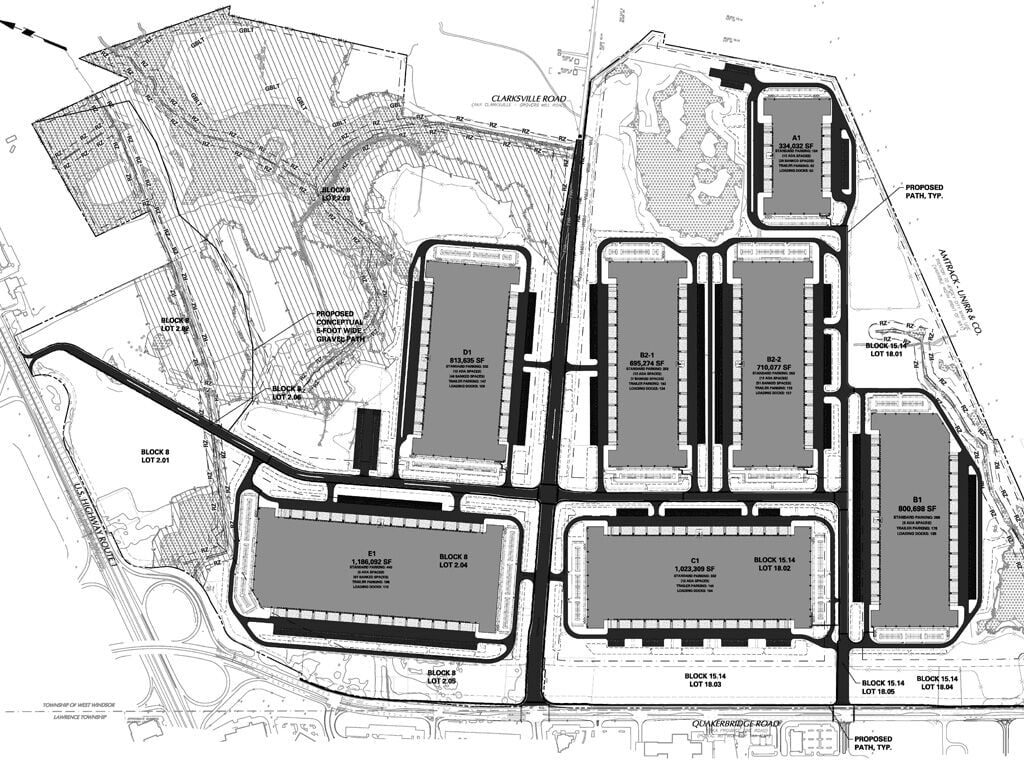
The Bridge Point 8 project calls for seven warehouses totaling more than 5.5 million square feet.,

