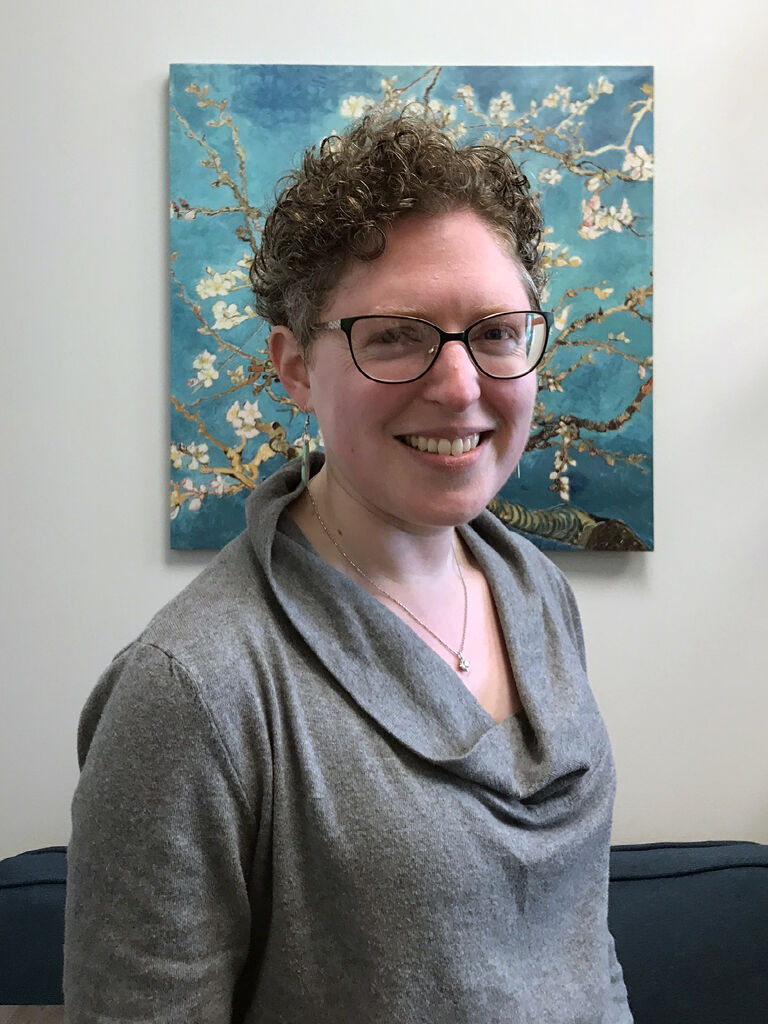
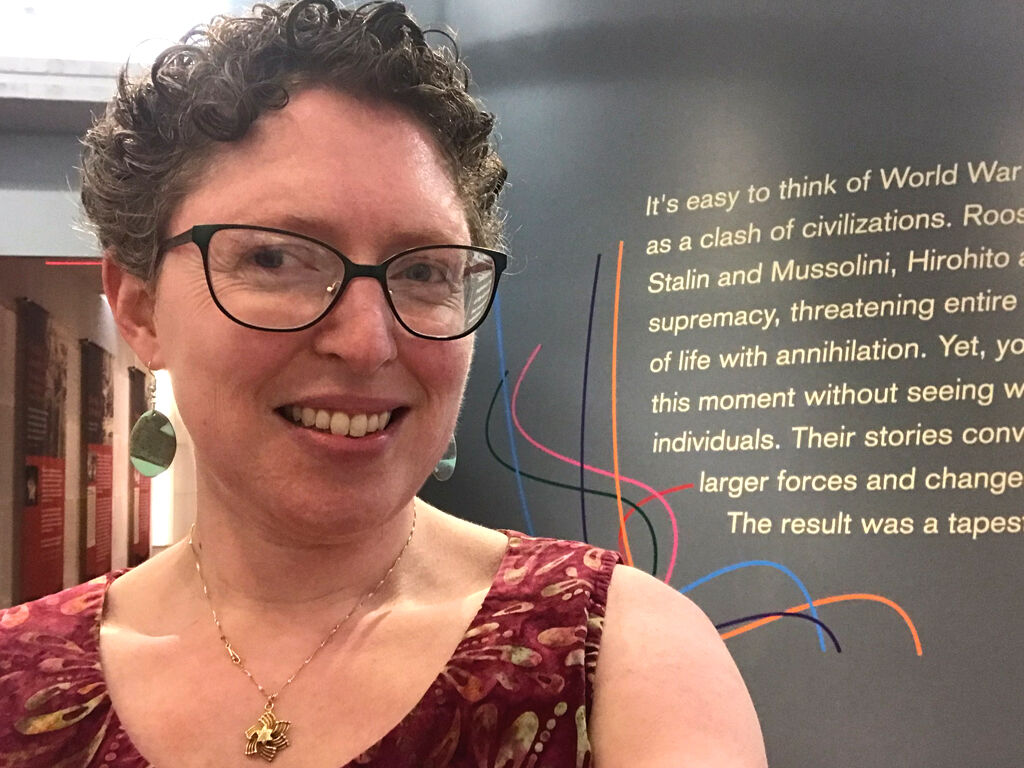
A jar of soil sits in the Jewish Center of Princeton’s “Black + Jewish” exhibit besides a panel on lynch laws, where by exploring race, religion and interactions between groups, the complexities of an under-discussed historical relationship are unearthed.
Ten of these panels are on loan from the Museum of History and Holocaust Education at Kennesaw State University (MHHE ) in Georgia and have traveled from curator Adina Langer’s public history class to the state of New Jersey; intending them as a “backbone for conversation” within the local community, Langer, her students, and TJC members have been working to articulate the reality of what people of these identities have endured — just as much as what they achieve from working together.
For Langer, who grew up in Princeton Junction, this step towards discussion starts with education. The combination of images and text, designed in the KSU program, highlights topics such as the emergence of the civil rights era, European immigration through the “Golden Door” of Ellis Island and the Great Migration, and the presence of Jewish refugee professors at historically black colleges and universities (HBCUs) due to World War II.
The exhibit, subtitled “Connection, Courage, Community,” remains on view at the Jewish Center through until October 31. To expand the project’s scope from Atlanta to a context much closer to home, TJC congregants Linda Oppenheim, Michele Alperin, Miki Mendelsohn, and Wilma Solomon produced supplemental information sheets that emphasize local connections found throughout the research process.
Emily Kafas, TJC’s communications and social media manager, is currently producing the additional materials, which will soon accompany the originals. But as a way of initiating dialogue outside of the exhibit, the Center has enlisted three speakers who share their perspectives through a series of virtual lectures.
Marc Dollinger, a professor and chair of the Department of Jewish Studies at San Francisco State University spoke on September 19. On Sunday, October 2, Langer will discuss the goals, intentions, and overall creation of the exhibit via Zoom at 4 p.m. In an interview with U.S. 1, she takes a few steps back to her time attending school at the Jewish Center, where her parents — physicians Corey and Mindy — have been active members since the late 1980s.
TJC is “really the community where I grew up, and where I had my Jewish education,” Langer says, referencing her bat mitzvah. “I wasn’t a Holocaust scholar in terms of what I had studied expressly in college or in graduate school, so my basic content knowledge, a lot of that really does trace back originally to the Jewish Center, and to my religious school upbringing.”
Drawn to the “free choice learning experience” of the institutions she now works within, as well as the accessibility of the Princeton area, Langer cultivated an interest in museums in early childhood. Her father began taking her on day trips to historic sites and institutions while her pediatrician mother, Mindy, would be on call at home.
Whether it was through visits to Teddy Roosevelt’s home at Sagamore Hill or somewhere nearby, Langer says she realized that while “being a doctor was a really important job,” it was “also, a very stressful one,” and decided to follow her parents’ interests in another way.
“Lifelong learning is a huge part of my family’s values,” Langer adds, positively associating conversations with her father, which became more intellectual in nature as she grew older, with the “curiosity” that compels her family.
“I think that I was attracted to studying history because I am an incurable polymath,” Langer says, referencing the term for someone with aptitude in a range of disciplines. “I really enjoy learning about how we got to be where we are in multiple aspects of culture and geography and science. They’re all the ways in which people engage with the world. When you study history, it doesn’t limit you to a single disciplinary perspective; it allows you to weave together all of the relevant threads in order to understand continuity and change over time,” she explains.
All of the Langer family have written poetry for U.S. 1 in the past, with Corey, a professor of Medicine at the Hospital of the University of Pennsylvania and the director of thoracic oncology, also having been president of the Delaware Valley Poets — a Mercer County group that merged with another local collective to form the Delaware Valley Poets/US 1 Poets Cooperative in 2021.
Adina’s brother, Micah, has explored a number of subjects, but is now studying to be a certified archivist at the Pratt Institute, preserving that same special desire for discovery.
After graduating from West Windsor – Plainsboro High School South, Langer received her B.A. in history and creative writing from Oberlin College in Ohio. She then rose from curatorial assistant to memorial exhibition manager for the National September 11 Memorial & Museum in New York City. She completed graduate school at the same time, earning her archives and public history master’s degree with a public history concentration from New York University.
Langer currently lives in Decatur, Georgia, having moved there in 2014 with her husband, Matthew DeAngelis, an associate professor of accounting at Georgia State University. After networking, she began teaching at the same institution’s heritage preservation program, where she met and befriended MHHE’s former curator, Julia Brock.
As Brock transitioned from that role into another, she advocated for Langer to apply for the open position. When Langer took on the task in 2015, her expertise was more in oral and public history than the actual subject matter of the Holocaust. She instead utilized her skills in “interpreting traumatic history for a diverse audience” from the 9/11 memorial.
“Black + Jewish” was made possible via a grant from the Breman Foundation of Atlanta, named after humanitarian William Breman. The Foundation’s funding, according to Langer, goes toward developing exhibits coordinating with their mission, and MHHE’s first venture was titled “Enduring Tension: (En)Countering Antisemitism in Every Age” in 2018.
When Breman added the themes of “combating antisemitism, addressing race relations, and working for social justice” for its 2021 grant cycle, Langer says MHHE applied for the grant, noting the emergence of “this very public conversation about race, and how we think about community in the United States” during the pandemic and Black Lives Matters protests.
The purpose, Langer adds, was “to create this exhibition that would illuminate this complex and wide-reaching history, and also really acknowledge that to say that there’s a Black community and a Jewish community, that is a false dichotomy. That there are Black Jews, that there are Jews of color, that we have to be thinking intersectionally when we are looking at this history, so we put that forward right from the beginning.”
Langer adds that many people — including her public history students, “a majority” of whom were not Black and/or Jewish — came into the course with little to “no knowledge at all that there was a relationship between” the groups.
But in other circles, such as Langer’s own upbringing in Princeton Junction, which she refers to at the time as being a “progressive Jewish community, but still mostly white and Ashkenazi,” people have often found pride in the primary history of what they did know. Stories of how “a lot of Jews from the north went and helped organize during the Civil Rights Movement, maybe went and participated in the Freedom Rides on the Greyhound buses or helped with organizing for voting rights in Mississippi,” were common, she explains.
The very concept of this alliance was worn like a badge of honor, Langer continues, that “because of a shared history of experiencing ostracization or discrimination, Jewish people who came from Europe seeking a better life in the United States could have some empathy for our understanding of the experience that Black communities in the United States have or had, and that this was a reason for working together in solidarity.”
Through this project, Langer was able to gain a deeper understanding beyond those claims, also consulting with volunteers of those identities in a community advisory group.
“If we’re telling a complex story, how do we make our best effort to weave together different voices?” she asks. “The whole title, we were very purposeful in looking at Black and Jewish. This is not an exhibit about Black history with some Jewish content, or an exhibit about Jewish history with some content related to Black history; we were really trying to make it be an exhibit about Black history and Jewish history, and where they came together.”
Langer wanted to show progress, but also convey the findings as an “acknowledgement of inequities and places where there were misunderstandings, or different priorities in different places at different times, and what might cause that,” she explains.
This is a core feature of the panel by KSU student Ben Schmidt, “Coming Together Again: The Black-Jewish Coalition and Contemporary Challenges” about the rise of “factionalism” in the wake of Martin Luther King Jr.’s assassination in 1968.
Despite earlier friction, the Atlanta Black/Jewish Coalition, a division under the American Jewish Committee, was an example of how the two communities “purposely chose” to reunify in recognition of their shared priorities to advocate for the renewal of the Voting Rights Act in 1982.
Likewise, in 2021, AJC established the Senate Caucus on Black-Jewish Relations to strengthen future joint efforts, with Senator Cory Booker representing New Jersey’s commitment to bipartisan collaboration going forward.
“Black + Jewish” launched in May, 2021, as one of MHHE’s almost 20 active traveling exhibits. It was on display at the Breman for several months before its journeys around the southeast — and now its first stop in the north — have given it another life.
According to Linda Oppenheim, this happened to be perfect timing for the Jewish Center of Princeton, whose social action committee’s previous racial justice initiatives have included “Examining Racism” workshops in conjunction with Not In Our Town Princeton.
After the murder of George Floyd in the summer of 2020, they held another program, and the response resulted in the formation of a group who began reading, watching, and absorbing all forms of information on how they could best combat racism.
When Senior Rabbi Andrea Merow joined the TJC, she gave this team a platform to speak to the congregation about their work, and Mindy Langer mentioned her daughter’s exhibit. Throughout the summer, TJC members met weekly, uncovering even more parallels to include in the localization of “Black + Jewish.”
One of the KSU panels speaks to MLK’s relationship with rabbis such as Rabbi Jacob Rothschild of The Temple, an activist leader who denounced segregation and led sermons on racial justice. According to The Temple’s website, this prompted white supremacists to bomb the synagogue in 1958, destroying part of the building but resulting in no casualties.
Oppenheim immediately noticed a similarity to the 16th Street Baptist Church bombing in 1963, where members of the Ku Klux Klan killed four young Black girls and injured one of the deceased’s sisters — Sarah Collins Rudolph, a woman whom a February, 2022, Governing.com article calls the “forgotten victim” of the attack that took the lives of her friends and sibling.
To this day, she is often left out of coverage, Oppenheim explains, never having received compensation from the state of Alabama.
Oppenheim also created a timeline of events from Black and Jewish history shown side-by-side, with fluctuating population numbers used to further illustrate the groups’ existences under systems of oppression.
Other planning committee members Linda Milstein, Debbi Dunn Solomon, and Ellen Pristach were instrumental in the process of enhancing the exhibit. By incorporating the experiences of fellow congregants with personal ties to places like Marietta, Georgia — where in 1915, Jewish factory worker Leo Frank was falsely convicted of the murder of a 13-year-old girl, then kidnapped from prison and lynched when his sentence was commuted due to lack of evidence — they were able to show the significance of public history.
The story behind the soil is that the Equal Justice Initiative, an Alabama nonprofit founded by lawyer Bryan Stevenson, spent years researching and documenting acts of violence against Black Americans. By establishing the National Memorial for Peace and Justice, a structure was erected to remember the thousands of “racial terror lynchings in states outside the Deep South,” according to the EJI website.
“One of the things I can say about growing up in the north, and then living in the South, is that there, for a very long time, was a sense that the worst examples of racial violence happened elsewhere. If you were thinking about something like lynching, you would think about Georgia, but you wouldn’t think about New Jersey,” Langer says, with Stevenson’s work able “to broaden that understanding, and help people understand that this history is not just a regional history; it’s a national history, and [it] unfolded differently in different places.”
In 1886, Samuel “Mingo Jack” Johnson was falsely accused of rape by a white woman in Eatontown, New Jersey, where he was beaten and hanged by a mob in what “was described as the first lynching in New Jersey since the Revolution,” the Monmouth Timeline says.
Oppenheim shares that the New Jersey Social Justice Remembrance Coalition, composed of groups from all around New Jersey, including members of Not-in-Our-Town Princeton, was part of a ceremony to honor Johnson’s legacy. Along with sending the jar of soil from the lynching site to Montgomery for the Memorial for Peace and Justice, the group filled several jars with additional soil to be displayed around the state. Now, one of those can be found in the “Black + Jewish” exhibit.
This is in understanding that while Frank’s lynching “was an outrage,” as Oppenheim says, Black individuals were disproportionately lynched — even in the north.
The last speaker in the lecture series is John Withers II, a former U.S. Ambassador to Albania who attended high school in South Korea with TJC congregant Wilma Solomon.
His father, John L. Withers, Sr., was “a newly commissioned Army lieutenant commanding an all-Black supply convoy in postwar Germany” when two young survivors of the Dachau Concentration Camp approached the soldiers looking for help, a 2007 boston.com article explains.
Risking their own status, Oppenheim says, the men protected and traveled with the teenagers, ignoring the rule against housing refugees. The bond that formed as a result is the subject of John Withers II’s 2020 book, “Balm in Gilead: A Story from the War,” that relates his father’s experiences.
Solomon reached out to Withers II after years, and the latter agreed to present on Wednesday, November 9, which is also the anniversary of Kristallnacht or “The Night of Broken Glass,” the infamous 1938 event in Germany marked by shattered glass from the destruction of Jewish-owned business, synagogues, and homes filling the streets.
After finishing its stay in Princeton, “Black + Jewish” will travel to Adath Israel Congregation in Lawrenceville from November 1 to 29, then Congregation Beth El in East Windsor through December 18.
Langer is optimistic that no matter the location, “Black + Jewish” will be able to “inspire people to look at their own local history,” turning inwards — and to voices that may have gone unheard or overlooked — for a greater awareness of where improvements can be made.
“It’s really meaningful to be able to give something back to that community that did so much to create the foundation of my own understanding of justice, and those moral obligations in what we strive for, and what role your work can play in trying to help educate and make the world a better place,” she says.
Black + Jewish: Connection, Courage, Community, Jewish Center of Princeton, 435 Nassau Street, Princeton. On display until October 31. Hours for the exhibit are Tuesdays and Thursdays, 9 a.m. to 5 p.m.; Wednesdays, 9 a.m. to 8 p.m.; Fridays, 9 a.m. to 3 p.m.; and Saturdays and Sundays, 9 a.m. to 1 p.m.
To register for the October 2 or November 9 Zoom talks, or to schedule a tour, email Linda Oppenheim at linda.oppenheim@gmail.com.
For more information, see TJC’s website at thejewishcenter.org.
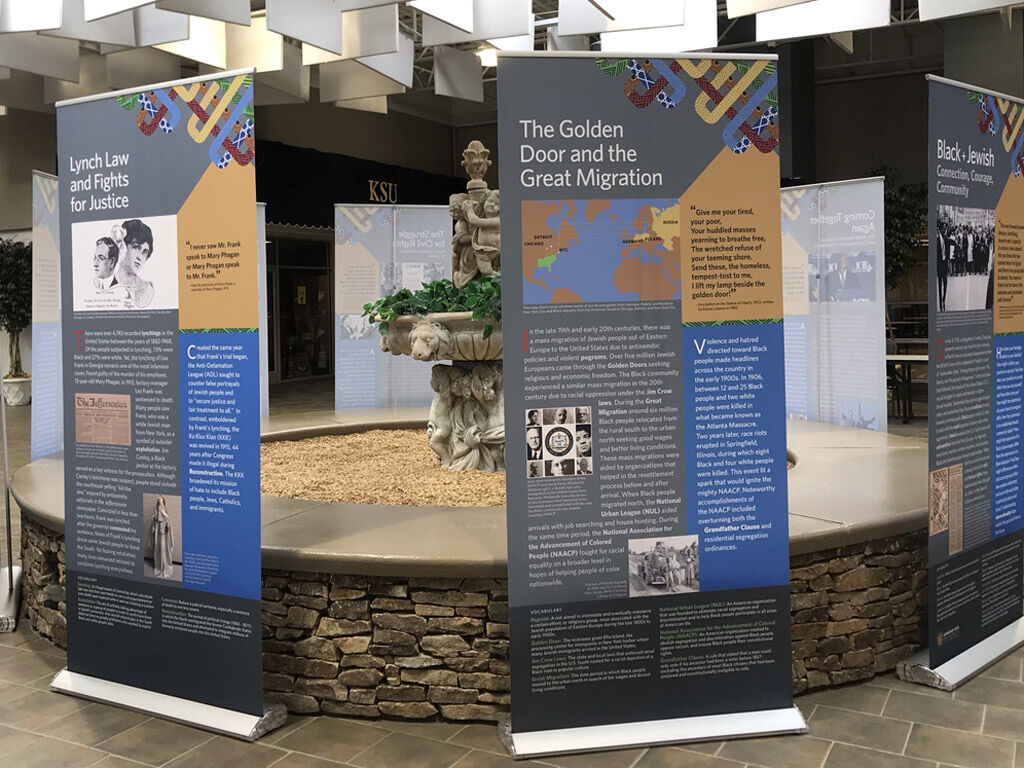
Panels for the 'Black + Jewish' exhibit, as seen at the Museum of History and Holocaust Education at Kennesaw State University, have made their way to the Jewish Center of Princeton.,