Scientists at the Princeton Plasma Physics Laboratory have flipped the switch on a first-of-its-kind device designed to unlock the secrets of one of the universe’s most explosive phenomena: magnetic reconnection.
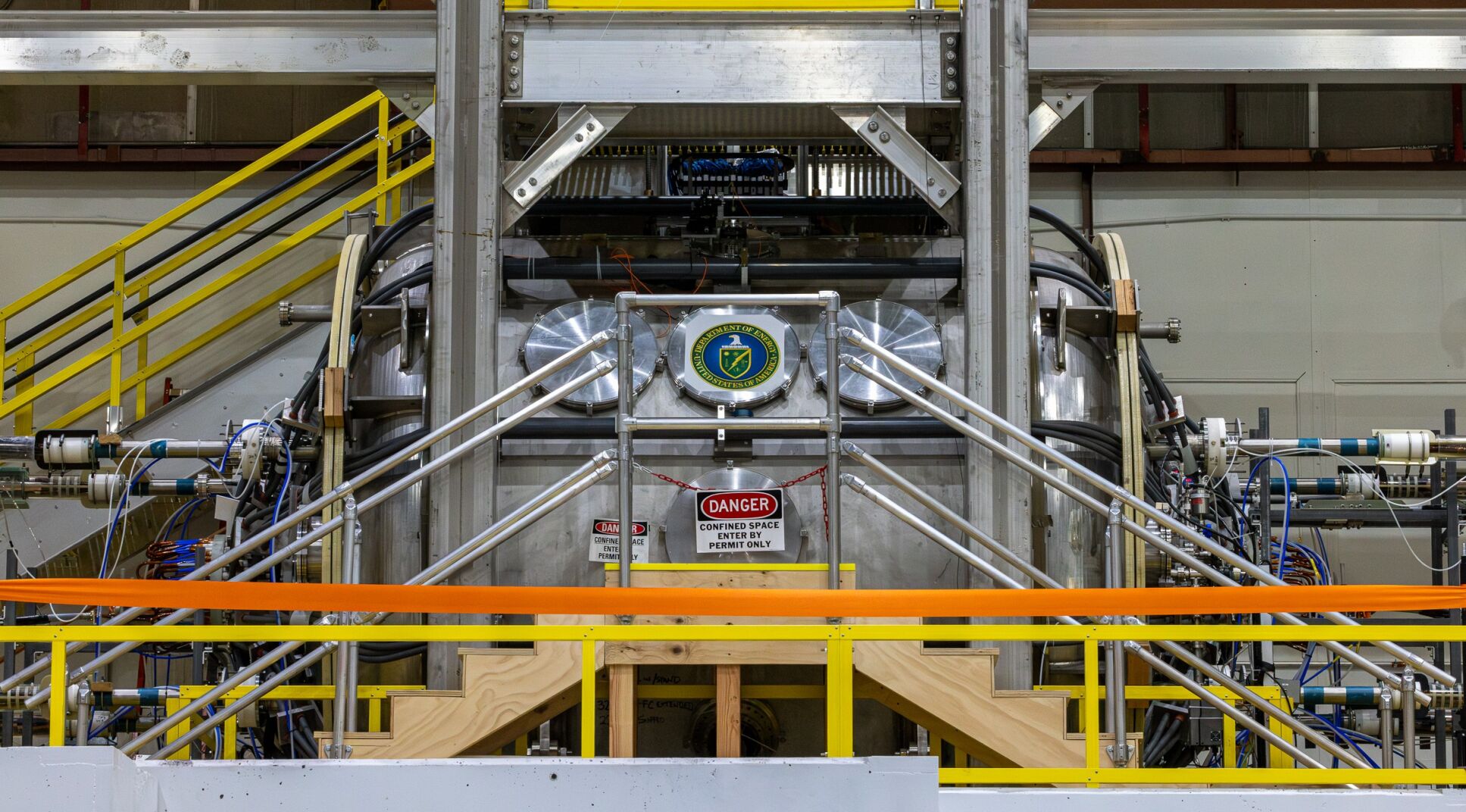
The device, known as the Facility for Laboratory Reconnection Experiments — FLARE for short — is a massive, gleaming barrel-like machine roughly the size of an SUV.
It lies on its side in a spacious research hall on Princeton University’s Forrestal Campus in Plainsboro, ready to reproduce a process that fuels solar flares, disrupts power grids, and interferes with fusion reactors.
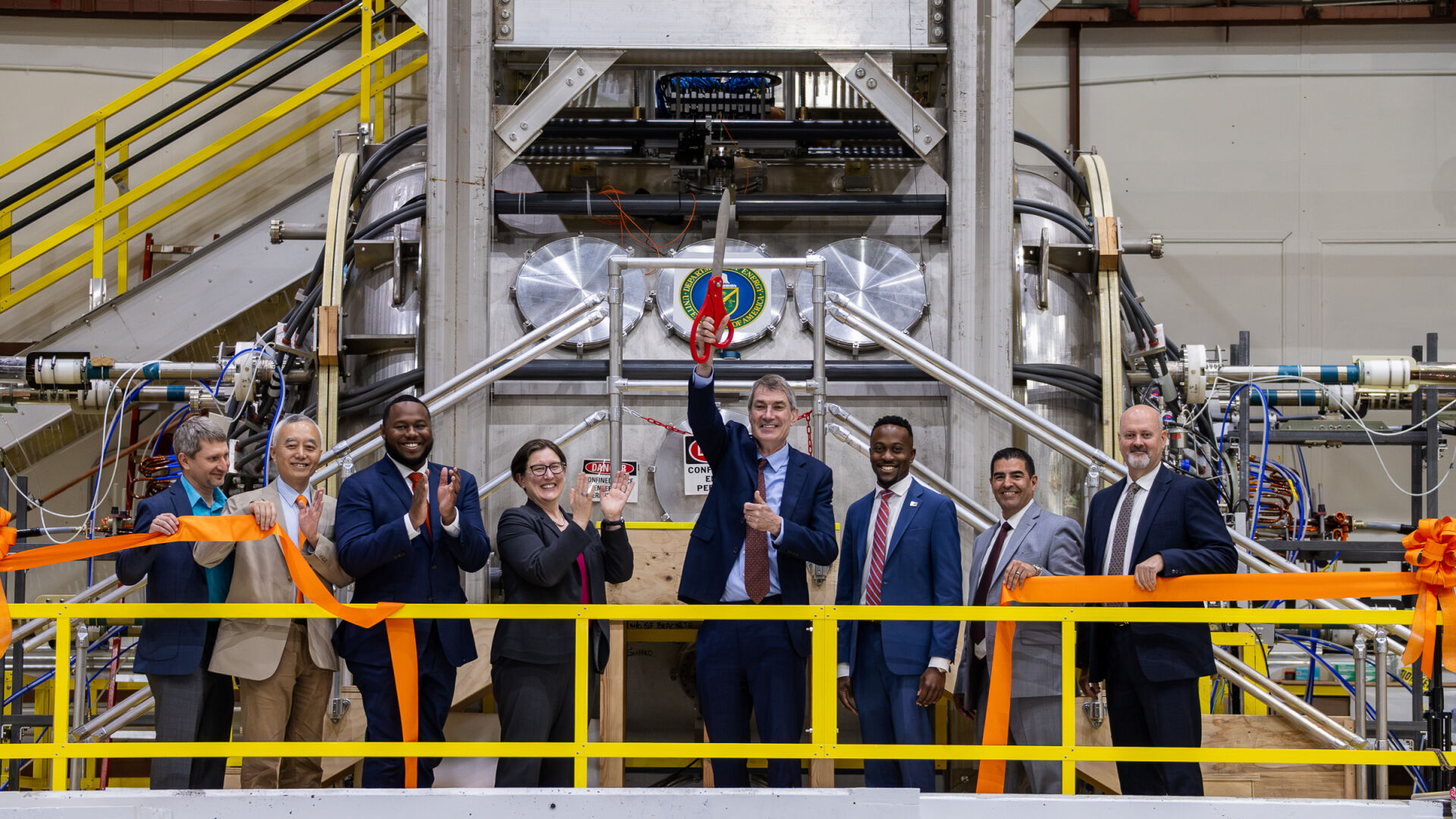
On June 12, the lab hosted a private ribbon-cutting ceremony to mark the beginning of FLARE’s operations. More than 50 guests attended, including scientists and leaders from the U.S. Department of Energy, Princeton University, and the laboratory itself.
The event marked the culmination of years of design and construction and the start of a new chapter in plasma physics research.
“This is the day when we deliver FLARE to the world,” said Steve Cowley, director of the Princeton Plasma Physics Laboratory.
“We have fulfilled our promise to design and build this one-of-a-kind device and offer it to the scientific community,” Crowley said. “I expect FLARE to produce important insights for plasma science in the coming years, and I just can’t wait.”
FLARE is specifically engineered to study magnetic reconnection, a process in which magnetic field lines suddenly snap apart and reattach, releasing tremendous bursts of energy.
In space, reconnection drives solar storms and massive plasma eruptions on the surface of the sun. These events can send electrically charged particles rushing toward Earth, damaging satellites, disrupting GPS systems, and even knocking out power grids.
In fusion reactors, reconnection can destabilize the plasma at the heart of the reaction, hindering the production of clean energy. Understanding how reconnection happens, and how to manage its effects, is crucial for scientists studying both the sun and fusion energy.
Until now, research into reconnection has been limited by the tools available—computer models that use simplified assumptions, or space-based observations that can only sample tiny parts of a vast process. FLARE is designed to fill that gap.
“FLARE is a new research platform with capabilities that scientists have not had access to before,” said Hantao Ji, a professor of astrophysical sciences at Princeton University and principal investigator for the FLARE project.
“It will provide information about magnetic reconnection that spacecraft, computer simulations and other laboratory experiments cannot provide,” Ji said. “It’s a new way of doing research that goes beyond what is currently available.”
One of FLARE’s key research goals is to determine whether reconnection can occur not just at one location, but at multiple points simultaneously. These locations, known as X points, are where magnetic field lines meet, break, and rejoin.
Although past research has observed reconnection at individual X points, scientists believe that in space, reconnection often takes place at several points at once. But so far, no experiment has been able to prove it.
“That’s FLARE’s mission goal,” said Jongsoo Yoo, deputy head of discovery plasma science at the lab and a member of the FLARE team.
“We believe that in large astrophysical systems, reconnection occurs at a large number of locations at once,” Yoo said. “But because of limitations in research space and available energy, we haven’t been able to conduct experiments to observe what happens. So far, there hasn’t been any hard evidence either way. We’re going to change that.”
To do so, FLARE will need to pack a powerful punch. During experiments, it can unleash more than six million joules of energy—enough to power 1,000 homes for five seconds.
That pulse helps recreate the same explosive conditions found in solar storms, but scaled down to fit inside a laboratory. FLARE’s powerful magnets help shrink the circular motion of charged particles, allowing the experiment to simulate a vast cosmic process within a controlled space.
The scaling technique is similar to what engineers use when testing model airplanes in wind tunnels instead of flying full-sized jets through thunderstorms. By maintaining the right proportions, scientists can observe the same physics on a much smaller, safer scale.
The advantages of doing this work in a laboratory setting are substantial. Unlike spacecraft, which are limited to observing small slices of space and cannot take repeated, precise measurements in a specific area, FLARE allows scientists to insert physical probes directly into the plasma.
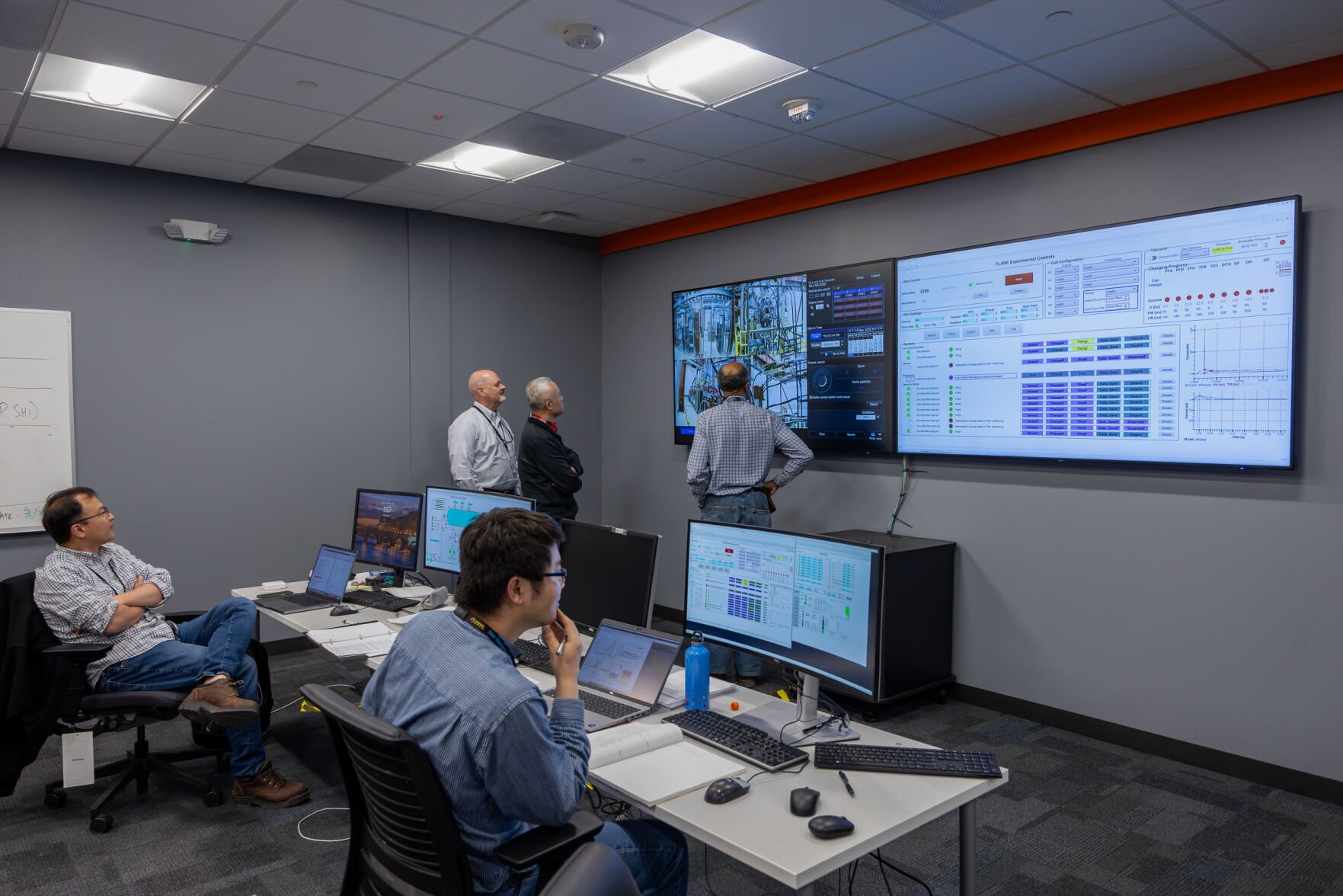
These probes provide real-time data on temperature, density, current, and other key properties of the reconnection process. According to Ji, That level of detail simply isn’t possible with simulations.
“Simulations aren’t real,” Ji said. “Instead, they are trying to be real. They incorporate a lot of approximations, but because there are so many, lots of important physics is lost. And we don’t know whether the lost physics is important.”
DOE officials praised the project as an example of what national laboratories are uniquely equipped to do: take long-term risks to answer long-term questions. Christian Newton, chief of staff at the Department of Energy’s Office of Science, said FLARE demonstrates the value of investing in foundational research.
“By investing in long-term scientific research, the national laboratories produce results that can bolster the rest of America’s science and technology sectors,” Newton said.
Jean Paul Allain, associate director for Fusion Energy Sciences at DOE, added, “Labs like PPPL can take big risks to build infrastructure that answers big questions. FLARE is a perfect example.”
FLARE’s status as a collaborative research facility means its impact will extend far beyond PPPL. Researchers from institutions around the world will be able to submit proposals and partner with PPPL scientists to design and carry out experiments.
Unlike traditional user facilities that simply provide access to a machine, FLARE emphasizes active collaboration and shared innovation.
“That’s our hope. We want to work with experts around the world,” Yoo said.
It’s unlike with user facilities, when you submit a proposal, receive a limited amount of research time, and staff scientists perform the experiment for you and then give you the data afterward,
“FLARE focuses more on collaboration than run time. As a result, researchers can be much more hands-on with our facility,” Yoo said.
The machine itself represents a major engineering achievement. Initial funding for FLARE came from a National Science Foundation Major Research Instrumentation grant, as well as support from Princeton University, the University of Wisconsin–Madison, and the University of Maryland. Final construction and commissioning were funded by the Department of Energy.
For PPPL, the launch of FLARE affirms the lab’s leadership in both astrophysical and fusion plasma science. It also demonstrates the growing importance of plasma physics in addressing some of society’s most pressing challenges, from reliable space weather forecasting to the long-term goal of developing fusion as a clean energy source.
“There is no way we can reproduce the full range of astrophysical conditions under which magnetic reconnection occurs without creating another universe,” Ji said. “But the beauty of physics is that you don’t have to.”
As the first experiments begin, researchers say they are optimistic that FLARE will yield answers to long-standing questions about how the universe works—and how we might better control it here on Earth.
“FLARE matters to PPPL and the world because it’s important for both astrophysical and fusion plasma studies,” Ji said. “This next-generation machine confirms that we are both a national and international leader in this research.”