We all know Clarksville Road. But where does it get its name?
In this issue of the *West Windsor Chronicles*, the Historical Society of West Windsor explores the story of a long-gone but historic hamlet that once straddled the border of West Windsor and Lawrence townships.
“Clarksville” was a West Windsor–Lawrence community that no longer exists. It largely centered on the intersection of Route 1, Quakerbridge Road and Clarksville Road, but also included the surrounding landscape.
It was presumably named after the Clarke family, who settled in present-day Princeton following Benjamin Clarke’s purchase of 1,200 acres of land in 1696, overlapping present-day West Windsor and Princeton. Although the hamlet’s name — dating at least as far back as the 1820s, if not earlier — was originally spelled “Clarkesville,” the “e” was dropped at an unknown date.
It is currently unknown exactly when pioneers first settled the West Windsor part of the 1696 purchase — as opposed to the Princeton part. However, we do know that farming families lived here at least by the 1770s, if not significantly earlier.
British troops were apparently captured on Dec. 30, 1776, during the American Revolution at a local farm about a quarter-mile northeast of the intersection of Clarksville and Quakerbridge roads.
These soldiers divulged crucial information about British troop movements to George Washington’s army — intelligence that likely helped them win at the Battles of Assunpink Creek and Trenton. Only four days later, nearby residents witnessed the American army marching up Quakerbridge Road on their way to victory at the Battle of Princeton.
We can pinpoint a particularly influential individual in early 1800s Clarksville: Dr. Israel Clarke, who served as West Windsor’s town physician for years. He is probably the specific person after whom Clarksville was named.
He owned an inn called Windsor Hall at the crossroads in the early 1800s; after him came a succession of owners. One of the proprietors, William West, hosted most West Windsor meetings from the 1870s through the 1890s before the township moved back to the community of Dutch Neck in 1891. His hotel was one of a few that were licensed to serve liquor — undoubtedly a draw for many.
In the 1800s, Clarksville flourished as a farming community that profited from Route 1’s stagecoach travel. Throughout the century, it also featured a second inn, a blacksmith, a wheelwright, a store and, of course, several farmsteads.
A schoolhouse — reputedly erected around 1822 — initially served 40 students under the tutelage of David Dye. It stood just inside Lawrence Township, at the southern corner of the intersection of Clarksville and Quakerbridge roads. It was also used as a Sunday school, meeting house and festival site. The building was reportedly destroyed in a fire in 1937.
A structure called the Clarksville Inn catered to early 1900s tourists. It sold liquor during Prohibition and was consequently the subject of prosecution. It seems to have been demolished to make way for Route 1 improvements in the early 1930s.
This building, however, should not be confused with two other establishments: the Clarksville Motel and the 1940s-era Clarksville Diner. The latter is easily West Windsor’s best-traveled building. Originally called the Princeton Grill and located at the Penns Neck traffic circle, it was a popular circa-1940 eatery that was relocated to Clarksville in the 1940s or 1950s.
In 1988, the diner was bought by Gordon Tindall III, who relocated it to Iowa and restored it. Ten years later — for reasons yet unknown — it was purchased by a French multimedia company called Canal+, based in Paris.
They shipped it across the Atlantic and converted it to office space. It now sits overlooking the Seine, its prominent lettering alluding to its original hometown across the ocean. For more, visit: WestWindsorHistory.com/ClarksvilleDiner.
Throughout the 1900s, Clarksville remained a farming community, home to several longtime families including — but not limited to — the Colemans, Dilatushes, Dohertys, Reeds and Schencks. One of the town’s largest tracts of farmland still existed as of January 2024 on the northeast side of Quakerbridge Road, south of Clarksville Road.
Starting in the 1950s, American Cyanamid — an industrial chemical conglomerate — opened an agricultural research and development facility on the site of several old farms. One of these was the Flock-Coleman farm where, as mentioned earlier, British troops were reportedly captured in 1776.
The company acquired surrounding properties over the next few years, razing old farmhouses in the process — including the historic barn, house and farm where those British troops were captured. However, the agricultural land was largely preserved and livestock thrived. It was not uncommon to see pigs nearly the size of cows.
The facility closed in the early 2000s, but you can learn more at WestWindsorHistory.com/AmericanCyanamid.
In the ensuing years, the old Cyanamid property passed through several owners, some of whom presented various plans for development — plans that were generally opposed by residents.
In 2019, a developer called Atlantic Realty purchased the approximately 650-acre site following a much-criticized proposal to build thousands of housing units, and a protracted legal battle between Howard Hughes — its previous owner — and the township over a plan to construct thousands of new residences and multiple commercial buildings.
A proposed complex of massive warehouses spanning much of the property is currently the prevailing — and equally intensely debated — future for the site.
Virtually nothing remains of Clarksville today. The Lawrence side of Quakerbridge Road features apartments and shopping complexes. The West Windsor side is primarily dominated by the recently demolished American Cyanamid complex, Nassau Park Pavilion and likely soon-to-be-gone farmland.
Still, the Weber’s Kennels building at 3440 Brunswick Pike remains in use, and its farmhouse may date to around 1800. As an isolated building along Route 1, it serves as an appropriate symbol for one of West Windsor’s most disappeared communities.
The Historical Society is an all-volunteer nonprofit; all our volunteers donate their free time to document and promote our township’s history. There is a lot to celebrate — but we can’t do it without your support.
Please consider volunteering or donating to help us grow and expand our impact. To learn more, visit: westwindsorhistory.com.
Paul Ligeti is the president of the Historical Society of West Windsor.
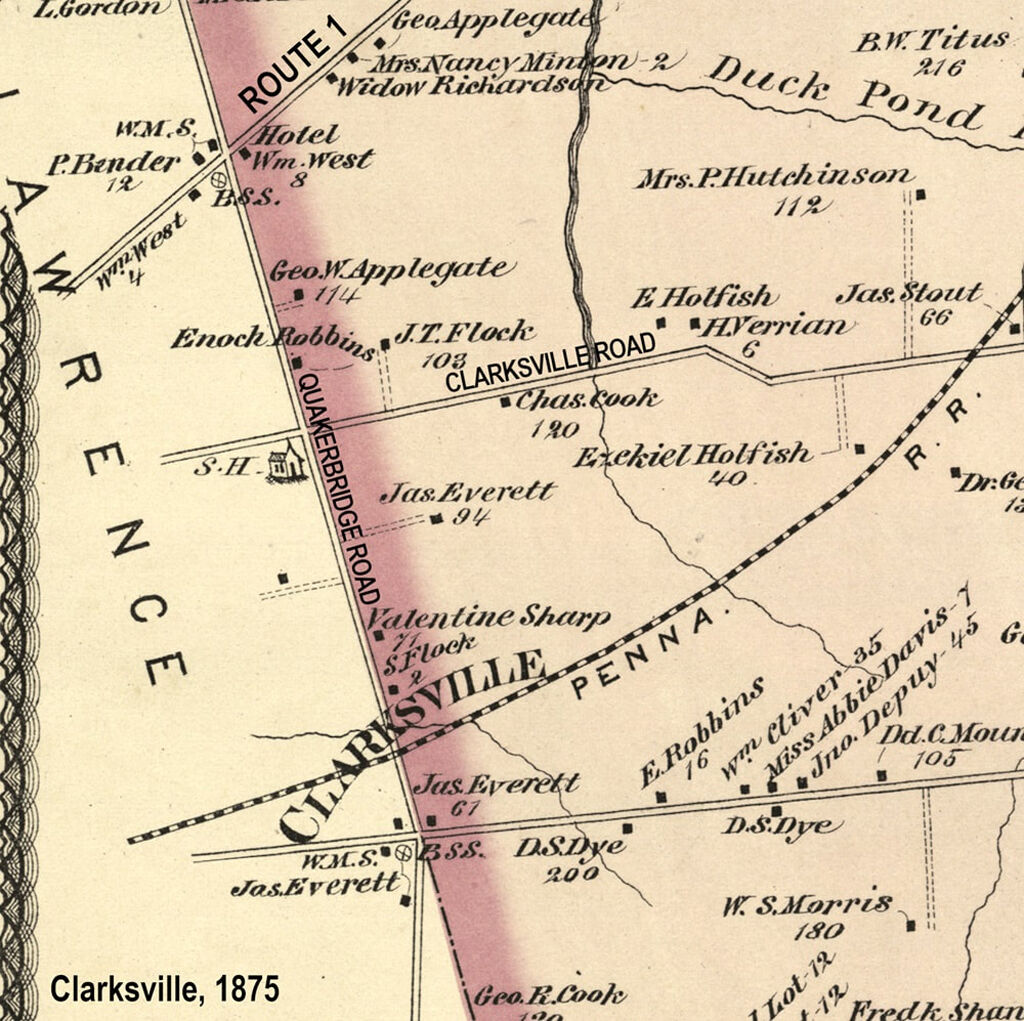
The Clarksville Area in 1875.,

