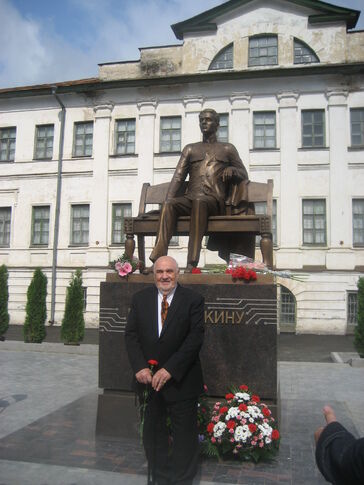
Frederick Olessi traveled to Zworykin’s childhood home in Russia last summer to dedicate the statue.
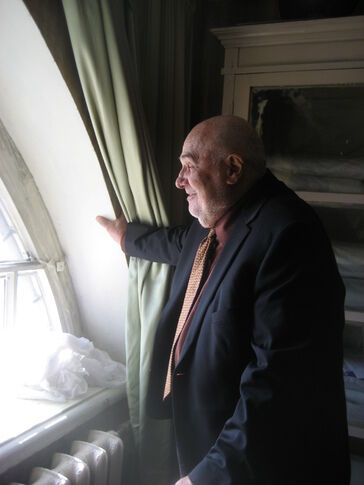
Frederick Olessi peers out the window in Zworykin’s childhood home in Russia.
The tale of the friendship between inventor Vladimir Zworykin and writer Frederick Olessi, Jr. begins in the late 1890s in Russia in a small room with a window on the top floor of the mansion.
The room was located in the home of the aristocratic Zworykin family in Murom, a small city that sprawls along the banks of the Oka River. The Zworykins owned a fleet of huge wooden riverboats. In the last days of the 19th century, Murom was not rich enough to have its own daily newspaper, but it did have a telephone network.
And this is where the window comes in. One day, six-year-old Vladimir fell very ill and nearly died. His father built an infirmary for his son on the top floor of the family’s great house, where the boy could recuperate and get fresh air. While he was sick, Vladimir looked out that window and saw workers putting up the wires that made up the telephone system. He asked his father what they were for.
“That is an instrument that carries the human voice over great distances,” the man told his son.
“How far could it go?” Vladimir asked.
“I think all the way around the world,” his father replied.
“Into the sky?” he asked.
“Why not?” his father answered.
But Vladimir’s imagination was bigger than that. Later, he looked at the moon through a telescope, out that same window, and wondered: could humans see, as well as hear, across great distances? Could they some day see the dark side of the moon?
Zworykin spent his life making that childhood flight of fancy into a reality we take for granted in the modern world, by pioneering the development of television at RCA’s labs in Camden and Princeton. Zwyorkin fled to the United States during the Russian Civil War of 1917. He moved around the country before settling in Princeton, where he lived until he died in 1989.
Some even say he invented television —and Olessi, a Twin Oaks Drive resident, is one of them.
In 1968, Olessi was a technical writer at RCA’s Sarnoff Laboratory in Princeton. He was assigned to help Zworykin write his autobiography, since Zworykin was not very good with English and spoke it with a thick accent that was hard to understand. Olessi interviewed the inventor, and completed an autobiography called “Iconoscope” in 1971 that was never published. It is available online at www.davidsarnoff.org/vkz.html The two became close friends, and remained so until Zworykin died.
RCA was the first company to commercialize electronic television, and in the late 1920s and 30s, Sarnoff Labs in Camden, led by Zworykin, was instrumental in designing and building the earliest televisions sold in the country. In the 1940s, when the lab was in Princeton, Zworykin further perfected TV so that it was ready for mass production in the 1950s.
He is also credited with many other inventions, including night vision devices, an ingenious but ultimately impractical electronic automatic highway and several medical devices.
Whether Zworykin should be considered “the inventor of television” is a matter of dispute. Most historians credit the American-born Philo Farnsworth with being the first person to create an all-electronic television. He is certainly the first one to demonstrate such a device to the public, having built a TV pickup and display system in 1927, and having shown it to reporters in 1928. His claim is well documented and corroborated by multiple witnesses to the event. Some of Farnsworth’s ideas were incorporated into RCA’s TV sets after Zworykin visited his lab in 1930. This led Farnsworth to successfully sue RCA for $1 million for violating his patents in 1934, the first such legal defeat the company had ever suffered.
Despite the legal verdict, there are those who believe Zworykin, not Farnsworth, built the first all-electronic television system in 1923. (There were mechanical televisions even earlier, that utilized spinning disks instead of cathode ray tubes.)
The dispute hinges on a demonstration of a cathode-ray-tube based television system that Zworykin demonstrated at Westinghouse laboratories some time in the mid 1920s. Westinghouse leaders left the demonstration unimpressed, and told Zworykin to go work on something “more useful.”
Unfortunately for Zworykin, he was not able to sufficiently document this incident for the 1930s court case. Olessi believes Westinghouse’s archives must contain some reference to this event that would corroborate Zworykin’s claim, but no one has found them yet.
If his account is true, and if his 1923 system produced a good image, Zworykin would have a credible claim to be called the inventor of television instead of Farnsworth. Oddly, Zworykin did apply for patents for the iconoscope and the kinetiscope in 1923, but was not granted them until 1938.
Olessi, who is 79, is certain that this is the case, and has been an ardent supporter of Zworykin’s cause for many years.
“There are so many claimants to being the developer of television, and many people were involved in certain aspects of it,” Olessi said. “But the fact is that from 1895 to the point of the invention of electronic television, he was the one who had the vision. He was the one.”
Olessi and Zworykin stayed close after Olessi wrote the biography. Olessi remembers the Sarnoff Research Center as being a kind of playground where Zworykin had free reign to develop his ideas.
“He felt that the RCA laboratories was his lab,” Olessi said. “He used to poke his head in everybody’s lab and see what they were working on. When I met him, he was almost 80 years old, and he was sort of a consultant there … he told me, ‘When I was in my laboratory, it was like playing all the time.’”
Olessi said the great inventor had a childlike curiosity about him. He remembers going to a concert with him, where a friend was playing the harpsichord. The octogenarian Zworykin couldn’t wait until the concert was over. As soon as the music stopped, he rushed to the instrument and lifted the top. He wanted to see how it worked.
“He just couldn’t contain himself,” Olessi said. “He just had an insatiable curiosity about everything. It was absolutely wonderful. He is certainly the most extraordinary human being I’ve ever met, and a great genius.”
One thing Zworykin was not curious about was television. A famous story about Zworykin, which Olessi repeated, was that some time in the 1950s, a Canadian reporter asked him what his favorite part of the television was. “The switch to turn the damned thing off,” he replied.
“Once the commercial people got a hold of television, for him, it was ruined,” Olessi said. “He thought television should be an educational and a scientific device.”
When Olessi quotes Zworykin, he does an impression of the man’s heavy Russian accent. Olessi said the language barrier dogged Zworykin his whole time in America.
“It hurt him in this country because people couldn’t understand what he was saying,” Olessi said, speculating about his good friend’s inner life. “I finally discovered, a long time after he died, what was happening. He had a muse in his head. He would be reading something, then stop and shut his eyes so he could absorb it, then go back to reading it. He was translating it to Russian, because he thought in Russian! He dreamed in Russian, and he invented in Russian all his life. That muse was a Russian muse.”
Olessi himself is a lifelong world traveler and writer, who speaks Spanish as well as English. He grew up in Lawrence, where he went to public schools. He got an engineering degree from Bucknell University, and worked in the Army in the intelligence field. He was hired by RCA straight out of the Army. He left RCA to start a career as a development officer, and he has worked at various nonprofits ever since, working in the development offices at Princeton University, Johns Hopkins and the School of Advanced International Studies, most recently serving as executive director of the Pearl S. Buck Foundation.
He also is a writer of plays and poetry. His most recent production is called “Education,” and it is about the last hour of the life of the accused anarchists Sacco and Vanzetti. It is being shown on Princeton Community Television.
Olessi’s home is filled with art that he and his wife Salud collected during their world travels. Salud died 13 years ago. He has a daughter and two granddaughters who live in Spain, where his wife was born.
Olessi and Zworykin were both Renaissance men of a sort. Zworykin enjoyed flying airplanes and loved art and music in addition to science. The two spent a lot of time together, including one momentous occasion in 1969. Zworykin still hated television at that point, but Olessi convinced him to sit down and watch American astronauts land on the moon.
“He went to bed every night at 9 o’clock, and this was going to happen at 10:30. His wife and his butler got him out of bed,” Olessi said.
It was worth waking up for. As they watched the historic event, they both realized what they were seeing was the fruition of Zworykin’s childhood dream: his invention was on the surface of the moon, broadcasting images back to Earth.
“When Armstrong said those words, he started crying,” Olessi said. “I reached over and grabbed his hand and said, ‘They did it well.’”
That moment was re-created for a movie that was made in Russia in the early 1990s. An actor played the part of Olessi. Zworykin’s legacy is celebrated more in his native land than in the United States. His face appears on Russian mugs and T-shirts, Olessi says, and there have been documentaries and movies made about his life. Occasionally, Russians will give Olessi a call. One time, they visited his house in Lawrence and shot footage of him speaking about his friend, Zworykin.
Just last summer, Olessi was invited by Russian officials to travel to Murom to dedicate a new statue of the inventor. The statue is in front of the mansion where he grew up. During the trip, Olessi made a special trip to a certain window at the top of the house, and looked out over the town square, where the telephone poles are an unremarkable part of the urban landscape. They are turning the room into a Zworykin museum.
Olessi had a suggestion about how to mark the location.
“There ought to be a plaque here that says, ‘Here, in the mind of a 6-year-old boy, the modern world of television communications was born. He saw here that it could be done. And he did it. He did it.’”
,