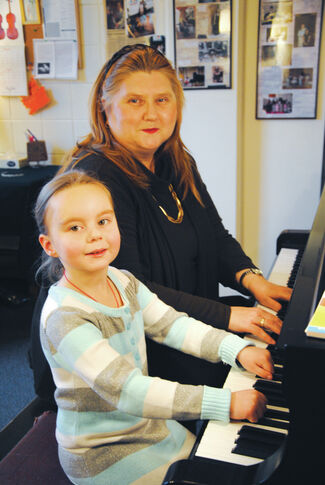
A piano teacher gives a student a lesson at the Westminster Conservatory of Music.
Faculty at Westminster Conservatory of Music instruct private lessons for children and adults
Westminster Conservatory has been nurturing area musicians since 1970, but its staff is as keen as ever to make sure people know the conservatory is open to the whole community.
Thousands of students currently take lessons with the Westminster Conservatory of Music, the community music school of Westminster College of the Arts of Rider University, but there’s room for many more. And while the full name might be a mouthful, it also connotes the history, mission and credentials of the school.
Musicians of all ages, skill levels and economic background can learn how to sing or play instruments from Westminster’s more than 150 faculty members. Students can join the community choir or community orchestra, take music theory classes or engage in music therapy, qualify for an honors program or, if they’re young enough, join the early childhood music program, which is for kids from 4 months to 8 years old.
The majority of students receive one-on-one instruction. Private lessons are given by trained, degree-holding musicians, many of whom are accomplished professional performers. In essence, Westminster tries to reduce the guesswork for parents who want their kids to get music lessons, but aren’t sure how to hire a teacher.
The program is affiliated with Westminster College of the Arts, of which historic Westminster Choir College is a part. Westminster Choir College offers degree programs in a variety of music disciplines. Rider University, in Lawrence, took over WCC in 1992.
Some faculty members also teach at WCC, but the majority are solely focused on private instruction through the conservatory.
“There is nothing like a one-on-one lesson with a musician, because you can customize the learning process to that one child,” said Marianne Lauffer, assistant director of faculty and extensions. “Consider when a child is one member of a choir, receiving singing lessons. The experience is going to be very different if you put the child in a room with one teacher.”
Most new students who go to the conservatory are interested in a particular discipline, though the staff can advise those who are not sure where to get started. When new students register, Westminster has them fill out a profile form that gives the staff a sense of where they are musically.
Staff then assess students’ skills and experience to determine the best placement for them. Besides vocal training, Westminster offers instruction in just about every instrument, including piano, organ, guitar, strings, brass and woodwinds.
Lauffer said a lot of time is put into ensuring students are placed properly according to their abilities and goals. Students who aspire to make all-state orchestra or band would get one kind of placement, while those who are less certain of their ambitions would get another.
“When new students come in, I’ll talk with the family, find out what their objectives are,” Lauffer said. “For a 7-year-old beginner, I’m not going to place them with a teacher who specializes in preparing musicians for competitions. Sometimes, an interview is required with the teacher to make sure we have a good match.”
Some classes are intended to be introductory, requiring no previous experience, while others are designed for advanced practitioners. Students who are particularly gifted can audition for a place in the conservatory’s Honors Music Program, which offers a comprehensive curriculum with a goal of mastery.
Hester Null, also an assistant director at the Westminster Conservatory of Music, said many students take private lessons at Westminster in addition to taking music classes at their elementary, middle or high schools.
“It’s not a situation where we’re competing with the schools,” she said. “Lots of high school kids come here for private lessons. They feel they need to supplement their playing here.”
Sometimes, schoolteachers in the area refer students to the conservatory, recommending those students get additional private instruction at Westminster, Lauffer said.
“Their emphasis is on group instruction,” she said. “A student could join a choir [in school] and probably not join the choir here. But they might come to us for private singing lessons.”
In the spring, all students enrolled in private lessons are signed up for evaluations in studio. They prepare repertoires and exercises, and a panel listens to them perform, providing them with feedback and a certificate. While students are not graded on their performances, all are expected to participate in the studio program. Instructors can also sign their pupils up for recitals that take place throughout the year.
Starting last year, to spruce things up, students recitals were sometimes themed. For example, in the spring there was a recital just for students who had started at the conservatory this year.
Ensembles like the youth orchestra or the community choir give at least two public performances a year. Additionally, the conservatory oversees a concert program, open to the public, in which many of the faculty members perform.
While most of the students are under the age of 18, Westminster instruction is open to people of all ages, and Lauffer said they have lots of adults on the books.
“We try to emphasize that this is not just a place where people become professional musicians,” Null said. “This is a place to learn about music.”
Students who are advanced, however, have opportunities to enter competitions if they so choose. Each year, for example, graduating students compete for several scholarships that are named in honor of former faculty.
The conservatory is based in Princeton, on the Walnut Lane campus of Westminster Choir College. Four extensions — at the Princeton Academy of the Sacred Heart, St. Ann’s School in Lawrence, the Crossroads School South in Monmouth Junction, and St. Ignatius of Antioch School in Yardley, Pa. — broaden the conservatory’s reach, so busy parents who can’t always get their kids to Princeton on a schedule have options throughout the area.
Lauffer said one of the many things that sets the community music school of Westminster Conservatory of Music apart from other schools is the environment, especially on the Westminster Choir College campus.
“On a typical day there is music coming out of 35 studios here,” she said. “Parents come on campus and see the bigger picture, see how students are majoring in music. It’s a very stimulating environment.”
More information, including how to sign up for lessons or classes, is online at rider.edu/conservatory.
,

