By Dan Aubrey
Trenton’s foundation has strong bones – or maybe a metal frame.
The capital city’s past is bolted to metal, with the most easily identifiable connection the John A. Roebling Company — known worldwide for pioneering the metal cables used for suspension bridges. Without them the Brooklyn Bridge, George Washington Bridge, and Golden Gate Bridge would be designer’s dreams.
Yet other Trenton foundries — Trenton Iron Company, New Jersey Steel and Iron Company, Phoenix Iron Company, and the Trenton Malleable Iron Company — helped put the “make” in the “Trenton Makes World Takes” bridge slogan and earned city metal workers a place in the famed Trenton City Hall mural of Trenton industry — created in 1910 by the important American (and New Jersey born) artist Everett Shinn.
Now after decades of an absence, Trenton metal is back in the form of a recently reclaimed site and a current effort by a group of different type of iron worker.
The current “Founding the Future: A Continuum of Iron Casting in Trenton with AbOminOg Intl. Arts Collective” on view until Friday, October 31, at the Old Barracks in Trenton is the link.
With the barracks – built in 1757 to house troops during the French and Indian War and entering history as the housing for the Hessian troops during the Battle of Trenton in 1776 – situated next to a recently new historic attraction, Petty’s Run, the industrial past does not run much deeper. Petty’s Run is the site of the only excavated Colonial-era steel mills in America.
The Trenton-based AbOminOg Int. Arts Collective, on the other hand, is a new group of metal workers who bring a new spirit to the old industry. Headquartered in the former Scudder Foundry, part of the old Roebling works on Pearl Street, the group’s mission focuses on the creation of new cast-metal sculptural artworks within an inspiring, supportive, and sustainable setting.
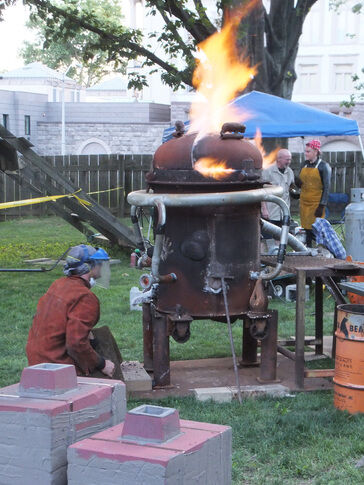
The Old Barracks fused Petty’s Run and AbOminOg together for this year’s 350 anniversary celebration of the naming and incorporating of the State of New Jersey. In addition to the exhibition of iron work by the participating artists – most former or current employees of the Johnson Atelier at Grounds For Sculpture – the group organized an iron pour to create medallions that commemorate the anniversary.
Together the two entities provide an easy and enlightening stroll through iron past and present.
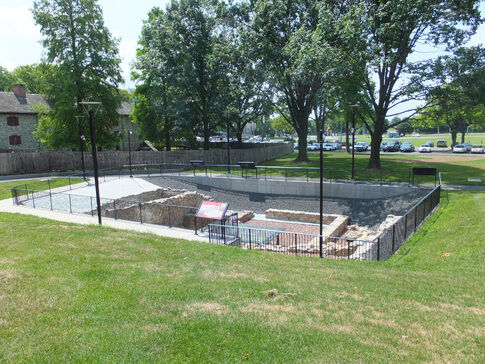
Petty’s Run industrial archaeological site sits on the lawn between the New Jersey State and the Old Barracks and accessed by a walkway. The site – the size of a large rectangular swimming pool – takes its name from Nathaniel Pettit, a Quaker settler who in 1711 purchased 1400 acres of land at Trenton. That includes the present grounds for the New Jersey State Capitol Building. The “run” was a water way that rushed to the Delaware River. It was later enclosed to a culvert that still exists under the lawn.
Signage by the Trenton Historical Society – calling the site “a forerunner of the great industries of Trenton” — reports that in 1734 Isaac Harrow set up an iron plating and blade mill on the run. Benjamin Yard purchased the mill in 1746 and established the first steel mill in New Jersey in 1750.
Since the steel mill – a rare and difficult to achieve enterprise in the colonies – was providing supplies and armaments to the Continental Congress, the mills along the run were “destroyed in 1776 by the Hessians, or by the Continentals to prevent the place falling into their hands.”
Although the destruction of the mill was related to the battle with England, its recovery is ironically connected with two native-born Englishman now connected with Trenton history: Richard Hunter and Ian Burrows – partners of Hunter Research located across the street from the site.
“As an Englishman –– if anyone ever told me in the mid 1970s that I would spend the bulk of my career in Trenton, I would have never believed it,” says Hunter. “Trenton is an extraordinary place. It’s hard to think of a city in this region that has as much history.”
Hunter’s and Burrow’s site-related efforts have been chronicled since 2008 on the company’s website at www.pettysrun.org, but seeing brings the past to the present, and a free visit to the site – maintained through a partnership between the State of New Jersey and Mercer County – is easy, especially on weekends when parking is plentiful (please note that the Old Barracks is closed on Sundays).
Paths and signage easily direct one about the colonial-era foundation and foundry structures, and informative panels show describe the site – still part of an active archeological dig – had become hidden by later mills, state structures, and row houses.
Steps from Petty’s Run is the Old Barracks where a sampling of efforts of 21st century iron artwork can be viewed around on the Barracks grounds for free (another smaller exhibition is inside and can be seen with admission).
AbOminOg takes its name from the furnace the group used for its first pour. “We just liked the sound of it. It was a kick-ass name for a kick-ass furnace,” says co-founder M. C. (Matt) Reiley.
Co-founder, Scot Thompson, however, says that it also has to do with the nickname for someone with pronounced and ungainly facial features that resembled the furnace.
As for the international reference, Reiley, who divides time between creating art in Trenton and New York City and working as associate director of preservation and conservation for the Central Park Conservancy, says it was just happenstance. Many of the group’s artists were foreign born and remained in region after the foundry at the Johnson Atelier ceased operations.
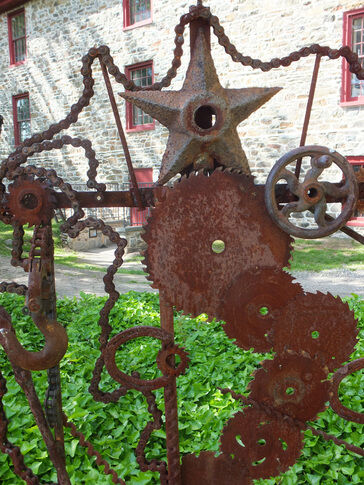
Starting from the gate that connects to the state parking lot on Barracks Street, David Robinson’s sculpture, fittingly titled “Gateway From the Past.” Robinson – who bases his operations in Trenton — builds rustic gazebos, outdoor sitting areas, and landscapes, founded the company Natural Edge, and served as a supervisor for restoration in Central Park in New York City. This work is made of old iron rods from Roebling Iron works and found objects, including from the Scudder Foundry.
Following the signs, the next sculpture is Joanna Platt’s “Exodus,” a trail of cast iron footprints that give weight to the empty space over them and an invisible body. Platt has served as sculpture technician and teaching artist for Johnson Atelier Technical Institute of Sculpture and has exhibited at City Without Walls, Newark, and Artworks, Trenton.
Morrisville based stained glass artist Steve Morse’s “Horseshoe Crab” seems the destination to Platt’s sojourner. It is a simple and strait forward replica of the creature in cast aluminum.
Fredric Minus – who also serves as a re-enactor at the Barracks – is represented by two works that combine found objects and create a poetic or playful response. The first is “Broken Plow Missing Horse Lost Dreams,” a plow with horseshoes on and leading from it. The other is “Vice of Life,” a stump with a rusty vice and a wall-mount mail box.
“Venus Vessel” is by Hopewell based Rory Mahon, who runs his own sculpture and photography studio, exhibits regularly in various galleries and museums, and had developed and ran the Sand Casting department at Grounds for Sculpture. The cast iron and cement work patterned after the Venus of Willendorf and was sand cast from foam cut on a computerized hot wire machine.
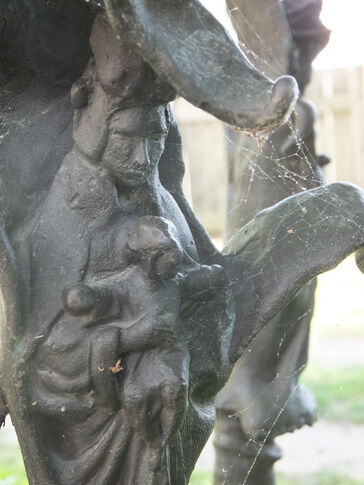
Kate Grave’s “East State Street 1” is the packing box-size bronze, concrete, and steel replica of an abandoned Trenton house, a subject that the artist has explored in both sculpture and watercolor paintings. Two other metal works in the exhibition – “Never/Not” and “Rota” –are less direct and more suggestive, blending shapes that suggest transcendence – including Madonna-like figures – as well as the serpentine. Graves, who came to the region to work at the Johnson atelier, has completed various commissions in the area, including a healing tree for Capital Health in Hopewell, and independent projects including the “Returning Sturgeon to the River” series.
Trenton resident Bruce Lindsay’s “Cooperstown” is a cast iron steel work that merges objects from the town’s history: an anvil connected to the town’s oldest building (a blacksmith shop) and a baseball and bat connected to the National Baseball Home of Fame. In addition to creating sculpture on view at Grounds For Sculpture, Lindsay created the United States War Dogs Memorial, State of New Jersey, in Holmdel.
Aylin Green’s “Iron Pillow” is one in her series of such objects that she calls “are intimate explorations of the body,” adding that lace and crochet are domestic and iron has a chemical connection to blood. “Together these materials tease out the meanings of this work: a corporeal softness translated through alchemy into the sensual hardness of metal,” says the artist who works at Grounds For Sculpture.
And Reiley’s “Enlisted,” is a cast iron and found object assemblage fashioned to resemble a flank of hapless military recruits.
Together these artists working in Trenton are exploring metal in a variety of ways and hoping to embrace more iron making in the region, where it was first brought to the new world. “I like to transmit ideas,” says Reiley, “and I think that using hot metal is a great transmitter. It’s pretty cool to take an element and alter it. The power of the act of creation is reinforced by making a metal art,” he says.
That is an idea that has been hot in Trenton for 280 years.
“Founding the Future: A Continuum of Iron Casting in Trenton with AbOminOg Intl. Arts Collective,” Old Barracks Museum, 101 Barrack Street, Trenton, on view through Friday, October 31, Monday through Saturday, 10 a.m. to 5 p.m. Admission to grounds and AbOminOg outdoor exhibition is free, museum interior exhibitions and tours, $8 to $6. 609-396-1776 or www.barracks.org Petty’s Run Archaeological Site, 115-125 West State Street, Trenton, open every day, free.
,
,