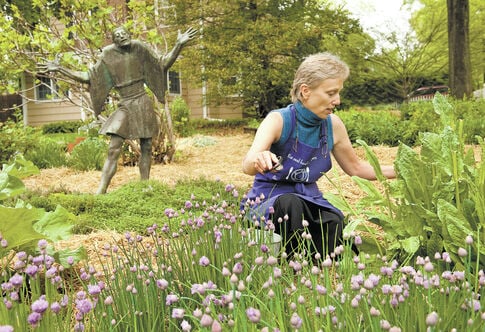
Dorothy Mullen, founder of the Suppers Program, tends to the garden that takes up most of the lawn space at her home in the heart of Princeton. (Photo by Mark Czajkowski)
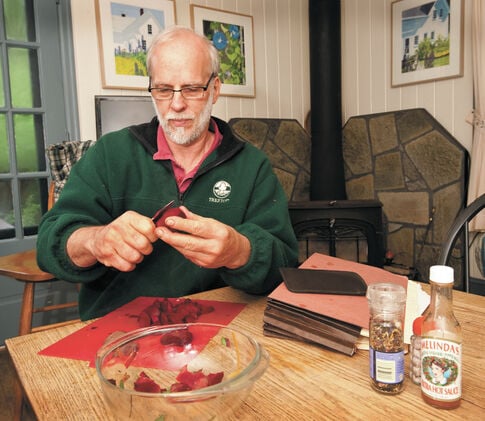
Roger Martindell, Princeton resident and long-time member of Borough Council helps prepare a meal during a Suppers meeting. (Photo by Mark Czajkowski.)
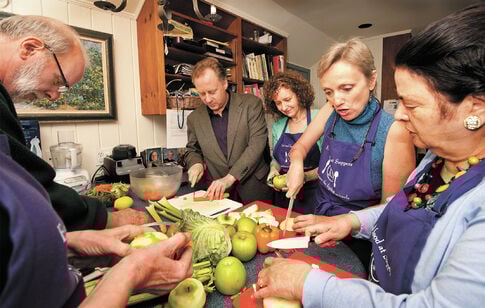
Dorothy Mullen believes that many health problems can be made better by eliminating the typical diet of processed food and chemicals. She formed the Suppers Program in an effort to teach people how to eat healthy meals. Pictured at a recent meeting are Roger Martindell, left, Eden Quariton, Karen Rose Tank, Mullen, and Priscilla Algava. (Photo by Mark Czajkowski.)
Group meets to cook health conscious meals without processed foods, sugar and wheat
By Dorothy Mullen
I live in a nice little house in downtown Princeton. Every week people come to my home to engage in radical acts of homemaking and subversive acts of health care.
My visibility in Princeton comes mostly from my involvement in the school gardening movement, but I’m also involved in the subversive activity of threatening the bottom line of major corporations with steaming pots of chili and great bowls of kale slaw.
It isn’t that I set out to undermine the medical community or the processed food industry that builds its customer base, it’s just that when people get their needs met for real food and social support they end up spending their money elsewhere. The vehicle that takes them there is the Suppers Programs.
Suppers is a non-profit organization that hosts nearly free-to-users programs for people who want more vibrant health. Members just cover the shared cost of the meals we make at gatherings in each others’ homes. No commercial messages are allowed, and people just join together to cook, eat and support each other’s conscious journey to better living.
My new favorite story is about a woman whose boss recommended she go to Suppers. The boss has never been to one of our meetings but knows about the program. She arrived one day having just been told by her physician that she had exhausted all pharmaceutical solutions, and he could not prescribe more steroids for her ulcerative colitis.
The next step was a visit to the surgeon to have her colon removed. But before going under the blade, she went for a second opinion and was told to eliminate specific foods to see if the inflammation, blood, mucus and pain that were ruining her life might be caused by food. They were.
After a few weeks of support at Suppers and entirely eliminating beef, dairy products, wheat and sugar from her diet, the lesions in her colon started to clear up, and she’s now down two-thirds on the prednisone. She was “just” having a horrible inflammatory response to foods that other people can eat without incident.
This is what we call a logical miracle at Suppers. A turnaround story like this is the natural conclusion of making good matches between problems and solutions. And we need more of that good match making considering that diet and lack of physical activity are already responsible for more premature death than alcohol and tobacco.
Not all stories of Suppers members are quite that dramatic. We frequently experience the reversal of type 2 diabetes, clearing of rashes and reduced dependence on antidepressants. It’s logical to expect these results when people’s food-related health problems are addressed with real food and social connection. We have about 35 of these meetings a month, and they’re all run by volunteer facilitators. Most are open to newcomers.
What makes this work is the culture of healing we’ve created. We say at Suppers that healing is a social experience. One of the greatest obstacles for people who want to improve their diet and lifestyle is a culture-wide failure to recognize that the processed food supply is inherently addictive.
You would have to live on a different planet to not have heard that we all need to eat more vegetables and less junk food, drink more water and less soft drinks. Lots of people know that they’re supposed to eat better. But it’s hard without support because manufactured foods act more like addictive drugs than food.
The program started as Suppers for Sobriety in 2005. At the time I was completing a master’s degree at The College of New Jersey in addictions counseling. I didn’t want to become a traditional addictions counselor, I wanted to start a free-to-users program to serve people with health and mental health problems related to food.
One day, I was complaining to the now-head of counselor education, Mark Woodford, about the lack of nutrition education in the field.
“What we need is Suppers for Sobriety,” I insisted.
The name stuck. “Suppers” launched with recovering alcoholics and has been branching out to meet the needs of people with a wide range of concerns related to the processed food supply, and particularly those with blood sugar and mood chemistry challenges (a third or more of Americans).
My understanding is that the brain is terrain. The body is a playing field, and all thoughts, attitudes and feelings are significantly influenced by the quality of the physical terrain that produces them.
It took a lot of years of illness and a month in a psychiatric ward to bring me to the conclusion that I was a completely sane person living in a crazy body.
I now see much of mental illness and addiction as perfectly normal reactions to abnormal conditions. Junk food, a toxic environment, lack of exercise and social isolation fuel enormous industries in whose best financial interest it is to keep us sick, whether it is or is not their intention to do so. That’s why I call my activity subversive: the economy would collapse if people actually met their normal dietary needs.
So when I was working on the program design, about seven years ago, I needed to steer clear of the profit motive that drives food processing and disease industries. When I was sick, literally for decades, I got reimbursed for everything that didn’t work and then paid $20,000 out of pocket for the non-reimbursable care that fixed the problem — chelation therapy for mercury poisoning.
Obviously the health care system and I were not a good match for each other. So when I designed Suppers, I was determined to avoid the energy that drives corporations to process foods, manufacture pharmaceuticals, sell weight loss programs and treat addicts and the droves of Americans who are sick with avoidable diseases. I needed to find a bottom line other than profit on which to build the program.
The solution was in cultivating the good will and passion of volunteer facilitators who would then create a network of meetings where people come to prepare whole food together, eat together, run food experiments, and get education and support for achieving their health goals.
Some meetings are oriented to prevention and forming new social relationships based on healthy living. Other meetings form around a mutual interest in a particular diagnosis. It depends on the passion of the person offering the meeting — frequently a woman who learned to prepare food from her mother and grandmother.
What’s a meeting like? Attending a Suppers is like going to a lunch or dinner party where the guests do the cooking. The host sets the menu and does the shopping. Members arrive to chop, slice, roll, sauté, stir fry and steam. Depending on the menu, there will be prep stations set up with lots of vegetables; some meat, fish or vegetarian option; and sometimes a whole grain dish.
When the meal is nearly ready, everyone gathers at the table to hear about five minutes of program literature that helps them understand they are here to “work a program.” Suppers is not a club, and I correct anybody who uses the word “club.”
We are serious about using Suppers to run personal experiments with food and experience a corrective social experience. We take an hour for the meal and discussion and then clean up. And that’s it!
We’ve learned a few lessons about not judging styles of eating. Suppers doesn’t favor vegan over omnivore or vegetarian over paleo diet; the emphasis is on personal experiments and self-observation rather than telling people what to eat.
The Suppers motto is, “How You Feel is Data,” and meetings are geared toward helping people cook, taste and especially feel their way to the best foods for them. We have diabetics who do much better on very low carbohydrate foods and others who reduce insulin needs just as well on a vegan diet. No two stories are the same because no two people are the same.
Experimentation is a recurring theme. The opening words at each meeting require members to not know what is right for another person and to support each individual’s personal pathway to better health using whole food.
“This is how we get vegetarians and carnivores to function harmoniously at meetings,” said Audelle Harvey, a member of the executive board of the non-profit organization that supports Suppers.
Audelle has had type 2 diabetes a while longer than she’s been treated for it. When Suppers first came on her radar screen three years ago at a function of the American Diabetes Association, she was using more insulin than she wanted to be using and kicking herself for not getting on top of the disease when she was first diagnosed.
“Everybody at my meeting was lowering their blood sugar with meat and low starch vegetables, and I chose to go vegan. I’m down 30 pounds and half of my insulin and have better lab work now than I’ve had in years, and I did it on beans and greens,” she said.
Some members attend as much to learn strategies for dealing with family food issues as for themselves. One grandfather in the group had a chronically constipated one-year old grandson who just couldn’t get his bowels moving.
Grandpa asked for guidance and then told his mother to get the child off formula and processed foods and onto water and real food. In a matter of weeks the child’s bowel was functioning and the parents are using the $200 they saved every month on formula to buy fresh fruits and vegetables. Real food. There’s that subversive activity again, supporting the bottom line of local farmers instead of food manufacturers.
Another good friend of the program is Susan Shor, a director of the Princeton Biofeedback Centre. Her work combines talk therapy and brainwave training. But she speaks in personal terms of discovering her own biochemical brain.
“At Suppers people become their own experiment for the first time in their lives. Until I ran experiments, I was unaware of the profound influence food was having on my mood, my energy and even my ability to feel love,”she said,
Susan contributed several stories to the Suppers book, Logical Miracles, including one called “Lentils Saved Me,” in which she discovered that prophylactically eating a serving of lentils at 4 p.m. saved her from sugar binging later in the day.
Speaking to the brain effects of food, a member who asked to remain anonymous, suffered for years with Celiac disease before he got the right diagnosis.
“The best term I’ve heard to describe how I felt when I ate wheat is ‘brain fog’,” he said. “You don’t have to have Celiac disease to feel sedated and mentally fatigued from eating wheat though,” he added. “I sit in meetings and listen to lots of more typical people complain that eating anything with gluten sets up cravings for sugary treats and poor impulse control.”
But most of them didn’t figure out that wheat was the problem until they ran their experiments.
All Suppers meals exclude wheat, sugar, and most processed foods, and there’s no hidden dairy. People don’t need my help learning how to cook with more wheat, sugar and stuff in envelopes. They need to learn how to make food delicious starting from single, whole, fresh ingredients, the foods humans were eating prior to these modern epidemics. It’s actually a pretty tough message to market because it’s so retro.
“What I love about Suppers,“ says Fran McManus, who has worked in marketing at Princeton’s Whole Earth Center for over 20 years, “is that flavor is central to the success of the program. If the food doesn’t rival the engineered-to-be-addictive processed foods for pleasure and deliciousness, most people won’t change their eating patterns.”
Fran did the breakfast challenge, which involves eating turkey chili and other experimental meals, and she learned that her energy and mental clarity were materially improved when she ate protein, good fats, low starch and high fiber foods at the start of the day.
In addition to home food preparation and a convivial social experience, there is an educational element. Raoul Momo of Terra Momo Restaurant Group is a member of the board, too; he’s known locally for his dedication to local food sourcing and supporting local non-profit organizations.
Terra Momo just hosted a benefit for Suppers at Eno Terra and the Canal Farm, featuring tours of the farm and instruction in permaculture. The Taste of Place event was attended largely by people involved with Suppers for whom eating intelligently has become a necessity and a joy. “What I’ve taken home is the basic message that humans and their food supply have become incompatible,” he said. “The way to turn that around is to teach people to prepare food from scratch using fresh food.” And that means a big emphasis on local sourcing.
Fresh food and a good life are how I combat my own food–related challenges. I was diagnosed as a “universal reactor,” as a young adult, which meant I tested allergic to everything. It was a consequence of the heavy metals I was carrying, and the effects were dire in terms of both physical and mental health.
I did my own experiments and learned lessons, some of which I didn’t like. I really wanted to be near vegetarian, but I get desperately unwell without a little animal protein most days. My health food is literally somebody else’s poison and vice versa. It is some kind of miracle that Audelle and I can eat at the same table and stand up for each other’s way of eating without judgment or criticism.
The only requirement for membership at Suppers is the desire to lead a healthier life. There is no attendance requirement other than RSVPing and following house rules like washing your hands and being respectful. You pay each time you go, usually around $8 to $10 to cover the shared cost of the meal.
Introduction to Suppers meetings take place at the Whole Earth Center and at my home. The next two are at my place (directions provided via email) Monday, Oct. 14, at noon and Thursday, Oct. 17, at 6 p.m. The Monday lunch meeting is a general meeting, while the Thursday evening meeting is vegan, featuring mostly raw foods.
I run a few vegan meetings each month, but I might have to slip down a hard boiled egg before the members arrive. What I really want people to know about Suppers is that the most important thing is learning how to not judge each other. People are more likely to heal when they take their time and discover how competent they are at interpreting the stream of data their bodies feed them all day.
Readers can register for the introduction to Suppers by emailing me at Dor@TheSuppersPrograms.org.
Editor’s note: In addition to her work with Suppers, Mullen is known in Princeton as the “garden educator.” Shortly after 9/11, she started a community garden at Riverside Elementary School, and she has maintained it ever since. The garden has become the focal point of a garden-based education program, in which all students at the school receive hands-on classes in the principles of gardening and in the differences between fresh grown food and processed food that makes up a large portion of the average diet.
For more information on theschool garden project visitwww.psgcoop.org.
,