Lot by lot and street by street, neighborhoods in Princeton are changing.
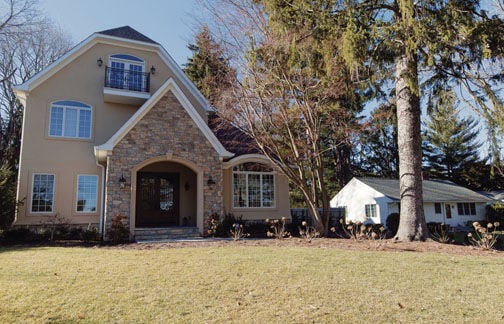
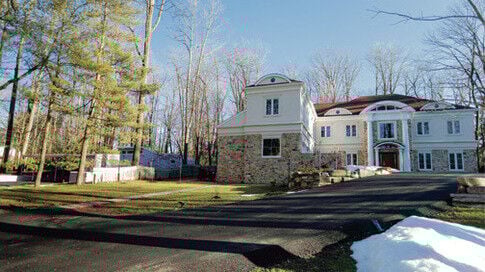
A tall Colonial-style house with prominent garage doors replaces the single-story ranch down the block. A modest older home is razed, and up spring two larger houses in its place. Who hasn’t seen those twin barns on Valley Road? Ask any resident, and chances are they can recall a newly erected house around town that evokes particular displeasure.
Teardowns, oversized McMansions, neighborhoods ‘undergoing a transition.’ However the new construction is described, it is clear current zoning ordinances permit larger structures than what had previously stood there. In fact, most of the teardown construction is built as of right, meaning the property owner — most of the time a developer — can build without having to go before the zoning board.
If future development matches recent trends, neighborhoods won’t just be physically transformed. The relatively modest portion of Princeton’s housing stock will one by one be replaced with new houses priced well in excess of $1 million.
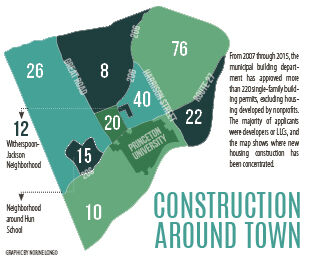
McMansion insertions are concentrated in Princeton’s older neighborhoods (see map, page 7), and while the pace has picked up recently, new construction represents a small percentage of Princeton’s overall residences. There are more than 7,500 units of housing in Princeton, and the 2015 average assessed price was $800,540. The municipal construction department has issued more than 220 building permits for new single-family units from 2007-2015, with a spike of more than 40 permits in 2015. (These figures exclude developments by nonprofits such as Princeton University.) Applicants included homeowners looking to upgrade their properties, but most of the building permits were granted to people looking to build and sell.
In response to resident concerns, last fall municipal zoning staff recommended five zoning amendments to address the construction of oversized houses. Only three ordinances were ultimately adopted in December, zoning changes that eliminated loopholes that led to larger houses and mismatched subdivisions. However, one proposed ordinance that reduced the maximum construction allowed on undersized lots went nowhere, and the main zoning limits that cap construction size, also known as bulk regulations, remain unchanged. (For a primer on zoning, see sidebar, page 8.)
Mayor Liz Lempert has expressed interest in exploring form-based zoning. Unlike conventional residential zoning that broadly regulates the size and scale of construction, form-based zoning would regulate house design in the context of a neighborhood. For example, a neighborhood’s form-based code could restrict the construction of garage doors that dominate the front of the house.
There is plenty of time for community input, as the consolidation of borough and township land-use ordinances is also on the municipal to-do list.
***
The list of resident concerns over neighborhood impact runs long. Some residents say the piecemeal development of expensive new houses represents a long-term change in the economic diversity of the community.
They have also raised more immediate objections to insertions that can turn a block into a construction zone. The most common is the impact of a new house on the character and quality of the neighborhood, from aesthetic concerns over style to more objective considerations such as height and size. Then there is a new house’s invariably larger imprint, which can mean increased impervious surface and fewer trees. Will neighborhood sump pumps be pressed into additional duty, and what about that intrusive new window next door overlooking your house?
The potential for worsening water drainage was the argument Maurie Cohen deployed when he spoke before the zoning board in July 2013. He said the neighborhood was underserviced by storm drains and suggested the town should assess the local hydrology. Local builder Daniel Barsky had purchased the property next door to Cohen, 27 Morgan Place, from the deceased owner’s estate for $360,000, and he was seeking permission to build on the undersized lot.
Five neighbors showed up to the hearing to request the new house be of similar size to the other 2,000-square-foot homes in the neighborhood. Cohen describes the effort as a “mission of mercy.”
The zoning board might have a reputation for toughness, but in fact it routinely grants permission to developers, as well as homeowners, to build anew on undersized lots. All 14 homes that line Morgan Place, a cul-de-sac street off of Mountain Avenue, sit on quarter-acre lots and are legally considered undersized. Decades after the neighborhood was built in the 1950’s, the township made the neighborhood a half-acre zoning district. In other words, the Morgan Place neighborhood consisting of quarter-acre parcels is now in a zone requiring a minimum lot size of half an acre.
This zoning change rendered the entire Morgan Place neighborhood nonconforming and subject to zoning regulations specific to half-acre lots.
New construction on undersized lots is permitted and made legal after a zoning board hearing to request a variance. Neighborhoods developed more than 50 years ago are filled with undersized lots, and Zoning Board members have concluded that owners of undersized lots cannot increase their property size. Denying a variance request would not only prevent the owner from building, but also limit the future development potential of surrounding undersized lots. From 2012 through 2015, the zoning board granted lot area, lot width, and/or lot depth variance relief to 39 applicants, 10 in 2014 and 17 in 2015.
However, most of the new construction in town is built on conforming lots that do not require a zoning hearing.
As for the property on 27 Morgan Place, less than a year after the zoning hearing the new four-bedroom house sold for $1.15 million.
Cohen, an NJIT professor with a background in planning, says that overall, the new construction next door did not dramatically affect the neighborhood. There has actually been an improvement in drainage. The old two-bedroom house sat on a slab, while the new construction dug a deeper foundation that may have affected the water table.
However, Cohen notes many of his neighbors are seniors, and he suspects the house next door is merely the first domino to fall.
In an email correspondence with a municipal planning official after the 2013 zoning hearing, the official described the houses in his neighborhood as “economically obsolescent.”
“It’s a funny feeling to have my house referred to as obsolescent when it’s fine for a family of five,” Cohen said. “He meant it’s too small for the market. What that says to me, as more houses become available, (is that) teardowns will sweep up and down the block.”
Cohen and his family moved to Morgan Place 13 years ago, and he says in today’s globalized Princeton real estate market, he could not afford his house on an academic salary today. Profit and gain direct community transformation.
“Anyone in similar circumstances 10 years behind me in life is priced out of town. People, including municipal officials, talk about wanting to have an economically diverse neighborhood, but the opportunities are narrowing. There’s discordance with rhetoric and social aspirations,” Cohen said. “The developer, the selling homeowner, higher assessments for the town, all the stakeholders are gaining. There is an economic logic working against social commitment.”
Cohen’s wife, Patricia Berhau, is also bothered by the disconnect between talk and action.
“We purport to care about sustainability: plastic bags fees, green waste, recycling,” said Berhau, who works for the Trenton nonprofit, Isles. “Then there’s a modest-sized home turned into a big home. The old product is wasted, new materials are used and there’s more energy consumption. Bigger is not necessarily better. We seem to be heading in that direction without deciding as a community to allow it to happen.”
***
The Barsky family built the new house at 27 Morgan Place, and they are one of the main developers in town. Under RoDan Investments and R.B. Homes, the father-son duo of Roman and Daniel Barsky live and primarily build in Princeton. (Roman’s brother Igor also builds in town as part of a separate company.)
They say their office on Witherspoon Street frequently receives phone calls and letters of complaint, often in response to unrelated projects. While other builders decline to put their names behind their product, they always place a sign outside their projects.
“We’re like the poster child, we get a bad rap for work that isn’t ours,” said Daniel, who lives in one of the few remaining ranch houses near the Hun School. He estimates the family business builds four to six homes a year, and they had a dozen projects in 2015.
As for criticism of the teardown projects they do build, Roman said they are responding to demand. Recently, smaller homes—less upkeep—located closer to town have become popular. In the last three years, Roman said 90 percent of the homes he has built range from 2,000 to 2,800 square feet, typically with four bedrooms and three bathrooms.
“I think we do build in character of the neighborhood,” Daniel said. “If people say something bad about the home, well, somebody bought the home.”
Roman adds Princeton has many small homes built 60 to 70 years ago, and when zoning was first put in place in the 1970s, more than two-thirds of the houses were rendered nonconforming.
“Zoning controls it all. (Even) if I keep mine small, somebody next door can build bigger,” he said.
Citing the expected increase of school children and property taxes after the completion of the 280-unit AvalonBay development on Witherspoon Street, Roman explains, “The town is going to look to us to build more. It’s important to carry that cost.”
Added Daniel: “A lot of homes we build produce higher tax revenues, but they don’t have as much cost to the system. Neighbors complain about rising taxes, at the same time they don’t want a house that produces more revenue.”
The Barskys do renovate properties here and there, but they estimate 95 percent of the properties they develop are not worth salvaging and so are torn down.
“All houses we build replace old houses, they haven’t been maintained over the decades and are beyond repair. We hear a lot: why don’t you fix the house? People not in the industry don’t understand how much work it requires,” Daniel said. “We’re doing a community service. A lot of the houses have unsanitary, unsafe conditions.”
In the past, homeowners looking to sell quickly have contacted the Barskys directly. They also pick up properties through distress sales, for example when a homeowner is about to lose their home because of unpaid back taxes. In one recent transaction, the selling owner had moved into a nursing home and was going into debt.
“When you deal with R.B. Homes, we make the process smooth,” Daniel said. “There’s no inspection and we can offer a quick close.”
Neighbors, he adds, also benefit.
“Because of the work we do, it raises everybody’s property value,” Daniel said. “If I buy a house next door to you and tear it down, that’s a sales comp. After we sell the new product, you know your property can be worth that much selling to a builder or doing it yourself. It helps the value of neighbors.”
The most common complaint they get?
“People don’t like the demographic of people buying our home,” Daniel said. “The complaint is, ‘We don’t like them as our neighbors.’ Their argument, in an open forum, is that it’s a million dollar house.”
One real estate agent who resides in Princeton and has worked locally for the past 15 years says McMansions do increase property values. However, rather than going straight to developers, sellers should list their property on the market if they want to maximize their selling price,
“You can get more if you list, that’s a definite fact,” said the agent, who spoke on the condition of anonymity because clients include builders. “Builders are usually the lowest bidders. They are trying to go before the market.”
As a selling agent, the realtor encourages clients to test the market and resist a builder’s enticing all-cash offer. Even after commissions, it’s a seller’s market.
“Everything under a million goes like hotcakes,” the realtor said. “The houses over a million don’t go as fast. New Jersey also has a one percent mansion tax on sales over a million.”
The realtor sees a lot of people who do not wish to sell to builders, and neighbors send letters to the office urging not to sell to one.
While clients have expressed opposition to selling to a builder, no client has settled for a lesser offer from a nonbuilder.
“When a builder comes with cash and a higher offer, that changes,” the realtor said. “Then they will sell to the builder.”
According to the realtor, it’s cheaper for builders to tear down and build anew than to renovate. And when a new house on the block rises up, look for property values to do the same.
“You don’t want to be the most expensive house on the street,” the real estate agent said. “If you have a $800,000 ranch and a $1.5 million is built next door, your house looks better.”
Paul Driscoll has lived on 141 Harris Road for 30 years, and he says McMansions tend to break up neighborhoods. Property values go up and older homeowners, tired of rising property taxes, liquidate and move out.
“I’m not convinced that selling my house as a teardown is worth more than selling it to a young or downsizing couple,” Driscoll said. “I would want to sell my house to somebody who likes it the way it is.”
The previous owner of 18 Marion Road West, Gerard Tulley, rebuffed multiple offers from builders. An older neighborhood located between the Little Brook School and Carnegie Lake, Marion Road has more than two dozen residences, a mix of 1950s era homes and bigger new houses.
Back in August 2013, another prominent builder in Princeton, M.R.M. Construction, appeared before the Zoning Board seeking a variance for an undersized lot at 15 Marion Road West. Tulley lived across the street from the property, which featured a doomed one-story ranch house.
He presented a petition with 18 signatures and showed the Zoning Board pictures of various homes in the neighborhood, pleading for the new structure to be limited to two stories. Several other neighbors noted McMansion replacements were ruining the character of the neighborhood. While some neighbors installed additions or rebuilt their houses, their construction fit into the neighborhood in terms of height, size and style.
When listing his property this year, Tulley wanted to sell to a buyer who would continue living in his 1955 two-story house. Last July, the eventual buyers, Bode and Cindy Lee, purchased the home for $711,000.
After house hunting this past summer, Bode tells friends also looking to buy that Princeton is a challenging market, with high prices, little inventory, and competition from builders as well as the university.
“Not even the upper-middle class can afford to move in,” Bode said. “Anything new is over a million.”
Before deciding on Tulley’s former home this past summer, Bode mentions he did check out a nearby house on the corner of Shady Brook and Gulick Road. With young kids in tow, however, the house’s disrepair and mold discouraged the young family. The large shell of a new house has already been erected on that site.
Two days after the Lee family’s July purchase, the newly constructed house at 15 Marion Road West that so concerned Tulley went on the market for $1.95 million, or nearly triple the price of the Lee’s new home. As the Lee family settles into the neighborhood, the house across the street remains empty and on the market.
What’s the assessment status of the empty house? According to the tax assessor’s office, in 2015 the new house at 15 Marion Road West received a $500,000 partial assessment, on top of its land value. An additional $250,000 partial assessment was added in 2016, and a final added assessment will occur when the house sells and a certificate of occupancy is issued.
***
As neighbors charge McMansions with altering a neighborhood’s social and physical fabric, how does new construction affect Princeton’s denser neighborhoods?
The stretch of Linden Lane north of Franklin Avenue is zoned for 8,500 square feet lots, or less than a quarter of an acre. The side yard setback, or the closest a building can be built to the lot line, is eight feet.
When the elderly owner at 141 Linden Lane sold her house to an LLC, the builder got a zoning variance for the undersized lot. The new house was placed exactly eight feet away from the lot next door, owned by Stephen Cheng, a graphic designer, and his wife, Fang-ting Liu, a piano instructor at nearby Westminster.
The young couple purchased their one-story house on the corner of Linden and Franklin in 2008. Coincidentally or not, the neighbor on the other side of the house retained an attorney when the developer was before the Zoning Board, and the new McMansion is set back farther away from the neighbor and closer to Cheng and Liu’s lot.
“I have nothing against teardowns, but is there any concern for the neighbor?” Cheng said. “It just doesn’t look and feel right. It doesn’t fit.”
While the setback distance irks him, what bothers him the most is the height.
There is one silver lining. The previous one-story cape cod had a small basement similar to Cheng’s, accessible via bilco doors. During construction of the new house, he noticed the builder was digging a deeper foundation. Cheng wondered how that would jive with Princeton’s high water table. Similar to what the Cohen household on Morgan Place experienced, water drainage has improved.
“It’s clear they have the lowest basement on the block,” Cheng said. “My sump pump doesn’t go on much at all anymore. I know next door is helping. You can hear the sump pump going on all the time.”
The houses on Leigh Avenue are even closer together: most lots are 30 feet by 100 feet. However longtime Leigh Avenue resident Joseph Weiss draws a distinction between the oversized insertions in the rest of the former township and his neighborhood. In the Witherspoon-Jackson neighborhood, the teardowns are not so much about the size of the new construction as the new design.
“The new houses are sized correctly for the most part,” said Weiss. “Some houses are not respectful of neighboring design. For example, there are new homes without a front porch and instead there’s a garage.”
Weiss, an architect by trade, explains why he feels design matters.
“I’ve lived here 23 years, and it’s about street life. The physical emblem is the front porch, which is a social space. We know everyone, and to replace the front porch with a garage door and have an entrance on the side, it breaks the fabric of the neighborhood. There are also new homes with 25-foot setbacks from the street in a neighborhood with 10-foot setbacks, which in my opinion is like a missing tooth. That really makes a difference. It’s somewhat jarring, and has people upset.”
Those interested in how the streetscape has changed can take a stroll down Quarry Street. A dozen new houses have been erected in the neighborhood since 2007.
Residents of the historically black neighborhood have organized, and the Historic Preservation Commission has recommended Witherspoon-Jackson for historic district status. Any physical modification to the exterior would need to go before the HPC for a hearing. Council is expected to take action in March.
While a part of the Witherspoon-Jackson neighborhood, Leigh Avenue belongs in the former township. Last May, a property owner across the street looking to build was seeking not just the usual undersized lot variance from the zoning board, but also variances to the front yard setback.
The applicant sought to comply with the average, or prevailing setback, in the neighborhood, a practice recognized under borough ordinance, while township zoning has required setbacks. Even Weiss gets mixed up at times by the two sets of zoning rules, and he makes sure to double check the ordinances when working on projects in Princeton.
In attendance at the zoning board hearing with several neighbors, Weiss was surprised to see that the applicant had only presented a plot plan with a box figure, despite requesting multiple variances.
The board ultimately directed the applicant to return with more specific information.
At the next meeting, Weiss questioned the applicant’s elevation calculations. He also checked setback calculations for neighboring residents and caught a couple inaccuracies from the applicant.
Weiss’ main concern was the position of the proposed house and its effect on the easterly neighbor. The applicant sought to push the house closer to the street. The effect on the street edge would have been minimal, but the orientation of the new building would have led to an increased shadow effect for the easterly neighbor, who lives directly across the street from Weiss. The dialogue was productive, though the lot is currently empty.
“I think it’s a good process, allow the public to see something,” Weiss said. “At least it’s transparent. You can have a discussion about it. The applicant needs to understand they will be affecting their neighbor on both sides.”
***
With all the houses going up in town, it is obvious the zoning is not restrictive but, if anything, quite permissive. In most cases, the property owner does not require a zoning board hearing, unless the lot area is nonconforming.
In response to the construction of “oversized houses,” last December council adopted three ordinances that eliminated loopholes in the bulk regulations. One ordinance prevents lot subdivisions like the twin barns on Valley Road. In that subdivision, a single deep lot with narrow street frontage was subdivided into two houses; the houses are oriented as if the end of a rectangular house faced the street.
Another ordinance, the final one passed in 2015, clarified what building spaces count towards a property’s total floor area. A lot’s total floor area is all the square footage of every story of every building on the lot, and caps on floor area is the primary zoning regulation that controls building size. The definitions of floor area, story, basement, and attic were amended and clarified, eliminating exceptions to floor area calculations previously utilized by developers and homeowners to build bigger.
Leading up to the promulgation of last year’s zoning amendments, one outspoken critic of Princeton’s zoning regulations and its enforcement was Charles Karney. A former professor at the Princeton Plasma Physics Lab who now works for SRI International, Karney has lived at 702 Prospect Avenue since 1988. Karney’s dive down the zoning rabbit hole began after an August 2014 zoning board hearing in which the property owner, Prospect Princeton LLC, was granted a variance to build a new structure on the undersized lot at 686 Prospect Ave.
Prospect Avenue is filled with undersized, nonconforming lots with buildings that predate the current zoning map. Karney’s neighborhood is in a half-acre zoning district. The lot two doors down from him was 18,530 square feet, or more than 3,000 square feet shy of the half-acre lot minimum.
Once the variance was obtained, the developer could build in accordance with the half-acre zoning regulations. The maximum amount of square footage that could be built on the lot was 3,706 square feet, or 20 percent of the lot area. However, the applicant’s attorney, citing a bonus for undersized lots that increases the maximum allowable square footage, said the house size would be 4,262 square feet, or 23 percent of the lot area.
Moreover, when calculating a building’s total floor area, certain spaces could be exempted.
Karney says the actual total floor area of the building exceeded 5,000 square feet. Municipal zoning officer Derek Bridger said the house was in compliance with his interpretation of the zoning ordinances.
The new house is three stories tall, and the third story includes a room with views of Carnegie Lake. Most of the third floor was excluded from floor area calculations because other than the one room, the rest of the third floor was designated as inaccessible attic space. However, during construction, Karney noticed a doorframe in the third floor hallway that would have made the rest of the third story quite accessible. He notified the zoning department, and the frame was covered up and replaced with an access hatch.
“I’m not sure what the original plans were, but it was clear the developer wanted a door,” Karney said. “What a silly thing to argue about! But it would change the floor-area calculations.”
Karney argues that zoning ordinances are not being enforced properly and floor area calculations are not verified after construction. This may open the door to additions or increased usage down the road, in which case Karney believes original designs merit additional scrutiny. In addition, even if there was less floor area and no third story at all, the developer would still be allowed to build to the same height. He suggested zoning ordinances should take volume into consideration as another means to control bulk.
At the May 19, 2015 zoning board meeting, the board held a discussion and Karney presented his views on the loopholes in floor area calculations and zoning interpretation. However, even after the zoning amendments approved last December, Karney says loopholes remain that contribute to oversized construction, such as cathedral ceilings and basement space built above elevation.
Two doors down from Karney, the now-completed three story house on 686 Prospect Avenue overshadows the one-story ranch next door. It was listed at $1.99 million last August, and a sale was registered at that price in December. As far as Karney can tell, the house remains unoccupied.
“It wouldn’t be so terrible for ordinances that veer to being strict, but there is still a relief valve for those claiming hardship,” Karney said. “I think one thing that has happened in the last 15 years is the real estate industry has gamed the system. Slowly, changes are being made that might address this. It’s a continual cat-and-mouse game with developers.”
When asked what tricks developers use, Bridger declined to discuss specifics, though he says he has seen builders push the floor area ratio, or FAR, the primary regulation that limits how much can be built.
“Everyone’s trying to maximize value of the property,” he said. “The maximum is the minimum.”
With respect to interpreting zoning ordinances, the zoning is “cut and dried.”
“I have to follow bulk requirements,” Bridger said. “If it meets bulk requirements, it’s approved.”
The zoning amendments passed last year did not significantly change the bulk requirements. And despite the municipal zoning staff’s recommendation, a proposed ordinance to eliminate proportional FAR, which provides a building bonus to undersized lots such as 686 Prospect Avenue, was not introduced by council at the Nov. 9 meeting.
Downzoning, for example reducing the maximum allowable FAR, would limit construction size, but municipal officials say there is a balancing act between not taking away property value and maintaining neighborhood character.
“There are considerations: impact on property values, neighborhood character and expectations when people move,” said Mayor Lempert, who is a member of the planning board and the zoning amendment review committee. “There tends to be a reluctance to out and out downzone because it can affect the value of people’s home. The value of a home is in part dependent on development potential. For the period when you’re paying taxes, it can be seen as a good thing, but in terms of seniors who see their home as an investment, most would want to maximize. In addition to property value, there’s the ability to do what you want with your house.”
Lempert said the borough explored downzoning roughly 10 years ago, and the initiative proved controversial. “My guess is developers would not be in favor of downzoning,” she said. “A lot of builders are actually interested in form-based codes because to them, having direction is helpful.”
Form-based zoning would address issues conventional bulk regulations do not, such as codifying restrictions aimed at preserving the streetscape, and creating standards for the look and feel of the neighborhood. There could be design restrictions on what neighborhood residents dislike, such as prominent street-facing garage doors.
“How does the building relate to the street and to the other buildings?” Lempert said. “There are ways to write in restrictions that better capture the relationship between home and street.”
There’s also the shade tree ordinance.
“In some neighborhoods, street trees provide the most dominant feature,” Lempert said. “We realize our tree ordinance needs to be strengthened to make it more difficult for developers to come in and destroy the existing tree canopy.”
When asked if the municipality supports new construction that results in new houses with higher tax assessments, Lempert said, “I personally don’t, because you have to look at the costs, like the changing fabric of the neighborhood. Surprisingly, it hasn’t had a big of an impact as it’s had on our bottom line.”
Council member Jenny Crumiller, another member of the planning board and the zoning amendment review committee, also mentioned the borough’s past attempt at downzoning.
“You don’t need a crystal ball to know that people will be upset if we reduce the allowable building size,” Crumiller said. “It seems like the people who are contacting us to voice their concerns are architects. They don’t want to be limited.”
Added Crumiller: “There is a strong profit incentive, and the professionals in the community whose business is developing and building are often the ones we hear from.”
At the same time, Crumiller says she hears more complaints from residents than compliments about recent development, and she encourages residents to contact council members.
“A lot of our zoning allows for a lot bigger size house than is existing,” Crumiller said. “Right now there’s no legal recourse, even if the planning board is against it.”
The municipal planning and zoning staff have a heavy workload, and according to Crumiller council is considering hiring a planning consultant to assist in addressing resident concerns. Lempert, Crumiller, planning board chair Wanda Gunning, vice chair Gail Ullman and planning director Lee Solow have held informal meetings with local planners.
The general recommendation, Lempert said, is a “community-visioning process” to formulate a formed-based code. Added Lempert: “The important piece is public participation and outreach. Sometimes resident response is visceral and they might not be able to explain why. A zoning ordinance needs specifics for what we need to encourage and discourage.”
Zoning, zoning, zoning
There are more than a dozen different residential zoning districts in Princeton, each with varying regulations. What zoning district a property is located in determines how much can be built.
Zoning districts were later added to many older neighborhoods. Generally, a quarter-acre lot located in a zoning district with quarter-acre lot minimums is more attractive than a quarter-acre lot located in a half-acre zoning district. In the former scenario, the property conforms with the zoning district and a builder can proceed with designing a new house. Most single-family housing construction follows this blueprint.
New construction on a quarter-acre lot located in a half-acre zoning district requires the extra step of a Zoning Board variance. (Though undersized lots also have benefits.) The quarter-acre lot is nonconforming because its lot size is below the half-acre zoning district minimum. The property owner can legally build on the undersized lot only after attaining variance relief.
For developers this perfunctory process requires time, money and notifying pesky neighbors. Applicants promise to adhere to all the other zoning regulations, receive the variance, and go on their merry way.
The zoning board does not require site plans from those small lot variances. Zoning Board chairman Barrie Royce has repeatedly told residents that in such cases, the board does not have jurisdiction regarding the size of the house as long as the applicant complies with the zoning ordinances that control size.
Undersized properties in the former borough can be developed without variance relief, and a proposed zoning ordinance last fall would have granted former township properties the same status. Since variances in these cases are routinely granted anyway, the change would streamline the process for all parties. However, Council did not approve the ordinance.
The other ordinance recommended by municipal staff that failed to pass would have eliminated proportional floor area ratio for undersized lots. If it passed, the maximum allowable square footage construction on undersized lots would have been reduced.
The main security residents have against building size lies in zoning ordinances referred to as bulk regulations.
The primary zoning tool that controls the size of a building is floor area ratio (FAR), which is the total floor area divided by total lot area. A lot’s total floor area is all the square footage of every story of every building on the lot. Each zoning district has a maximum FAR that limits what can be built.
27 Morgan Place is a recently developed undersized lot. The property has a lot area of 10,222 square feet, a quarter acre, but it is located in a half-acre zoning district and so is subject to the half-acre zoning district regulations. The maximum FAR permitted in half-acre zoning districts is 20 percent. In other words, 20 percent of the property’s lot area (10,222 square feet) is the construction allocation.
That figure is 2,044 square feet. Yet, the maximum floor area that can be built is 3,129 square feet.
How? Proportional FAR, or ordinance 10-B 330.
Recommended to Council for elimination last fall, proportional FAR calculates a bonus for undersized properties, i.e. a more generous floor area allowance. For 27 Morgan Place, the lot’s FAR cap max is adjusted upwards from 20 percent to 30.6 percent. By comparison, the maximum FAR for neighborhoods in quarter-acre zoning districts is only 25 percent.
Allowed a maximum gross floor area of 3,129 square feet, the developer of 27 Morgan Place ultimately built a four-bedroom, 2,665 square foot home that sold in 2014 for $1.15 million.
Another important bulk regulation is setback requirements. Setbacks dictate a building’s minimum distance from the street or lot line, preventing a building from being placed too close to the street or to an adjacent property.
However, setbacks can also determine the height of the building. In the former township, zoning districts of a quarter-acre and below have a height maximum of 30 feet. Zoning districts with larger minimum acreage have a height maximum that is determined by the setback-to-height ratio. For example, properties in half-acre zoning districts have a 1:1 ratio. A building set back 25 feet from the road can be built 25 feet high. (Former borough zoning districts operate in the reverse, a height-to-setback ratio. Ask the zoning department about that.) So a quarter-acre lot located in a quarter-acre minimum lot zone cannot exceed a height of 30 feet, but if a quarter-acre lot is located in a half-acre zoning district, it is not subject to the 30 feet height limit but to the height-to-setback ratio.
,