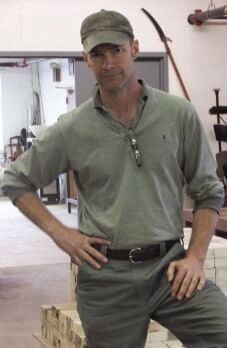
Sculptor Bruce Lindsay relocates his studio from Hamilton to Trenton
“I needed a new place,” says sculptor Bruce Lindsay in his newly acquired business studio and living space on Allen Street in downtown Trenton. “My studio (at Grounds for Sculpture) in Hamilton was serving its purpose, but I outgrew it physically and wanted to do different things in production.”
New is relative. The space is actually a 1925-era two-story brick building that was originally used by Richardson and Sons building supplies. More recently it was owned by the late sculptor, entrepreneur and Trenton mayoral candidate Frank Weeden.
“Trenton appealed to me because there are some great old buildings. And it’s relatively affordable (much more affordable than New York City or Philly). I sought to create a situation for myself that was live-work. I think it is particularly of interest for artists because we’re not 8 a.m. to 5 p.m. workers. As a small business owner there were a number of things that attracted me to Trenton,” says Lindsay, the artist who has creates and has exhibited at Grounds For Sculpture, Montclair Art Museum, Trenton City Museum, Audubon Artists in New York City, and elsewhere. His works are also in various public art collections.
Lindsay’s work with others has been formalized through his business, Integral Sculpture Work. “It provides other artists with production services: modeling, enlarging, mold making, fabrication, and restoration. It is principally metal work. My clients are in the Mid Atlantic sector—Washington, New York. This is a natural outgrowth of my interest in collaborating with other artists. I am interested in the relationship that develops with an artist and their foundry.”
Lindsay—a former intern and later manager with the Johnson Atelier at the Grounds For Sculpture in Hamilton—is a practitioner of the ancient process of lost-wax casting, something he says he is passionate about. “The advantage of the process is that it provides a very accurate translation of forms into bronze. We can even translate fiber and fingerprint textures.”
The process involves a series of models and casts and the use of molten bronze to replace a wax replica.
Lindsay, born in 1961, says that he was introduced to the lost-wax process at Bucknell University by sculptor and professor William Lasansky. “I was an English literature major and for one of my electives I got involved with a studio art course. Mr. Lasansky was producing his work in the lost-wax process. It lit a spark in me. I found it fascinating and decided to pursue it. This is an example of a good liberal arts education: that you can be exposed to other fields and realms and to find something with passion and want to pursue. I think my mother wanted me to go into law, but that didn’t work out.”
His connection to the process comes from knowing himself. “First, I like working with my hands. This process is tactile and labor intensive. Second, I have a fascination of the transformation from one form to another. It’s an important facet of the artwork I am creating. Then there’s a certain appeal to the process because seeing a bronze pour is a spectacle. The molten metal is beautiful. It’s a treat to watch. There is a lot of sensory information around the pour,” Lindsay says.
The beauty, however, only comes through a labor intensive process. “To get from your original pattern to the finished casting you have to go through a number of steps. It’s arduous. You have to be really committed. Time is one element. The other potential difficulty is the cost of creating these objects. The variety of materials and the energy costs, including the propane, adds up.”
Lindsay attributes his sense of beauty in part to interacting with natural forces and shapes when he surf fished for bluefish and striped bass during family vacations to their getaway in Nantucket—a few hours from the Boxford, Massachusetts, home where he lived with his General Electric career man father and stay at home mother.
In 1985, Lindsay found his way to the Johnson Atelier. “I had done my own casting and built my foundry equipment, but I recognized that I had a lot to learn. I joined (the atelier’s) apprenticeship program which had just moved to the site in Hamilton,” he says.
The apprenticeship helped both professionally and artistically. “We could use the facility after hours. We had to pay for our materials, but we had access to the state of the art equipment. Before the reorganization (that closed the foundry component of the atelier) it allowed a lot of young artists to evolve and create a portfolio of their own,” he says.
Lindsay’s approach to creating is fluid. He has a personal vision, yet he is open to working with friends, community members and clients.
“I consciously made an attempt to find a means of expression in sculpture that was unique. As a young emerging artist it is important to differentiate yourself from the pack,” he says about the work that is purely his own. “The term I use is biomorphic abstract. It looks like something from nature, but you cannot figure out.”
He also makes life-size cast bronze figurative sculptures that are allegorical representations of concepts drawn from Tibetan Buddhism.
Of his approach to working with others, he says, “I see commission work as a particular type of trial to create work that meets the expectation of the client and be placed site specific and function visually and technical needs—to design work that takes those factors into account.”
“The most significant work that I was commissioned to date was the United War Dogs Memorial,” says Lindsay of that public artwork adjacent to the New Jersey Vietnam Memorial in Holmdel, New Jersey. “These dogs were credited with saving thousands of lives.”
Lindsay attributes his involvement with public art to his experience at the Johnson Atelier. “The apprenticeship program was pulling artists from around the world. That helped broaden perspective on public art. Secondly, the clients of the Johnson Atelier were prominent New York artists and heavy weights. Being involved with the organization, we had direct contact with (these artists) and talked to them and saw how they would develop work for public commissions. That was a type of training beyond the program.”
Other training is recent and includes his decision to go to Wheaton Village in Millville to learn glass casting. The process is similar to lost-wax casting and uses molten glass. “It was a revelation for me. The glass provides color. Glass also contains interior features, where the metal sculptures are all about surface.” To demonstrate, he shows a glowing glass figure that is satisfying in its shape yet filled with a wondrous galaxy of shapes.
“The latest development is my involvement with 3D printing,” he says. “It is another kind of material that has been a revelation of sorts. Sculptors generally don’t create a number of pieces because of the process and cost. Therefore their evolution as artists can be somewhat slow. But I found that 3D printing is a process that allows for a faster turnaround so to speak.”
Lindsay—who is also a member of the Trenton-based AbOminOg International Arts Collective and is participating in the group show currently on the grounds of the Old Barracks—says that in addition to other projects, he is currently working with fellow sculptor and painter Kate Graves on the “Portable T Project.” It uses a removed “Trenton Makes The World Takes” bridge letter “T” being treated for an upcoming exhibition and event for the Port of Trenton Foundation (a project designed to commemorate Trenton’s role as a port).
“Trenton is a good place to be as a working artist. I think there’s good energy, an indicator of positive change,” he says.
“Founding the Future: A Continuum of Iron Casting in Trenton,” an exhibition of sculpture by Bruce Lindsay and other members of the AbOminOg Intl. Arts Collective, is set to be held at the Old Barracks, 101 Barrack St. in Trenton, Monday through Saturdays, 10 a.m. to 5 p.m.; outside exhibition is free. For more information, go online to barracks.org.
Bruce Lindsay and Scott Thompson lead an Introduction to 3D Printing, Saturday, July 12, and Enlarging Your Art with 3D Printing, Grounds For Sculpture, Saturdays, Sept. 13 and 27. Phone: (609) 586-0616. On the Web: groundsforsculpture.org.
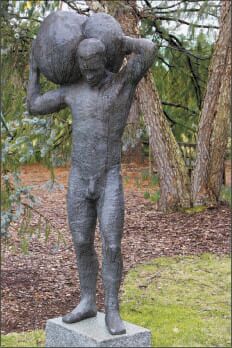
Bruce Lindsay’s “The Use of Memory” at The Grounds For Sculpture in Hamilton.,