It was during an exercise class in 2017 that Lourenza Mejia of Hamilton Township noticed the first hint that something wasn’t right: a sensation she describes as a “shock” in her left leg. “It came from nowhere, would come and go, then stop,” she says. “I’d feel it for seconds, and that was it.”
Concerned, she consulted a doctor who had performed minimally invasive spine surgery on her husband, Juan Carlos Mejia, in 2009: Marc J. Levine, MD, Director of the Orthopedic Spine Surgery Program in the Orthopedic and Spine Institute at Robert Wood Johnson University Hospital (RWJUH) Hamilton and a member of RWJBarnabas Health Medical Group. An MRI revealed she had spondylolisthesis, a condition in which one bony vertebra of the spine slips forward in relation to the vertebra below it.
“The vertebrae are essentially rings stacked on top of each other with the spinal cord running down the middle,” Dr. Levine says. “When one ring moves forward, there’s less space in the middle where the nerves are.” That can pinch nerves in the spinal canal, causing a range of symptoms, including pain.
“In 2019, I started feeling tingling and numbness in my two feet,” Mejia says. “I knew my main spinal nerve was being compressed.”
The value of surgery started to become clear. “At this point, I was more scared to become dependent than to go for surgery,” Mejia says. “Surgery offered a chance to have my life back.”
Mejia decided to proceed with surgery at RWJUH Hamilton both because the hospital was right in her own community and because her husband’s earlier spine surgery had turned out well.
“We used a relatively new minimally invasive procedure called an extreme lateral interbody fusion,” Dr. Levine says.
The procedure accesses the spine through small incisions in the side rather than through the back or front of the body. “This approach doesn’t disrupt major back muscles and avoids the often-painful long-term problems people can have with open procedures,” he says.
Dr. Levine placed a titanium implant in Mejia’s spine and blocked it in place with a plate and screws. Special imaging called fluoroscopic intraoperative imaging took continuous X-rays that provided the surgical team video-like views of the spine as they worked.
“The implant allows us to realign, fix and fuse the spine, which takes pressure off the nerve and prevents the deformity from worsening,” Dr. Levine says. “These minimally invasive procedures allow patients to recover much more quickly with less pain than they would with traditional open procedures. Many times, results can be dramatic and truly surprise people.”
Mejia was among the amazed. “After three months, I went back to my workout classes. I’m so grateful to Dr. Levine. He’s our angel.”
For more information about state-of-the-art orthopedic surgical treatments offered at RWJBarnabas Health, visit rwjbh.org/ortho.
To learn more about Robert Wood Johnson University Hospital Hamilton, visit rwjbh.org/Hamilton or call 609-586-7900.
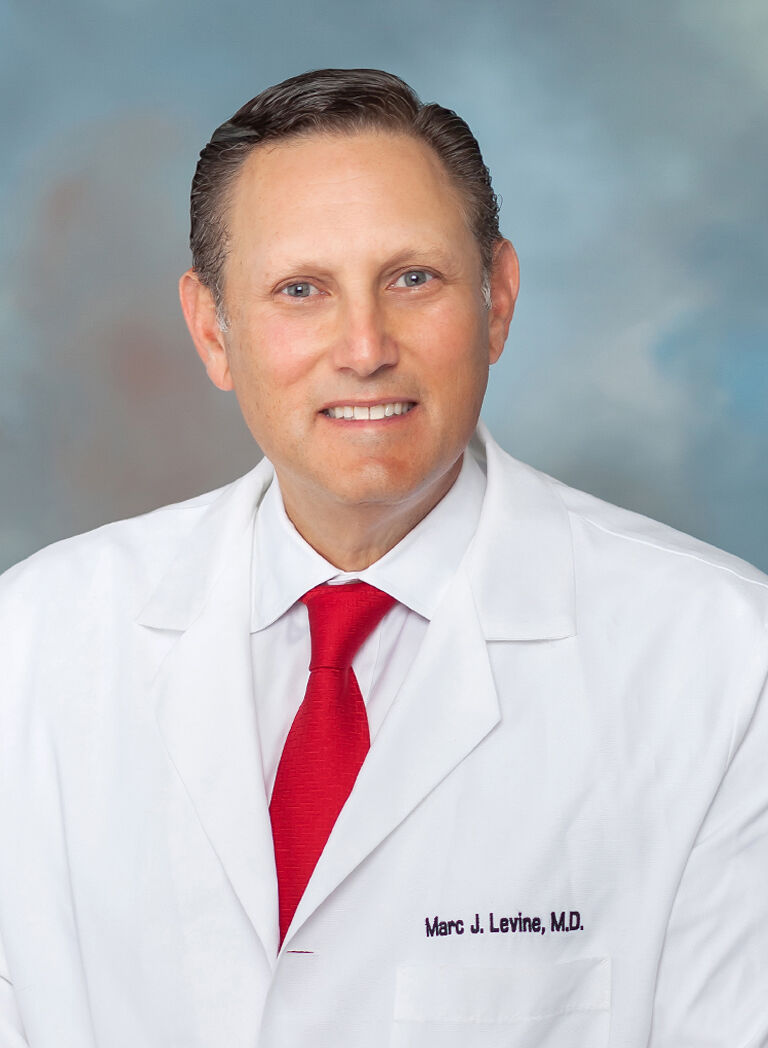
Marc J. Levin, MD, is the Director of the Orthopedic Spine Surgery Program at Robert Wood Johnson University Hospital (RWJUH) Hamilton.,

