Joint Commission certifies Center for Orthopedic and Spine Health for hip and knee replacement surgeries at RWJ Hamilton
On June 17, less than a week after the OrthAlign Plus handheld navigation device had been cleared by the Food and Drug Administration for use during hip replacements, Dr. Michael Ast became the second surgeon in the country to employ the technology in the operating room under FDA approval.
The physician was working in the Center for Orthopedic and Spine Health at Robert Wood Johnson University Hospital Hamilton, which this year became the first hospital in the area to be recognized by The Joint Commission in three orthopedic specialties: hip replacement, knee replacement and spine surgery.
In the ultracompetitive field of healthcare, every medical center is looking for an advantage, and one way RWJ Hamilton has set itself apart is by its commitment to making the Center for Orthopedic and Spine Health a destination for orthopedic care.
The multidisciplinary program has been designed to bring together teams of orthopedic specialists, pain management professionals and physical and occupational therapists to provide patient care. The program offers a full range of orthopedic services, from minimally invasive operations to trauma and other complex procedures. In addition to joint replacement and spine surgery, the program also treats injuries and conditions affecting the neck, shoulder, hand and feet.
The Joint Commission, an independent organization, is the nation’s oldest and largest standards-setting and accrediting body in the health care industry, evaluating more than 20,000 health-care organizations and programs in the United States. The Joint Commission’s review evaluated RWJ Hamilton for compliance with standards of care specific to the needs of orthopedic patients and families, including infection prevention, leadership, pain and blood management.
Over the course of a year, hundreds of surveys are sent to RWJ Hamilton’s orthopedic patients following their hospital stay by Press Ganey, the leading patient satisfaction organization in the U.S. Those results are reported to hospitals for constant monitoring. In 2012 and 2013, the hospital’s orthopedic unit ranked in the 95th percentile of hospitals nationwide.
The Center for Orthopedic and Spine Health is a separate unit, with all private rooms. A dedicated orthopedic coordinator collaborates with the care team to set and achieve rigorous goals regarding patient outcomes and safety, starting with pre-surgery education.
Typically, patients attend pre-surgery classes to learn about joint replacement. During classes, they look to learn what to expect during their hospital stay, how to prepare their home for their return, what their family members should expect and what to do before surgery.
While joint replacement surgeries are ever more prevalent, with technological advances such as OrthAlign making them more efficacious, Dr. Ast says surgery is the last resort for his patients. He and his fellow physicians look to exhaust every other option before resorting to an operation.
Ast has been using OrthAlign for knee replacements since last year, and was confident that once approved for hip surgery, he would use it there as well. But as far as patients are concerned, the effects of various techniques and technologies are more or less invisible.
“OrthAlign offers nothing different (to the patient) in terms of surgical time or recovery,” Ast said. “It’s just a tool I can use to help me be more accurate in what I do.”
OrthAlign, which looks like a smartphone, helps surgeons ensure that replacement joints are installed at the correct angle. A difference of even a few degrees can lead to pain and, over time, degradation of the implant.
“Nowadays, most joint replacements, barring any complications, should last a very very long time,” Ast said. “But to minimize the other complications that can cause it to fail sooner, this is another arrow in our quiver to work to make those problems less common.”
Ast has been practicing at RWJ Hamilton for eight months. Before that, he worked at the Hospital for Special Surgery in New York. A member of Mercer-Bucks Orthopedics, he is fellowship trained in hip and knee replacement surgery.
He said that while he does more than 400 joint replacement surgeries a year, he spends most of his time talking about pain management.
“Here at Hamilton, they have really embraced the ideas that have become the cutting edge of pain control,” he said.
Ast said when it comes to surgery, most of his patients get spinal anesthesia rather than general anesthesia, which he said has been shown to significantly reduce pain as well as blood loss. Meanwhile, anti-inflammatory and nerve-modifying medications minimize the use of narcotics during recovery.
He also said the majority of his patients go directly home from the hospital, and not to rehabilitation centers, which he says studies have shown offers the best results.
“I’ve had a lot of patients come in and out of hospital in a day,” he said. “They go home the next day, and the entire time here they never once ask for pain meds. The nursing care is wonderfully proactive. The most common thing I hear from patients is, ‘I cant believe it didn’t hurt.”
Ast said that while the majority of the people he sees are between the ages of 50–65, he is seeing many more patients younger than that in recent years.
“People are unwilling to stop living the life they were living,” he said. “My job is to get them back there.”
RWJ Hamilton runs seminars periodically giving prospective patients information on how to treat joint pain, with a goal of keeping them out of the operating room.
“There’s no such thing as minor surgery,” Ast said. “I tell people, ‘You need to earn a joint replacement.’ It’s a big deal.”
But if there are no alternatives, the practitioners at RWJ Hamilton’s Center for Orthopedic and Spine Health feel they can offer the best care of any hospital in the area.
“It really is a wonderful team dynamic, and I work at many local hospitals,” Ast said. “I have a patient I worked on recently, he had his knee replaced on a Tuesday and went home on a Wednesday. I called him on Thursday and he said, ‘I have to tell you, I can’t explain how wonderful the care was in that hospital.’ I’ve heard it more than once.”
More information about the Center for Orthopedic and Spine Health at Robert Wood Johnson University Hospital Hamilton is can be found online at rwjhamilton.org/RWJOrtho.
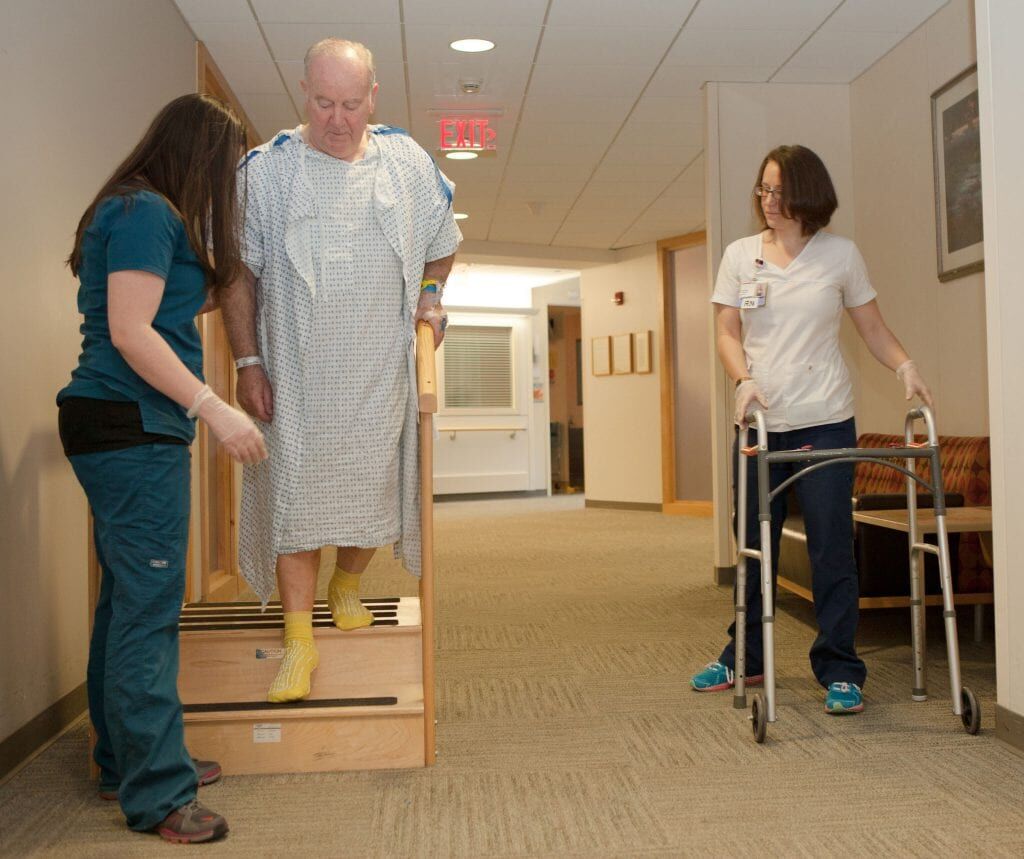
Paul Goubeaud, of East Windsor, works with Dr. Ciara Kelliher, left, a physical therapist, and Jenna Hempelman, an orthopedic nurse, as part of his post-knee-replacement therapy at Robert Wood Johnson University Hospital Hamilton’s Center for Orthopedic and Spine Health.,

