By Victoria Weisfeld
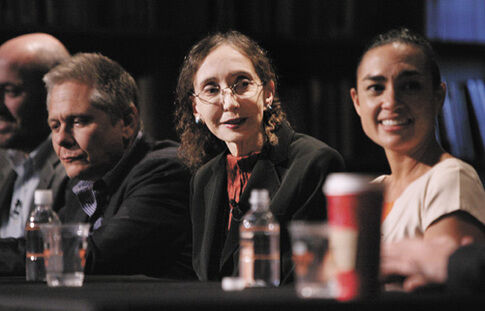
Joyce Carol Oates isn’t a person bitten by the writing bug early in life. She wanted to be a teacher. And, it’s as a teacher that Princeton University celebrated her on Nov. 7 in the Chancellor Green Rotunda, with 10 of her former students — all successfully published writers today — returning to talk about their experiences in her classes and workshops and with her personally.
During the event, Oates’ former student offered wide-ranging reminiscences about their experiences with their teacher and mentor. In one panel were writers Boris Fishman, Jonathan Safran Foer, Jennifer Anne Kogler, Julie Sarkissian and Whitney Terrell, and the other featured Jonathan Ames, Christopher Beha, Pinckney Benedict, Kristiana Kahakauwila and Walter Kirn. Authors and fellow Lewis Center for the Arts instructors Edmund White and Sheila Kohler handled introductions and posed questions to the panels.
Oates began teaching at Princeton in 1978 and has announced plans to retire from full-time teaching in 2015. She will teach at Stanford University in the spring, and plans to continue to teach a course each fall in the Creative Writing program of the Lewis Center.
The former students lauded her accessibility and careful attention to their work. But Oates also has found time to create more than 100 books, including fiction, essays, plays, poetry and memoir.
Her recent works include The Accursed, set in turn-of-the-century Princeton, which reviewer Stephen King called “the world’s first postmodern Gothic novel,” and Carthage. Her 1969 novel Them won the National Book Award for Fiction. In this long list is her “unlikely bestseller,” On Boxing.
During the panels, Ames (Wake Up, Sir!) commented that in his day, the only photograph in Oates’ office was one of her with Mike Tyson. This got a laugh from the audience observing Oates’ birdlike frame.
Boxing might seem an activity far removed the daily life of a literary academic, but one might say all writers are boxers, whose opponents are the words they are trying to batter into place in meaningful sentences that express ideas, display characters, and tell unforgettable stories. While this or that writer is applauded as “brave” for spilling raw emotions messily onto the page, Oates’ former students called her truly “courageous” —and here the boxing metaphor emerged explicitly—for never “pulling her punches.” And she taught them not to, either.
Numerous ex-students commented about her guidance related to how she prepares her students to be writers, including, as Foer (Everything Is Illuminated) said, maintaining the energy to produce a completed work. He said many students — equally talented and ambitious as the published writers present — at some point just stop writing.
Oates makes her students excited about the process, in the hope that they won’t stop, because from draft to draft, although incremental improvements may—probably are—achieved, they become smaller and smaller. As Whitney Terrell (The King of Kings County) said, “Half the game is just hanging in.”
And the work is hard. Edmund White called his conversations with Oates “one Sisyphus talking to another.”
Another gift she gave students, the panel members said, was permission to identify themselves as writers. Being a writer is not necessarily an identity people are comfortable claiming for themselves.
In France, White said, no one ever says, “I am a poet.” “I write poems” might be OK, but external validation is needed for writers to assert their status in the creative world. Christopher Beha said that Oates made him feel like a character himself — a persona — apart from his ordinary sense of self.
The students further praised her for finding something in every piece of student writing that she loved. She would point out the particular strengths of a piece of writing, then focus the seminar participants on how to make it better — much as editors of a magazine might, which was a frequent classroom discussion device.
Her sense of humor came through by way of the former students’ comments and Oates herself. “You let me hand in all those dirty stories,” Ames said, “and you never just X’d that stuff out.” To which Oates replied, “There wouldn’t have been much left. Your name, maybe.”
Over her years of teaching, she’s observed changes in her students. Most prominently, she said, at Princeton today the student body is very diverse, coming from many different countries and backgrounds. Students have traveled more, visiting countries that decades ago most wouldn’t even have heard of and encountering different cultures that inevitably affect their work. They also read different books, and Oates emphasized the importance of the earliest books one reads—before college, even before high school.
Today’s childhoods typically include Harry Potter and more films. Her favorite reads were Lewis Carroll’s Alice books, which she first devoured at age eight or ten. Fantastical. Penetrating. Funny. Inciting curiosity. Qualities we were told she brought to her decades of teaching.
The most specific piece of writing advice to be gleaned from the event was this: never let characters have a conversation while riding in a car. Her former students laughed in a way that suggested they’d heard that one—and other cliché-avoidance tips—more than once.
Julie Sarkissian, author of the novel Dear Lucy, long-listed for the Dylan Thomas Prize, recounted how she grounded some of her early writing in her own experiences, and how Oates wanted her to separate this work from the lived reality, to make the fiction whole and entire in itself. Apparently, the teacher wasn’t swayed at all by Sarkissian’s argument that what she’d written was “true.”
Sarkissian said she learned right then that “the fact that something is true is a pretty pathetic defense when it comes to fiction.”
Is it going too far, then, to say fiction is about lying? Deftly? Another of Oates’s students present was Pinckney Benedict, author of the collection Miracle Boy and Other Stories, and apparently Oates once said something like, “Pinckney seems like the kind of person who would lie to an interviewer.”
A startled Benedict found this a revelation: “You can lie to an interviewer?” and swore he’s included two or three whoppers in every interview since. Now I wonder what lies lurk in his excellent Glimmer Train interview from Winter 2013, which has him saying, “I am not trying in my own work to demonstrate that my heart is in the right place because, quite frankly, it is not.”
Trying to establish a common ground with readers — “we’re all well-meaning people together,”he says — “is the antithesis of a powerful or worthwhile literature.” That statement underscores the “don’t pull your punches” approach to writing Oates encouraged in her students.
Foer recounted how he’d once turned in a set of pages on which Oates wrote: “Confusing, but uninteresting,” with the latter charge the more piercing. Even unpleasant and essentially boring characters have to be made interesting, she said, in the context of fiction. They become interesting through their uniqueness.
“The more unlike anyone else you make a character, the more universal that character becomes,” wrote Donald Maass in Writing 21st Century Fiction. Benedict, originally from rural West Virginia, sets his stories in an Appalachian region so vividly portrayed the reader can reach out and touch the surrounding mountains and smell the barns and fresh-turned earth. In commenting on his skill in this, Oates echoed Maass’s counterintuitive statement: “The regional, if it’s intensely felt, is the universal.”
A conversational thread I especially related to was Oates’s dictum that “Writing is about solving problems.” How do you get this character from here to there, believably? If you need a character out of the picture a while, where does she go? Why? How to get from here to there is what Oates taught her students.
Joyce Carol Oates may have written more than a hundred books. But when she has to identify her profession, she told those gathered, “If I have to put it down on some form, I write ‘teacher.’”
Vicki Weisfeld is a Princeton resident. Read her blog at vweisfeld.com.
,

