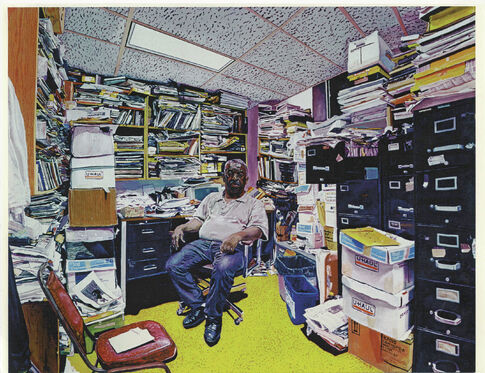
The late photographer Lou Draper shown in a Mel Leipzig painting that is now at the Whitney in New York, will be in focus June 21 at the Kerney Campus.
Editor’s note: Photographer Lou Draper seems to have been “discovered” as a master artist. Over the past few years there have been exhibitions of his work in museums and art galleries, articles in the New York Times, a website devoted to his work, and a growing buzz about him in art circles.
But many in the Trenton region discovered Draper long ago when he arrived to lead photography classes at Mercer County Community College. From his home on West State Street in Trenton, he soon became a presence in the city. He participated in the Trenton Artists’ Workshop Association, and was an active part of the Trenton area art scene until his death in 2002.
Since then an informal volunteer network of regional artists and arts professionals has vowed to keep Draper’s images in front of the public and worked to create a book that will be sent to museums and made available to the general public.
“Louis H. Draper Selected Photographs” is the fruit of that effort. The book was created through involvement and discussion with Draper’s artistic associates in Kamoinge — a New York City group that Draper helped form in 1963 to address the under-representation of black photographers in the art world — and family members in his native Richmond, Virginia. The book’s final phase was completed by New Jersey State Museum fine arts curator Margaret O’Reilly, former MCCC faculty member and designer Eric Kunsman, and photographer and historian Gary Saretzky, who wrote the introduction, which has been an excerpted and edited below.
Members of the Trenton area can reconnect with Lou Draper — or become acquainted with him for the first time — on Sunday, June 21, with “Trenton Makes: Arts and Artists in Trenton,” a downtown MCCC campus event that will include a book celebration, preview of new gallery spaces, an open house, and a strong focus on one of Trenton’s most celebrated photographers.
By Gary Saretzky
In 1957, while studying at Virginia State University, Lou Draper saw a copy of “The Family of Man.” Although he had been making photographs for his college newspaper, it was only then that he decided to go to New York City to become a photographer. Taking workshops with Harold Feinstein and W. Eugene Smith, he developed a passion for street photography combined with high standards for photographic printmaking. These mentors, dedicated photographers with humanistic ideals, must have had a big impact on him.
Draper told me that he learned the most from Feinstein but Gene Smith was a major influence as well. A highly talented documentary photographer, Smith is still revered as the idealist who quit a high paying job for Life magazine over editorial control of his photo essay on Albert Schweitzer. Smith’s photo essays on humanitarian themes; his dedication to social causes; his vast library of books and encyclopedic reading habits that included African American literature; and his loft where he taped jam sessions in the wee-hours by New York’s top jazz musicians, could not help but make a lasting impression on Draper, who became his assistant in 1961-1962. Draper eventually had to quit because his employer, who used amphetamines, expected him to work for days at a time without sleep. “Photography Made Difficult,” the title of Smith’s workshop at the New School for Social Research, was true in more ways than one.
In the fall of 1968, at New York University, Draper took a photography course with Paul Caponigro, who continues to exemplify the spiritual approach to photography developed largely by Alfred Stieglitz and Minor White. Although Draper didn’t acquire any new technical skills, he was so impressed with Caponigro that he wrote to him afterwards that he was “one of the few living examples of a man who is organically what he does. This [class] has been very important to me as an experience because of the example which you set… .” Through these youthful experiences, Draper learned to integrate photography into his daily life, to make it become a part of his purpose in life, not just what he did for a living.
As he wrote later, “I began to realize that what I felt had worth; that I could make strong statements about the world in visual terms and that often these images did in fact move people emotionally. I had power. I was a force… [This power] was given to me for the purpose of sharing.”
During these early years, Draper acquired self-knowledge through effective critiques of his photographs in classes and workshops, an experience that he provided students when he became a teacher. He later recalled, “Among the things I found out about myself was that I had an interest in people and that I was intrigued by the varying mood and complexities of light. I also came to realize that there are things about the world I hated and that these too were valid statements to be made with a camera. I hated injustice, and slums, and people being shown in less than true grace.”
Indeed, one of the signifying characteristics of a Draper photograph is the dignity with which he portrayed people, regardless of their race or social standing. The respect that Draper showed for others in both his photographs and in his interpersonal relationships was reciprocated by all who knew him.
Quickly recognized for the quality of his work, Draper was included in Photography at Mid-Century, an important exhibition at the George Eastman House in 1959. The list of contributors, including Harold Feinstein and Gene Smith, still reads like an international Who’s Who of Photography.
Draper had a strong sense of pride in his black heritage: he affiliated with other black photographers, was thoroughly familiar with black literature and history; and was a fan of jazz and blues. Nevertheless, as he politely but firmly explained to Harry Naar, the curator of the Rider University Art Gallery, who invited him to have an exhibit with Aubrey J. Kauffman in recognition of Black History Month, he wanted to be thought of as an artist, not as a representative black artist, and requested another time slot. This story is but one example of how Draper resisted stereotyping and wanted his work to be seen on its own individual merits.
Although teaching jobs and freelance photography enabled him to continue doing his personal work, Draper’s income was marginally sustainable by the late 1970s. Consequently, when William Barksdale, founder and coordinator of the photography curriculum at Mercer County Community College (MCCC), invited him to join the faculty in 1982, Draper was glad to accept.
Draper’s job responsibilities grew when he succeeded Barksdale as coordinator in 1987. At MCCC, one of his major accomplishments was planning both the move of the photography department to a much larger facility in the Fine Arts Building and an expansion of course offerings. Honoring its highly regarded college professor, MCCC presented Draper with a distinguished teaching award.
Undoubtedly, he had a positive influence on numerous students. Between 1992 and 1996, Joe Ryan studied with Draper while developing a successful career as a rock music photographer. He recalled that “Draper wanted me to see everything I could see. Sometimes I’d bring him a print and I’d think, ‘I have something here.’ He would tell me, ‘There are a hundred people out there doing it better.’ He always made me want to go out and try harder. Draper made me go for the gold.”
The change in Draper’s life after he began working at MCCC is reflected in the shifting subject matter in his personal work, although photographing people continued to be his specialty. As he wrote during this period, “The human face in general and portraiture in particular, are still the catalysts for much of the photographic work I do.”
In the 1980s and 1990s, his horizons, social network, and opportunity for personal growth expanded. For example, he became good friends with, and sometimes student of, other art faculty at MCCC, especially painter and art history lecturer Mel Leipzig, with whom he shared an office for many years. Leipzig, whose painting of Draper at his desk is now in the collection of the Whitney Museum of American Art, recalled, “Draper was the most ethical person I ever met. There was something noble and warm about him.”
In 1989 Draper had a major retrospective, “Enter the City: Photographs by Draperis Draper,” that opened at Stockton State College and traveled to the Johnson & Johnson World Headquarters in New Brunswick. The catalog included one of Draper’s most memorable photographs, “Girl and Cuba, 1968” (also known as “The Black Angel”), of a very concerned-looking girl in a white bDraperse, her hands clenched under her chin, and the huge inscription, “CUBA” in the background.
In the 1990s Draper kept up his ties to Kamoinge, helping to revive it after a period of inactivity, but he also became involved with the Trenton Artists Workshop Association (TAWA). In 1990, TAWA selected Draper as one of a delegation of six to go to the Soviet Union as part of an exchange program of artists and exhibitions. There Draper had a chance to meet Russian artists, including photographers. Upon his return, he put together a fine portfolio of images he made on his trip. Three years later, Draper began an extended series, “New Jersey Artists.” In 1995 he helped TAWA organize “Trenton Takes: 24 Hours in the City,” which occurred on May 3, 1995. Among other work in his later years was a series of portraits of elderly Jewish women and a project to document historic buildings in Mercer County.
After teaching the fall 2001 semester, Draper was diagnosed with untreatable cancer and died peacefully on February 18, 2002. He was buried in his hometown, Richmond, Virginia.
Mel Leipzig soon invited Draper’s sister, Trenton-area friends, and Kamoinge members to come to his home to plan “to do something for Draper.” All agreed that this book should be published and that an endowed Draperis H. Draper Scholarship be established at MCCC. To fund the book production costs and the scholarship, Leipzig spearheaded a committee that organized an art auction at MCCC. Nearly 100 artists, including both Kamoinge members and Draper’s many friends, colleagues, and students from the Trenton area, donated their artwork. More than $30,000 was raised.
The next task was to organize Draper’s archives, which were at MCCC, to the point where a selection of photographs could be made for the book. As documented in Mel Leipzig’s painting, Draper had managed to store about 75 cubic feet of unorganized papers, photographs, slides, negatives, books, and other materials in one-half of the rather small office they shared; he had more stashed elsewhere. (He even raised the ceiling tiles above the bookcase behind his desk to gain vertical storage space.)
As a career archivist, I was glad to take on this task with the enthusiastic assistance of John Sunkiskis, an instructor in the MCCC photography program. We arranged the nearly 1,000 prints by Draper (not including duplicates) into groups such as Abstractions; Major Trips (Mississippi, Africa, and Soviet Union); The City; and Portraits.
Kamoinge reviewed most of Draper’s archives, picked a few more, and established the final sequence. The selections were influenced by Draper’s own preferences of which negatives to print and which to exhibit and publish during his career.
Eric Kunsman, Draper’s former student and successor as coordinator of the MCCC photography program, did a wonderful job with the scans, matching them to the original prints, and prepared the digital files and page layouts. No prints were made from Draper’s negatives or slides; all images in the book are from Draper’s prints, which convey his choices in cropping, contrast, and local tonal manipulations. Margaret O’Reilly, as book editor, prepared the biographical data in the back of the book and brought together the final product.
I am confident that Draper would be highly pleased with the results — but have no doubt that he would have found ways to improve it.
Trenton Makes: Arts and Artists in Trenton, James Kerney Hall on the James Kerney Campus of Mercer County Community College, 102 North Broad Street, Trenton, Sunday, June 21, 3 to 5 p.m.
The event is a celebration of the donation of a Mel Leipzig Painting, “Fashion Design, MCCC, Trenton Campus “to Mercer County Community College; the debut of the book, “Louis H. Draper: Selected Photographs,” a survey of Lou Draper’s career in photography; and the presentation of the design of the new art gallery and community room at Mercer’s campus in Trenton.
“Louis H. Draper: Selected Photographs” can be purchased at the event for $40 per copy. The book also can be ordered from the College for $40 per copy plus $10 per copy shipping and handling. Orders can be sent to “Louis H. Draper: Selected Photographs,” c/o Patricia A. Richards, AD 250, Mercer County Community College, P.O. Box 17202, Trenton, NJ 08690.
Although the event is free to the public, the sponsors are seeking patronage support at $150 per patron ticket. Each patron receives an invitation to lunch with Mel Leipzig at Settimo Cielo and a copy of the book, “Louis H. Draper: Selected Photographs.” For information on being a patron for this event, please contact MCCC Foundation at (609) 570-3608 or gwazdae@mccc.edu.
,

