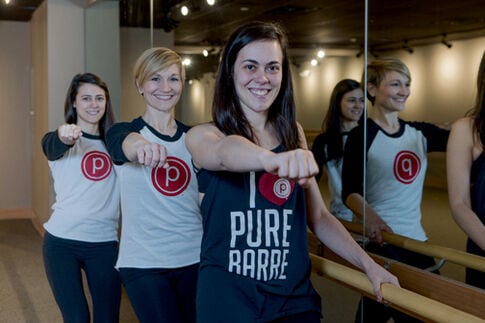
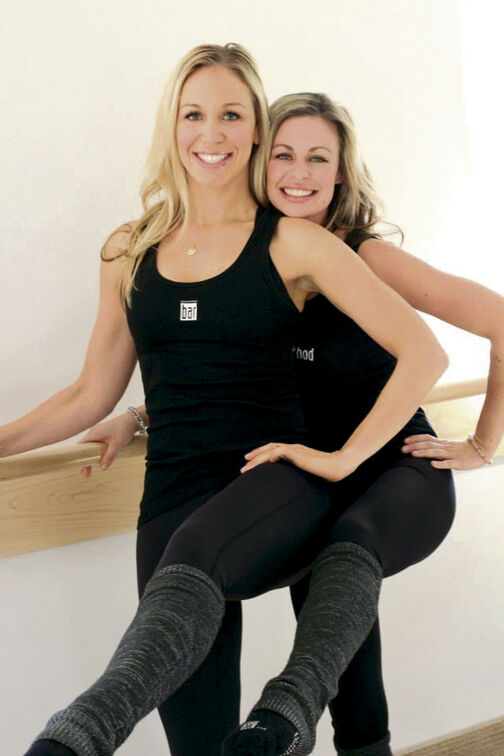
The traditional ballet bar isn’t strictly used for ballerinas anymore—it’s now the star of bar exercise, a high intensity workout that uses the bar for stability and balance.
Located on Emmons Drive off of Route 1, The Bar Method has been servicing Princeton bar clients since fall of 2012. The studio first opened as a temporary location offering free workouts a few months before its official opening, allowing the studio to build a community of dedicated customers. Just last week, Palmer Square welcomed a branch of Pure Barre.
Princeton resident Arce-Quinton thought about opening a branch of Pure Barre to Princeton last year after marrying her husband, who was already commuting to Princeton for work. She always had a yearning for entrepreneurship and was already a frequent Pure Barre client, so she decided to bring the lifestyle to town.
“Not only did we chose Palmer Square because it’s the heart of town, but we decided to live here too,” explains Arce-Quinton in a press release about the new store. “Princeton has been very welcoming and I’m so excited to share my passion for Pure Barre with the local area.”
Pure Barre began selling franchises in 2009, and now has over 325 studios across the country. The most common age of clients falls between the undergraduate age range to clients in their 60s. Clients as young as 16 are welcomed to come workout at Pure Barre.
One 55-minute class offers a workout that focuses on the thighs, arms, abs and glutes. The only equipment clients are required to bring are gripping socks to prevent sliding during the workout. Pure Barre provides the rest—a ball, weights and a tube— but a majority of the exercise relies on body weight.
The Bar Method studio co-owners Jennifer Tigue and Amy Clark met at a Bar Method in Summit, NJ close to eight years ago, when bar exercise was not yet popular on the east coast. They bonded during 5:30 a.m. classes, where the two remember being the youngest clients in the class. The friends later decided to quit their jobs and open a Bar Method studio in Princeton.
Tigue and Clark were opened the temporary location in June 2012, which offered free classes in June, July and August and $5 classes until the studio’s official opening. Though not all Bar Method studios begin this way, Tigue and Clark decided it would be an effective way to introduce newcomers to the bar workout.
Close to all of the customers who started taking classes at the temporary location are still active clients today, Tigue said. Even those who have moved away from the Princeton area have kept in touch with the studio owners. Tigue said that the workout is so popular because it’s effective and engaging.
“It’s a very deep mind-body engagement,” Tigue said. “So in that hour, you really can’t think about food shopping or what you have to do late. [The workout] always flies by.”
Something common to both studios is that instructors don’t take the bar workouts. Instead, they lead the classes and walk around correcting clients on their form and ensuring that the workout is safe for everyone participating.
Bar Method clients across the nation usually fall in the 18 to 65 range, but because of the close distance to the University, Tigue said there is a higher percentage of people aged 18 to 25. Clients typically take three to five classes a week.
The Bar Method takes careful attention to safety, as the company was founded by psychical therapists, Tigue said. The workout is meant to be safe for people who have injuries. All Bar Method instructors first complete a training to become certified teachers, which unique to the company. They’re first train for six months, after which they are tested in bar, as well as in anatomy and physiology.
“There are clients with arthritis who come in seven times a week because it’s low impact and it helps [reduce] inflammation,” Tigue said.
Instructors are also constantly reevaluated to ensure that they are meeting specific standards. A special emphasis is placed on how to assist clients verbally and physically to ensure that are performing the exercise safely are getting the most out of their workout.
“[Instructors] are trained on modifications for different body types, different injuries, and even different stages of pregnancy,” Tigue and Clark said. “You will not find this in any other bar fitness studio.”
The Bar Method was founded in Connecticut in 2000 by wife and husband Burr Leonard and Carl Diehl. They had been licensed Lotte Berk trainers since 1991. Lotte Berk was a German-Russian ballet dancer who essentially invented ballet-based fitness training in the 1950s in England.
Pure Barre was founded by dancer and choreographer Carrie Rezabek Dorr in Birmingham, Michigan a year later, in 2001. Dorr had been a Bar Method instructor prior to opening her own studio.
Both Pure Barre and Bar Method workouts are choreographed at the corporate level. Owners at both studios train instructors and teach classes themselves. Pure Barre is most known for its music, Arce-Quinton said. The workout begins with fast-paced music during the “sprint stretch,” a routine unique to Pure Barre. This portion of the workout works the muscles to a complete shaking fatigue, which is followed by a long period of stretching. The music then shifts to calmer, more relaxing songs.
This process of overworking the muscles and then stretching them out is common to most bar workouts. The Barre Method technique involves performing 1-inch isometric movements to fatigue the muscles and then long stretch period to elongate the muscles while they are warm, Arce-Quinton said.
There is only one level of workout at Pure Barre, so instructors offer modifications to make the exercises more difficult or easier for clients. After a few sessions, it becomes easier to tell how you can challenge your body more and make the workout more strenuous, Arce-Quinton said.
Bar Method is different in that it offers four different levels of workouts: level one is geared towards beginners. “Mixed for everyone” is a bit more difficult the studio encourages clients of all backgrounds to give it a try. If the client is looking for more quad and glute work, “Mixed plus” is the next level. And most recently, the studio has started offering “Bar moves,” an advanced class that offers more cardio and recommended to clients who have taken at least 20 “Mixed” classes.
Traditionally, the Pure Barre demographic has been women aged 35 to 55, but in Princeton the demographic is completely different, Arce-Quinton said. College students, young professionals and a large group of clients over 50 make up the clientele.
Though the workout attracts mostly women, Pure Barre is looking to expand to include more men, who generally seem to be intimated by the idea of ballet even though bar exercise does not incorporate any ballet moves, Arce-Quinton said.
“[Pure Barre] is constantly changing and evolving,” Arce-Quinton said. “No class is ever going to be the same, no music combination will ever be the same, so that’s why it keeps your attention—I think that’s why people keep coming back.”
Pure Barre, 31 Hulfish St., Princeton. Web: purebarre.com/nj-princeton. Bar Method, 29 Emmons Drive, West Windsor. Web: princeton.barmethod.com.
,