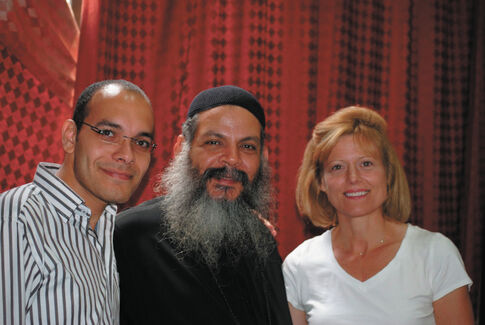
Leslie Doll, right, with one of the Coptic priests overseeing the Center of Love ministry along with one of the center’s volunteers.
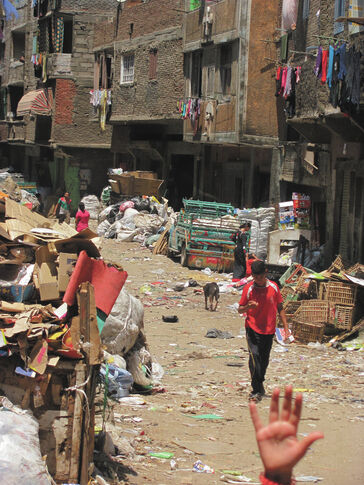
Mokattam, one of a number of “garbage villages” in Cairo, Egypt, where the Coptic Christian community collects the city’s garbage, sorts and recycles it. The residents there literally live in the garbage. (Photo courtesy of Leslie Doll.)
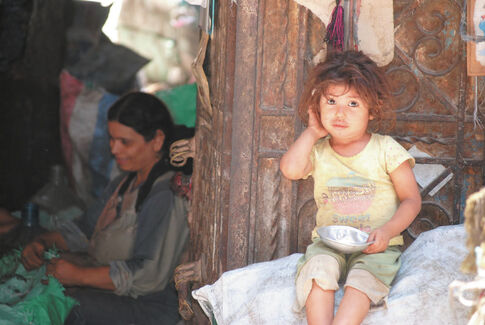
One of the younger residents of Mokattam in Cairo, Egypt, with her family. Princeton resident Leslie Doll recently visited the town, which is nicknamed “Garbage City,” to work with Coptic Christians, who are one of the country’s largest minority groups. (Photo courtesy of Leslie Doll.)
Princeton residents, Leslie and Bob Doll, bring aid to one of Egypt’s poorest neighborhoods
By Michele Alperin
Leslie Doll and her husband, Bob, believe that wealth is a blessing to be shared, and on a number of occasions they have shared their money with worthy causes to back up that belief.
For example, in 2008, the Dolls donated $1 million to help pay for the construction of a chapel in the new University Medical Center of Princeton (UMCP) at Plainsboro.
This year, Leslie visited Egypt to work with Copts — the country’s native Christians, many of whom are underpriviledged poor and the targets of discrimination.
Residents of Princeton for more than 20 years, the Dolls wealth comes from Bob’s years of working in the financial industry — he is currently the chief equity strategist and senior portfolio manager at Nuveen Asset Management, and formerly served as vice chairman and chief investment officer at BlackRock, one of the world’s largest publicly traded investment management firms. The Dolls, who live on Christopher Drive, have three children — Emily, 23, Bobby, 21, and Caroline, 18.
“God didn’t give us this wealth to make us comfortable or make us happy, but the idea is that he gives it for a person to help others,” Leslie said.
As they started to look more closely at how many people in the world were in need, they started to question the global inequities in wealth distribution.
“Why do some people live on a dollar a day and some with millions?” Doll asked. “We were blessed to be born in the United States and have graduate educations and have the opportunity to have a job and make money and provide for our families; others were born with no opportunities at hand and no matter how much they pull on their bootstraps, they are not going to get out of that.”
For the Dolls, this wasn’t an intellectual matter — it meant actively finding better ways to steward their wealth. The first step in their exploration was a trip Doll took to Ethiopia with Emily.
“We wanted to see some different projects that we could learn about, and learn about needs around the globe,” she said. In Addis Ababa they delved primarily into work related to microfinancing and medicine, in particular HIV/AIDS and fistula centers. “We went there to learn about what was going on around the world and how we could capitalize on that with organizations doing their work out of Christian love.”
On their way to Ethiopia, by chance, she and her daughter had a day’s layover in Cairo, where Doll had a good friend. After a trip to the Pyramids, her friend took them the town of Mokattam, nicknamed Garbage City, which is populated largely by Coptic Christians who are the garbage collectors for Cairo. Lacking trucks, they use donkeys and carts, and recently pickup trucks, to gather the city’s garbage, which they bring back to their community to sort and recycle.
“They are living in mountains of garbage day and night,” Doll said. “It is a slum, the poorest of the poor.” Many community members are disabled, due both to the harsh conditions they live in and the genetic problems that result from cousins marrying cousins.
About her first visit to Mokattam during her Cairo layover, Doll said, “It took me by surprise and really moved me. 60,000 people, the lowest of the low, with the lowest social status in the whole country — it broke my heart and really stuck with me.”
Her emotional reaction was not just to the way they lived, but responded to their stories of the suffering they had undergone — of houses and businesses being burned down for no reason other than being a Christian. What’s more, the attacks were often not by strangers, but by people who had lived next door to the victims for years.
The chance visit to Egypt during her layover led Doll and her husband to become involved in many projects in the country. Often they involve help to persecuted minorities, like the Coptic Christians, who she said are descendants of indigenous people who turned from paganism to Christianity, which dominated Egypt until Islam took over in about the 11th century.
“Egypt has a long history of martyrdom, persecution, and marginalization,” she said, noting that Christians are the largest minority in Egypt. For example, the Islamists blamed the Christians, whose population is 10 to 12 million, for the June 30 uprising in Cairo, where more than 20 million took to the streets. “While the Islamists were blaming the Christians for being against Morsi, it was clearly the whole country,” she said.
The disability center the Dolls helped to build in Mokattam serves this Christian minority. It now has six floors of services for children and young adults who are unable to go to school and are often shunned by their families. The disabilities are mostly cognitive, plus physical disabilities where arms and legs do not work properly and a number of cases of cerebral palsy.
“They can’t work and can’t go to school; they are uneducated and illiterate, so their families don’t know what to do for them,” Doll said. “They need a lot of help, and there aren’t government services or any services at all.”
What Doll has seen through her work in Egypt is a nation where the Christians and the majority of moderate Muslims want everyone to live in peace and equality, but the Muslim Brotherhood, she said, “is a radical fringe group in Egypt, and they want to impose shariah law, theocracy, theology, and religion which leave out anyone not a Muslim.”
While the Muslim Brotherhood was in charge, the country did not see much in the way of law and order is happening, with the government having been largely and overtaken by the Muslim Brotherhood.
“A lot of incidents that could have been taken care of by police go without any investigation,” she said. “They don’t hold anyone accountable.”
Over the past three years, Doll has taken teams from around the United States to Cairo to do service work.
In a recent trip to Egypt, from June 15 to 30, she served in Garbage City, but also took a trip down to Upper Egypt, where she talked to people in the villages about their lives.
Also on this visit she conducted a project that brought together American evangelists and Coptic Orthodox from around the world to communicate and work together. Their project involved busing children from poor villages to a conference center north of Cairo for a program that included worship, singing, games and three solid meals as well as educational gifts, food and clothing. Each day they worked with different age groups, but the final day, when they had planned to teach 16- to 18-year-old girls about keeping safe, particularly from sexual abuse, had to be cancelled because of large protests in Cairo.
In these villages, next to simple houses, were beautiful Coptic churches, some 1,400 years old and decorated with frescoes and art, which were burned down. “They didn’t burn a corner of the churches,” said Doll. “They would throw gasoline in and then throw Molotov cocktails; 84 churches and institutions were completely torched.”
Through talking to the villagers, Doll empathized with the emotional anguish and isolation people felt during the protests when they did not know where their family members were and realized there was no one to help them. Then when the attacks were over, the community had no safety net and no insurance.
Although the Coptic Church has been able to give everyone who had lost property a little bit of money, “it was not enough to rebuild a business, get another animal, or get a car fixed,” Doll said.
But Doll and an organization she works with (but whose name she can’t give, for safety reasons) were able to raise a sizable sum, and are hoping to raise $200,000 more to cover individual needs that have been verified.
In Mokattam, where Doll will be returning this year, a particularly meaningful experience for her was to be part of the Coptic Church’s prayer ministry.With them, she would climb stairs, stepping over rats and garbage, to visit people living in terrible conditions, without hope for tomorrow.
“We visit these people, serve them, clean them, do the practical things they need, and hear about what’s going on. We are also able to pray with them, and that is meaningful piece of it for me,” said Doll, who adds, “Even to help somebody get from today until tomorrow, to be a light in the darkness, is very satisfying.”
Doll will be returning in June to Egypt, where the people she has met continually amaze her. Despite knowing that their physical lives are really in jeopardy, they are strong and have deep faith, she said, which creates an environment where Doll finds herself perhaps more comfortable than in Princeton.
“You take the bells and whistles away and reduce life to its very core, its deepest center, which is not about what you are having for dinner or what new dress you are going to buy,” she said. “It’s about life and existence and faith in the Lord to give you your daily bread every day. I am learning more about how to trust God through them than here, where we seemingly have whatever we need and more.”
Anyone who would like to know more about the ministry in Mokattam, or would like to donate or serve, should visit centerofloveegypt.com for more information.
,