By Jacqualine Pillsbury
The Lewis School and Clinic for Educational Therapy, on Bayard Lane in heart of Princeton, is known internationally as a pioneer and leader in Pre-K through College Preparatory multisensory education for students with language-based learning struggles related to dyslexia, auditory processing and attention.
Founded in 1973, The Lewis School is a small, private, non-profit, co-educational day school focusing on students who learn differently.
Marsha Lewis, the school’s founder, said she was this type of student. As a dyslexic child she knew she was bright, creative and intelligent, but she also knew she wasn’t learning in the “traditional” way many other students were.
Lewis said she immediately knew that she needed a different approach to her educational instruction, and wanted to help students like her “learn how to learn” in order to reach their full potential academically and socially. She researched and developed a comprehensive, structured and sequential multisensory curriculum that would help learners like her excel in school, which would then transfer into every other aspect of their lives socially and professionally.
Lewis recognized that many people with dyslexia often have unique gifts and aptitudes. In other words, each person is different and learns in a way that is tailored to his or her strengths and weaknesses. For this reason, the faculty at Lewis is taught to teach differently.
Each teacher is rigorously trained and prepared, step by step, in the Lewis Diagnostic Clinic as educational therapists.
Through these approaches, the brain is prepared to perform, with reliability and fluency, the complex processes of invention, thinking, comprehension, analysis and expression.
The students become informed participants in this process of learning and are able to access the educational tools that encourage intellectual pursuit, creative expression and personal fulfillment.
In order to participate in the unique program, students travel daily to Princeton from as far away as Philadelphia, New York City, and the Jersey Shore. Their curriculum matches and exceeds the New Jersey Core Curriculum Standards, said Lewis.
“After-school activities are offered as they are in any traditional mainstream school,” said Cathy Byers Reimer, director of public relations and communications at the Lewis Schools. These programs include drama, cheer, sports, chorus and other activities. Students can participate in sports at levels ranging from club teams to competitive teams.
“The educational environment is warm and nurturing, which plays a major role in the students’ restoration of confidence and self-esteem,” said Reimer. “Students know they are alike in one way or another — that each one of them learns differently and each child has individual and remarkable aptitudes and talents.”
The school has an informal peer mentoring program where older students pair up with younger children to support and guide them through the school year.
The school also offers a therapy dog program. As part of the CARE Program (Children and Animals Realizing Education), therapy dogs come to school daily with their owners who are Lewis teachers. The children read aloud to the dogs,and learn the correct way to take care of the animals. In return, the dogs give unconditional support and love, which helps the students build their confidence.
Many current teachers are Lewis School alumni. Lewis said that this perspective provides insight to recognize the classroom struggles faced by the students. Their personal experiences are an advantage and in turn provide the tools to help the students.
To inquire about sending your child to The Lewis School, contact the admissions office at (609) 924-8120. After the initial conversation, the parents are invited to campus for an on-site interview. Future students are scheduled for educational evaluations administered by Lewis teachers.
This process gives teachers the ability to integrate teaching and diagnostic perspectives garnered on both sides of the educational blackboard: the perspective of the neuroscience-based multisensory to be delivered in the classroom and the perspective of clinical research into the brain’s learning processes.
After the second session, parents and test administrators review the results together. They meet with the admissions team to determine if the student meets the criteria for admission. Though the school year officially begins on Sept. 8, admission is offered on a rolling basis throughout the school year.
The Lewis School and Clinic for Educational Therapy, 53 Bayard Lane, Princeton. (609) 924-8120. www.lewisschool.org
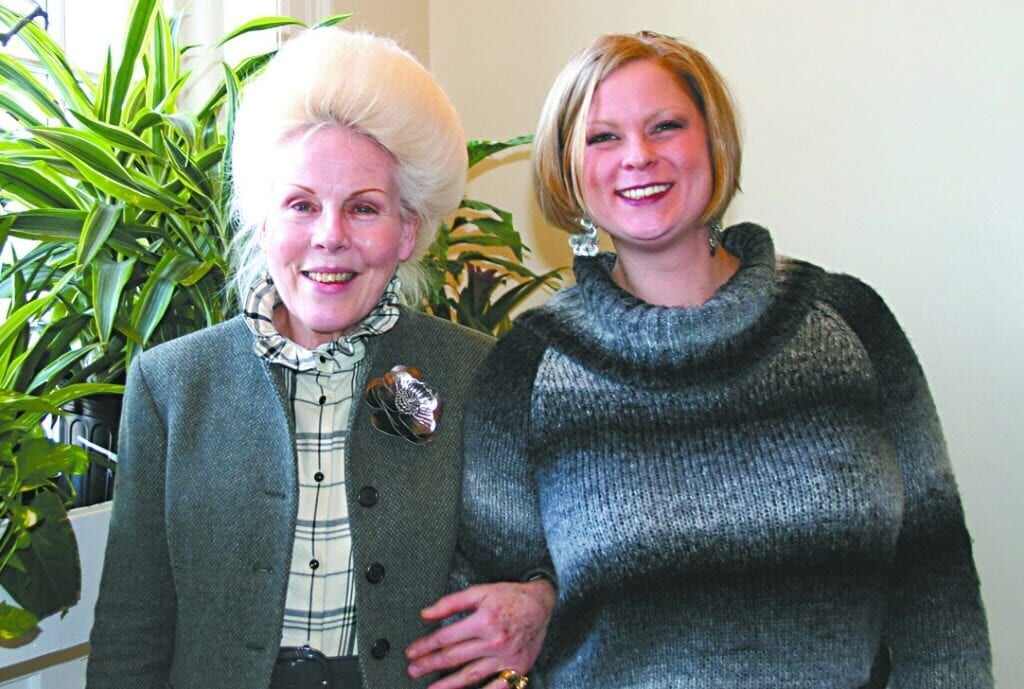
Marsha Lewis, left, the founder of The Lewis School, with Cathy Byers Reimer, director of public relations and communications.,

