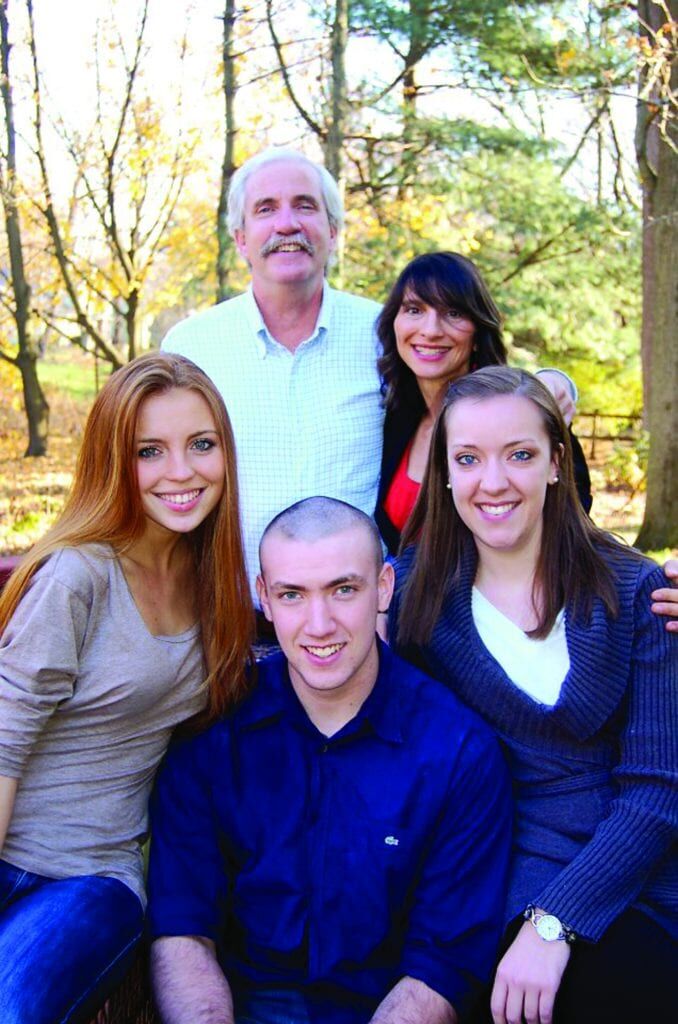
Hope Loves Company provides needed support for caregivers of ALS patients
Jodi O’Donnell-Ames might never have become a massage therapist if her husband hadn’t been diagnosed with ALS.
But she found, as Kevin O’Donnell gradually succumbed to the neurological disease, that she could give him comfort by massaging his head, his face, his hands. The bonding those sessions engendered was so powerful that she eventually went to go to school to become trained in the profession. She believed she could help others in need: that she could empathize with her clients in a way that few can, because of what she had been through.
In the six years between Kevin’s diagnosis, in 1995, and his death in February 2001, O’Donnell-Ames dealt with the overwhelming demands put on those who care for loved ones with the disease. The difficult years of taking care of her husband—feeding him, bathing him, dressing him, remaining by his side during lengthy hospital stays—will be with her always.
In the years since, she has spent much of her life putting that experience to use helping others. Those efforts culminated in the 2012 formation of Hope Loves Company, a nonprofit organization whose motto is, “Because if you live with ALS, so does your family.”
The mission of Hope Loves Company is to provide emotional and educational support to children and young adults who have family members with ALS. The organization’s marquee event is its annual summer retreat, Camp HLC, where young people from around the region can share their feelings with counselors, do team-building exercises and art therapy, and perhaps most importantly, spend time with other young people who are going through the same things.
“I thought we really needed a camp,” said O’Donnell-Ames, who has lived in Titusville since 2003. “We need kids and families to have three days of bonding and learning they’re not alone. That is my biggest goal in this, because my children felt like they were alone (when they were growing up.)”
So far two camps have been held, one in 2013 and one this year, held June 6–8 at Fairview Lake YMCA in Newton. Attendance doubled from one year to the next, and in fact, one of Hope Loves Company’s biggest early challenges is handling the demand for the services it’s providing. Since the 2014 session wrapped, O’Donnell-Ames said she has been contacted by people who learned about it too late to attend in June.
“A woman called me from New York, she said, ‘I know a number of kids who missed your camp, when’s the next one?’ and I’m like, ‘Next year?’” she said. “The woman thought there were more camps she could direct these kids to, but no, that’s it.”
O’Donnell-Ames and her eight-member board have been considering their options. It’s possible they could set up another camp as early as October, but as an all-volunteer workforce with limited financial resources, they’ll need more sponsors and grants to come in before they can realistically expand.
It’s a classic conundrum that can occur when a nonprofit organization fills a void only too well. But O’Donnell-Ames is staying positive about what she and the group can achieve.
“I figured it would take five years to be in position to expand,” she said. “The response we are getting is so overwhelming that the time is coming now, not five years from now. It’s very exciting. It’s just a little daunting.”
* * *
ALS claims every person that it affects, most within two to five years after diagnosis. In people with ALS, the nerves that connect the brain to the rest of the body die, for reasons that no one can explain. Over time, patients lose motor function, necessitating a wheelchair, and lung function, necessitating a ventilator.
ALS usually strikes people between the ages of 40 and 70, meaning a large number of sufferers have children or grandchildren whose lives will be affected. Jodi O’Donnell-Ames’ daughter Alina, who graduated from the University of Delaware in May, was just 2 years old when Kevin was diagnosed. He was 30, she was 29.
As Kevin’s condition deteriorated, everything changed, for him as well as his young family. After a few years, he lost the ability to walk, and needed a wheelchair. They had to sell their car and buy a van, and their Burlington Township home had to be made accessible. O’Donnell-Ames said her daughter didn’t readily understand what was going on in the early years.
A breakthrough came when Kevin was scheduled to participate in a local parade. O’Donnell-Ames helped Alina decorate the wheelchair for the occasion, and she let her daughter ride along. From then on, she said, Alina was more accepting.
“She was proud to sit on her dad’s lap,” O’Donnell-Ames said. “Then other kids wanted to ride on his lap. It taught kids, it taught Alina that it’s OK to be different.”
At first, with his wife’s help, Kevin was able to continue working, and O’Donnell-Ames said he took great pride in providing for his family. But eventually that became impossible. He lost all muscle control and became dependent upon a ventilator. He was essentially helpless, and for years, O’Donnell-Ames rarely left his side. After he lost his battle, she entered a battle of her own, falling into a deep depression.
“You go from 24/7 as a caregiver to ‘What now?’ I felt like I had done the greatest thing I could ever do in my life. Nothing could compare,” she said.
Three months after Kevin’s death, she began pleading with friends and colleagues for a job. The former schoolteacher was, she admitted, “in a really bad place.”
“I was a widow, a single mom of an 8-year-old, and also foster parent for my great niece. I had a lot on my plate, and I didn’t know what to do next. I didn’t know if I should go back to teaching. I sent an email out one night at 2 a.m. I said, ‘Please, someone hire me, I need to work. I need to have a purpose.’”
Perhaps surprisingly, it was Alina who helped her begin to climb out of the darkness. O’Donnell-Ames recalls attending a wedding with Alina and a number of Kevin’s family, and being overwhelmed by all the emotions she was feeling. At one point, she told Alina she was going to their hotel room.
“Alina was like, ‘Where are you going?’ And I said, ‘Your aunts and uncles are here, Mommy’s sad and she’s going to go lie down,’” she said. “And she said, ‘You’re always sad. Don’t you realize life goes on?’”
O’Donnell-Ames was flabbergasted.
“I said, ‘Who are you talking to? I’m your mother. Maybe you should get a grip and start grieving!’ And she said, ‘What do you think I am doing?’ Her grieving was anger. My grieving was depression. And I never thought somebody’s grieving could be anger at 9 years old.”
On the work front, a lifeline came from the ALS Hope Foundation, a Philadelphia-based organization that offered her part-time work. Eventually, she became their director of communications. One day in 2002, in that role, she was to lead a “Fall Fun Day” for a group of kids whose parents or grandparents had ALS.
She said she wanted kids to have something to take home from the experience, so she ordered a supply of a book called, What Did You Learn Today? written by a woman named Tina Singer Ames, who suffered from ALS. The book was intended to help young people come to grip with the affects of the disease. Tina Singer Ames died in 2000.
The book was delivered to O’Donnell-Ames by Warren Benton Ames, Tina Singer Ames’ widower. He too had children, a daughter Nora and a son Adam, who had gone through what Alina had gone through. They struck up a great friendship, feeling a natural affinity for one another because of their similar experiences, and were married in 2003.
Today, O’Donnell-Ames does whatever she can to help caregivers through the tough times. She frequently gets calls like one she got recently from a man whose wife had been diagnosed with ALS, who asked her to meet for lunch. He told her he didn’t want to read in a book or online how his wife would deteriorate—he wanted to hear it from someone who knew firsthand.
A few years ago she put up a website offering copies of the book to people who wanted help explaining ALS to children. To her surprise she received orders from around the country. Demand for the book played a role in the formation of Hope Loves Company.
“We have 30,000 Americans living with it, and we have one drug for it. Where’s the money going to go? Not to helping families. It goes to patient care and research. So there’s a need for what we do,” she said.
And on top of all the outreach that she does to try to give hope and help others cope, there’s the massage therapy. O’Donnell-Ames has plenty of clients who are in fine health, but many of the people she takes care of are ill.
“I think my specialty really is with people who are ill, because I come from a different place,” she said. “I’ve actually massaged people as they’re dying. I lost my brother-in-law on Easter Sunday, and I massaged him for three days before he passed. I’ve done it for local people. I think there’s a compassion you learn and also a humility that you learn (when you go through what I went through).”
She remembers the person she was before Kevin was diagnosed—before she had ever heard of ALS, or known what it could do to a person and a family.
“When I get people saying that you have helped us already beyond words, to me that’s just a affirmation of where I’m supposed to be and what I’m supposed to be doing,” she said.
On the Web: hopelovescompany.com.
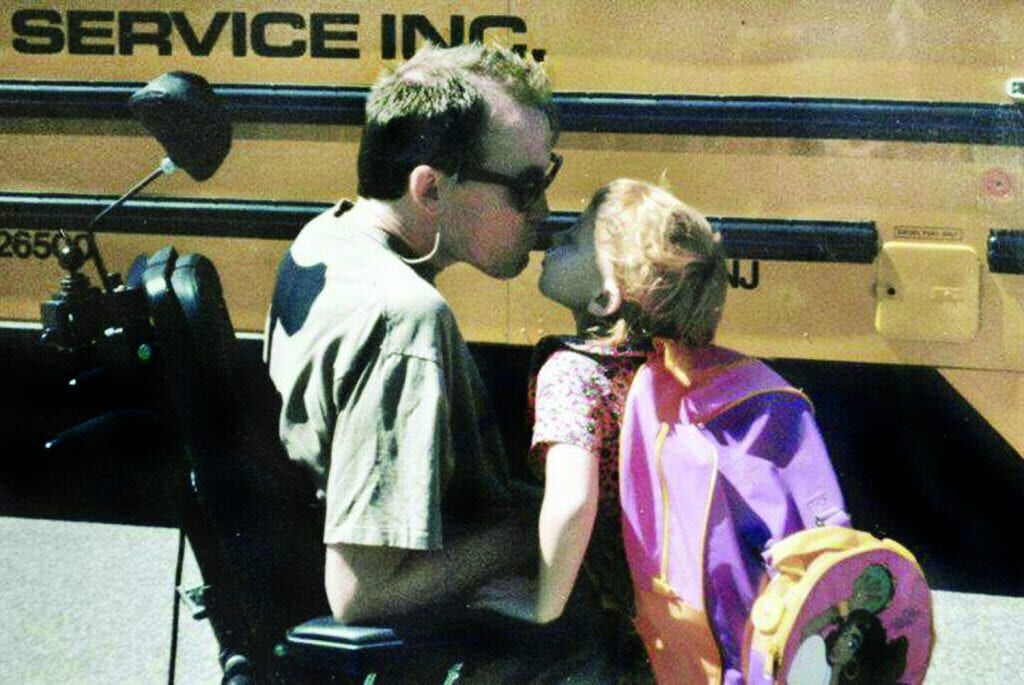
Kevin O’Donnell after diagnosis with ALS kissing his daughter Alina goodbye on her way to school.,