Think of a Hamilton without a hospital. Or the police station. The library. Veterans Park.
It’s hard to imagine the township in this way, without those familiar sights. But it may have been a reality had Maurice “Maury” Perilli not been a township fixture for the last half century.
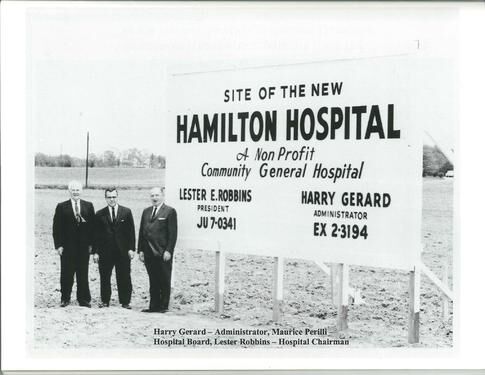
Perilli, who died on Nov. 25 at age 95, served on the township planning and zoning boards, the township committee, as mayor for four years and as the police commissioner for eight. He served on and acted as chairman of the Robert Wood Johnson University Hospital-Hamilton board starting in 1970, back when it was known as Hamilton Hospital.
Perilli had been a key part of Roma Bank since he joined the board of directors in 1970. He was the bank’s executive vice president from 1979 to 1991 and was appointed chairman of the board in 1991, a position he held until his retirement in 2011.
And that’s just scratching the surface of who Perilli was and what he meant to his long-time hometown.
“Maury is responsible for the township we have today,” said Tom Glover, a township historian and a close friend of Perilli’s.
Despite Perilli’s local fame, his effect on the community and the various high-level positions he held, Perilli never forgot who he was, Glover said. Just a kid from Chambersburg.
“We got along famously just because of the way he talked,” Glover said. “He had a lot of humility. Going to talk to him at Roma Bank, he was this great man in an affluent office, but it was just like talking to my brother. Here I am in the audience of a guy who everybody knows, respects, loves.”
As mayor, Perilli was responsible for the development of several Hamilton landmarks. Consider Veterans Park—the township’s central recreation space—which was almost entirely Perilli’s doing. In 1968, Perilli, mayor at the time, and his administration started acquiring land for the park, after residents rallied in favor of a park in the township.
He helped get Hamilton Hospital, now known as RWJ, built after he and other local leaders envisioned a medical facility in the township. They proposed moving Trenton General Hospital into suburban Hamilton, and in 1970, that vision became a reality.
“The RWJ Hamilton family is deeply saddened to learn of the passing of one of our founding fathers, Maurice Perilli,” outgoing RWJ president Skip Cimino said. “As a longtime board member, Maurice played a pivotal role in helping to build our hospital (formerly Hamilton Hospital) more than 40 years ago. Our thoughts are with his family as we remember and celebrate a great man for his countless contributions to Mercer County and his personal achievements.”
Later that decade, Perilli spearheaded another local staple. After a jump in drug abuse during the 1970s, Perilli used his position as mayor to take action: he formed the county’s first narcotics squad.
“Maury was passionate about the causes that he undertook,” said Roma Bank president and former state senator Peter Inverso, a Hamilton resident. “When you go through a litany of organizations that are here in Hamilton, Maury was one of the fathers.”
Perilli also laid the groundwork for the public library and police station, an area he referred to as Hamilton’s “center city.” In fact, Perilli’s close friend and former colleague Marge Norton said actually sitting down and determining the township’s physical center is what drove him to choose the location.
The police station was built in 1966 and the library in 1973. Prior to the move, the library was located in the municipal building’s basement. The new, bigger site was exciting for Hamiltonians, Norton said.
“It was a big thing,” she said. “He was kind of unique.”
Norton met Perilli while attending committee meetings in 1969. Norton had just moved from New York to Hamilton. When Perilli needed a part-time secretary at Roma Bank in 1978, she took the job.
Perilli joined the bank’s board in 1970, eventually helping Roma open a Mercerville branch. He continued to ascend the bank’s ranks, becoming vice president, executive vice president and eventually chairman of the board. He retired in 2011 at 92, after 41 years with the company.
“Maury always said and always gave credit to the people who worked for him,” Norton said. “He said he could have never done it on his own. He always said, ‘If you surround yourself with good people who work hard, who are loyal, everyone benefits.’ He was really kind of remarkable.”
He was dedicated, and he expected his employees to act similarly. They couldn’t help but oblige. Perilli was always at the bank, morning until night, as long as his workers were there. Norton said he mentored her and several other Roma employees, helping them learn how to become tellers, open accounts and more.
His work ethic was trumped only by his generosity. Norton said it was not uncommon for him to slip an employee $20 and say, “Here, take your wife out to dinner. Enjoy yourself.”
“He was an excellent business person,” Norton said. “Everyone who worked for him said the same thing: ‘What a great guy.’ He was a hard worker, and he expected you to work hard. He was generous, fair, smart, responsible. I can remember working at the desk opening accounts in Mercerville. People would walk in looking for him, and sometimes he wouldn’t be there. They would say, ‘Here’s a check for $10,000. Ask him what I should do with it, and open the account.’ People had so much faith in him because he was such an honest person.”
Honest is an understatement, Inverso said.
“There are so many causes and efforts that he was not only a part of, but led,” he said. “He made the town what it is today. He was a man who wanted to make sure that things were done aboveboard, transparently, and honestly. He always viewed public office as a service, not an opportunity.”
Acting otherwise never had crossed his mind. Inverso said Perilli carried with him an “Old World” mentality that was all about work, morality and respect.
What stuck with Inverso the most about Perilli, though, was all Perilli accomplished without a formal education. He was always “sorrowful” that he never had the opportunity to attend college—he dropped out of school after his sophomore year at Immaculate Conception High School to work during the Great Depression—so he made up for it by working at Mercer County Community College and going after other educational pursuits.
He was awarded honorary degrees from Thomas Edison State College in 2001 and Rider University in 2002, which Inverso said Perilli considered two of the happiest moments of his life.
“He had a fondness for education,” Inverso said. “Without a formal education, I think his depth of knowledge was greater than many people who have doctorates today. He had that quality of being able to deal with issues that were complex, and he worked hard at understanding them. By doing that, he made himself into an individual that had a strong knowledge base.”
Norton agreed. Perilli had a working knowledge of such a wide range of topics that Norton and anyone who knew him felt comfortable asking for help no matter the issue.
“When I sit back and think about him, he just knew a lot about everything,” she said. “If there was a funny noise in your car, he would tell you what he thought it was. He could sit down with you and talk about money, help you think clearly and not rush into anything. Very often, he took on other people’s issues and problems. It would become his own problem. He would tell people how he would do it if he were in their situation, and they knew he wouldn’t steer them wrong.”
Perilli was known as a “people person” who couldn’t go anywhere without being recognized by a friend, a neighbor, a former coworker. And he never forgot a single one of them.
“He was the most compassionate and warmhearted man I have ever met,” Glover said. “We would go out to lunch, and everybody knew him. Everybody knew Maury, and Maury knew everybody. He remembered every encounter he had with a person.”
Inverso expects that ardor for Perilli, whom he calls “an icon in the community,” to persist for a long time. After all, Hamilton residents can’t go far without encountering an area or building Perilli influenced.
“Nothing is permanent,” Inverso said. “Maury was with us for 95 years. He touched so many people over time in so many different ways that it’s hard to say how he did it. He always had an open door, a warm heart and a wallet ready to give. Men like him come few and far between. This community is better for having him be a part of its development.”
,