By Jeanette Beebe
Michael Lemonick has marked many seasons in Princeton. He was born and raised here. He’s watched the winter turn to spring year after year. And when he talks about the weather, it’s not small talk.
For three decades, Lemonick has been one of the nation’s eminent science writers, notably for Time Magazine, for which he wrote more than 50 cover stories. In November, he became the opinion editor at Scientific American. And in between, he spent seven years as the senior science writer at Climate Central, the Palmer Square-based nonprofit, nonpartisan research and media organization that employs climate scientists, researchers, fellows, and journalists.
Lemonick knows it’s been a warmer winter. But, he says, that doesn’t mean we should assume this year’s milder temperatures are due to climate change — especially since last year’s winter was quite cold.
“The fact that it’s warmer this year than last year? No. That has nothing to do with climate change,” he says. “The fact that, on average, it’s warmer in every state in the winter than it was in 1900, and that it’s been steadily rising? Yes, that has everything to do with climate change.”
What people sometimes struggle to understand is that what’s happening in one particular year is meaningless, Lemonick says. We should only consider climate change’s effects on winter weather over 50 or 100 years — not from one winter to the next.
Lemonick has a favorite story to illustrate this phenomenon. He remembers photographing his home’s thermometer when he was a child growing up in Princeton. “It was Jan. 24, 1967. I was in 8th grade here in Princeton. We were out on the playground without coats because it was 70 degrees,” he remembers.
Lemonick was born in Princeton when his father, Aaron, was a graduate student at the university. A year later, his father moved the family to Haverford College in Pennsylvania, only to return to Princeton four years later, when he accepted a position as a professor of physics at Princeton University.
At Princeton University, Aaron Lemonick was a professor of physics, dean of the Graduate School (1969 to 1973) and then dean of the faculty (1973 to 1989). His accomplishments reach far past the laboratory and well beyond the world of physics. Joseph Taylor, winner of the 1993 Nobel Prize in Physics, attributes his decision to study physics to Lemonick’s freshman physics course at Haverford.
When Aaron Lemonick retired in 1994, the University awarded him the President’s Award for Distinguished Teaching. He hardly slowed down after retiring — through the University’s “Teacher Prep” Quest program, he helped local elementary school teachers develop creative methods to teach science. Aaron Lemonick died in 2003; his wife, Eleanor, died in 1992.
Michael Lemonick and his younger brother, David, shared their father’s passion for science. As children, they both vowed to pursue careers in science. David excelled in the field, and he eventually became a medical doctor.
Michael, on the other hand, struggled through his science classes — especially biology. Despite his best efforts in high school and at Harvard, he worried that he would have to resign any hope of following in his father’s footsteps and entering the science world. Even so, it was astronomy that first captured Lemonick’s imagination as a child, and it evolved into his favorite science topic.
His father shared his sense of wonder and passion for understanding science with his children. “He would tell me about stars and galaxies and atoms and molecules, and he did it in a way that was appropriate for a 5-year-old,” Lemonick remembers. “A good teacher doesn’t talk over his students. He connects with them. And he did it with such enthusiasm that I thought, ‘This is the coolest thing! I really wanna learn about this stuff!’”
He even tried to major in astronomy at Harvard University — though it didn’t work out. “My interest was at the level of story-telling and narratives, not equations,” he says. “When I tried to major in it, there was no storytelling involved. It was hard science. Math. Not interesting at all to me,” he says.
Eventually, Lemonick backed away from his dream of becoming a scientist like his father.
“My father was well aware that I tried to major in science and that I was a horrible failure,” Lemonick says with a wry grin. “He had no illusions about whether I would be a scientist.”
After earning an undergraduate degree at Harvard (’76), Lemonick worked hard to figure out his next steps. He moved to New York for a stint at an advertising agency (because, he insists, he “actually couldn’t think of anything better to do”), and then he moved back home to Princeton for a few years.
Fortunately, he was able to discover a career that would let him combine his passion for science — especially astronomy — with his skills as a writer who explains science, and who makes difficult topics clearer.
“I realized that I could stay involved with my favorite topic without doing a single equation if I became a science journalist,” he says. His career path finally chosen, Lemonick completed a master’s degree in journalism at Columbia University in 1983.
Like his father, Lemonick is passionate about exploring and understanding scientific concepts, and sharing knowledge with peers, pupils and the public. He is passionate about many of the same topics that intrigued his father. The subjects that his father researched are often the themes that Lemonick chooses to write about.
“Astronomy and physics are my greatest interests in science. I love writing about them. I might do nothing else if I had that chance. That’s what I wanted to do. That’s why I got into science journalism — because I wanted to write about those topics,” he says.
Asked if he ever considered branching off from his accomplished father and studying something different, he instantly answers. “No, I was so interested in that — why would I?”
Lemonick has remained true to this scientific ethos. Throughout his career, he’s made a point of side-stepping emotional arguments in order to remain committed to the scientific method. This approach sometimes proved challenging — never less than during his time at Climate Central.
“My interest in climate change has much more to do with the scientific basis for understanding it. I am not an environmentalist. I am somebody who is interested in the intellectual question of how the Earth’s climate system works, and what the likely consequences are of what we’re doing with it, and why,” he says.
Climate Central is not an advocacy organization, “but most of the people who work there are passionate about shouting the dangers of climate change and getting people to listen,” he says. “And I am not like that.”
Today, Lemonick lives in town with his wife, Eileen Hohmuch-Lemonick, originally from Queens, who has taught photography at Princeton Day School for several years. The couple celebrated their 31st wedding anniversary last summer. They have two sons (Danny and Ben), and a daughter, Hannah, who has begun a Ph.D. in Near Eastern studies at Princeton after living in Chicago for nearly a decade.
His first post as a professional journalist was as a senior editor at Science Digest magazine. Three years later, in 1986, he joined Time magazine as a science writer, and worked there until 2008. He left Time briefly in 1988 to try his hand as the executive editor of Discover magazine, only to knock once again on Time’s door after realizing he “simply missed writing too much.”
At Time, he covered a wide variety of science and technology topics, including astrophysics, medicine, physical science, oceanography, the environment and neuroscience. He published more than 50 cover stories at Time magazine, including articles about the Exxon Valdez oil spill, climate change, and the impact of tourism on the ecosystem and environment of Antarctica before leaving for Climate Central in 2008.
In November, Lemonick took a new job: now, he’s the opinion editor at Scientific American. In this role, he’s no longer a full-time writer; he edits the blogs and opinion pieces written by staff and guest writers. He commutes to New York four days per week and works in a 46th floor office of 40 people, with roughly 15 other editors.
“Once again, it’s every topic under the sun,” he says. “It’s a whole new thing for me. I’m gathering opinions from other people, deciding what sounds interesting, and also what might be interesting for our readers,” he says.
Lemonick has also written six books. “Most journalists find that if you really get into a topic, you can never get into enough detail in a magazine article — even a long one,” he says. “You have to leave a lot of stuff out. And that’s a bit unsatisfying.”
His most recent book, Mirror Earth: The Search for Our Planet’s Twin (2013) reports on the work of scientists who are on the hunt to find the stuff of science fiction: Earth-type planets orbiting other stars that may be capable of sustaining life.
Mirror Earth isn’t only a well-researched, scientifically rigorous book about big, cosmic questions. It’s also a narrative full of stories about the lives of these scientists who call themselves ‘exoplaneteers’ — their triumphs, frustrations, and failures, and their journey towards finding ‘exoplanets’, those small, elusive worlds just beyond our Solar System that, in cosmic terms, are our neighbors. Lemonick’s book illustrates just how shy our cosmic ‘neighbors’ can be, and details the techniques these scientists must use to catch a glimpse.
Lemonick also follows the work of ‘exoplaneteers’ who hunt for Earth-type planets orbiting other stars in Other Worlds: The Search for Life in the Universe (1998). He has written two books on cosmology: Echo of the Big Bang (2003), and The Light at the End of the Universe: Dispatches from the Front Lines of Cosmology (1993). He also wrote a scientific biography on the astronomer who discovered Uranus (The Georgian Star: How William and Caroline Herschel Revolutionized Our Understanding of the Cosmos, 2009), and Global Weirdness, which he co-wrote with Heidi Cullen on behalf of Climate Central.
“It you’re a runner, you have to run a marathon — or it feels like you’re not really a runner,” Lemonick explains. “So it feels like you’re not really a writer unless you’ve written a book. So that’s where it comes from. It’s both the ego, and the desire to really tell the full story.”
Lemonick continues to work as a freelance journalist for general interest publications (The New Yorker, Slate) and science-oriented magazines (Discover, Audubon, National Geographic). He’s taught science journalism courses at Columbia, Johns Hopkins, New York University — and, yes, Princeton.
At Princeton, Lemonick regularly teaches two courses: ENV 316: “Climate Science and Communications,” a journalism workshop and FRS 188: “Life on Mars — Or Maybe Not,” an intensive seminar open only to first-year undergraduates. In fall 2014, he taught another course: ENV 349: “Writing About Science,” a workshop for non-science majors.
Lemonick admits that it can be difficult to make certain science topics interesting to readers. To engage readers, journalists can and should try to tell stories about science instead of just rattling off facts. It’s important to keep science human, Lemonick says, and adding personal details about the scientists themselves is a great way to pull readers in.
Science isn’t just about numbers or data, Lemonick says, but also about how things work, about what happened, about what people do and feel. It’s important to remember that it’s the responsibility of journalists to inform and ideally entertain readers without leaving out or downplaying “inconvenient” facts or implying that the news is more significant or promising than it is known to be.
Lemonick warns students that it’s dangerous when journalists publish stories on study results too quickly. The news that emerges from research labs and surveys takes time to become clear. The scientific method requires scientists to conduct experiments again and again to confirm results over time; often, the lab team’s original conclusion is proven to be wrong, or in need of further investigation.
Lemonick says that his environmental courses share one fundamental goal: he wants his students to learn how to produce media that communicates climate science. “Climate is the most important global threat that we face today,” says Lemonick.
And Lemonick emphasizes that the global climate change situation is getting worse. “It’s a more serious problem than it was ten or twenty years ago,” he says. “The general understanding of climate science and the implications and policies has not grown very much, even though the problem has.”
For Lemonick, this means that there’s more of a need now for his coursework than ever before. “It’s the same reason that Climate Central is a good idea,” he says with a smile.
Climate Central has offices in New York and in Princeton. Lemonick took on the role of the nonprofit’s senior science writer six months after it was founded, in 2008.
The agency currently has several programs, including climate science, energy, sea level rise and meteorology. In addition, its High Meadows fellowship recruits recent graduates for an intensive yearlong fellowship that includes mentorship and training in multimedia storytelling.
“We were founded to be a bridge between the scientific community and the public,” Lemonick says. Climate Central’s work — multimedia slideshows, video presentations, digital articles, newsletters, maps, graphics, and interactives — is journalism, Lemonick explains. He says its mission is to “communicate climate science to the public.”
Lemonick understands why some people assume Climate Central is an advocacy group (akin to Greenpeace, The Union of Concerned Scientists, or 350.org). But, Lemonick insists, those assumptions miss the mark.
“Yes, we’re advocates for the idea that people should understand what’s going on with climate,” he says. “Someone who reports on human trafficking wants people to understand what’s going on with human trafficking. It’s not a crazy motivation.”
Climate Central’s coverage of climate, he says, has the same goals as any other news organization, working under the same principles as The New York Times, and aims to be free of agenda, slant, and bias. “We want to inform people as honestly as possible about what the story is with climate. And if the story is complicated and subtle, then that’s what we do best. That’s the whole idea,” he says.
What sets Climate Central apart, Lemonick says, is its commitment as a news outlet to publishing stories that are unexpected and surprising, given other organizations’ coverage of environmental issues.
“There are certain websites that will not publish anything that implies that it’s not as bad as we thought,” he says. Such websites are advocates, he says, with a mission of convincing people that things are “really, really bad” — and that something must be done about it.
“If a study comes out that says — and this is hypothetical — that Greenland is not going to melt as fast as we thought, those websites are not going to run that story,” Lemonick says. “Climate Central would run that story. Absolutely.”
Another thing that separates Climate Central’s news coverage from other outlets — especially the mainstream media — is how it’s funded. Unlike commercial news organizations, Climate Central doesn’t sell subscriptions and advertising.
“Newspapers and magazines that are owned by corporations feel the need to get money out of this enterprise,” he says. “And we don’t. Climate Central doesn’t.”
Of course Climate Central isn’t immune to the pressures of monitoring digital engagement (and attracting eyeballs, so to speak). But that reality isn’t easy to talk about, even for Lemonick after he has moved on from the organization.
After a long sigh, Lemonick says, “Look. You have to write stories that people will read. You have to prove that people are actually paying even the slightest bit of attention to your stuff.”
Is there any true freedom for news organizations from the coverage bias that may arise due to the pressures of outside financial support? Lemonick suggests that the only way forward for independent news organizations is to seek endowment funding. ProPublica, the investigative journalism organization, currently uses this model.
Still, what happens to news organizations when the endowment runs dry? Lemonick says that even for news organizations that work through funding models that allow for complete editorial freedom, the future is unclear.
“Whether those models are sustainable, I don’t know,” he says.
Lemonick is working on another book, but for a change it isn’t about astronomy or climate; it’s about neuroscience. Lemonick is writing about Lonni Sue Johnson, a Princeton local and an accomplished commercial illustrator who developed encephalitis, a brain disease, eight years ago.
“It destroyed part of the brain we use to create new memories. She is incapable of learning anything new,” explains Lemonick. “She lives in this perpetual present.”
Lemonick’s book will also tell the story of how the scientific community has studied Johnson’s experiences. “I’m writing about her story, and about the scientists who are studying her, to try to understand how memory works in the human brain,” he says.
The book will be published by Doubleday, and it will be released as early as next winter.
Lemonick stumbled onto the topic by chance while walking in Princeton roughly two years ago.
“A woman approached me on the street, and I recognized her right away,” Lemonick remembers. “We’d gone to middle school school together. We were in the marching band. She asked me, ‘Have you heard about what happened to my sister?’”
“It really interested me because memory is so essential to my sense of who I am — especially living in the town where I grew up. I’ve got memories laid upon memories.”
Lemonick says while he worked at Climate Central, he’d be walking around Princeton and see someone he went to elementary school with, someone he worked with in the 1970s, and children of friends of his — all on the same day. “Those kinds of interconnections that are really satisfying to me,” he says.
Through all of his experiences as a writer, he has returned again and again to those days when he thought he would be a scientist. While his destiny lay in another field, the foundation he established as a young man is what you could say he has built his entire career upon. His studies of physics, his love of astronomy — it has all helped him as he’s had to become an expert on a wide variety of science topics.
“Understanding how the universe works has so many levels,” he says. “From the universe as a whole, to what makes the sun shine, to where did Pluto come from, and what’s happening in a black hole, and what causes earthquakes, and what’s Mars like — and all of these questions about how the universe is put together, and how it operates, and how it all unfolds.”
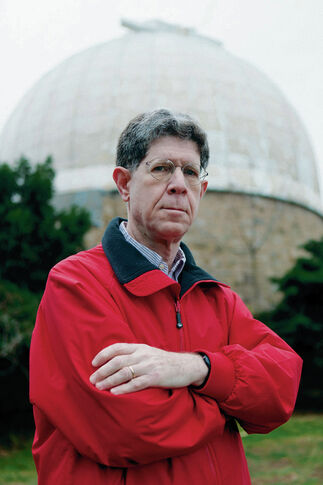
Michael Lemonick outside the Fitzrandolph Observatory on the Princeton University campus. The observatory has been closed for years. “New Jersey is a terrible place to do astronomy,” Lemonick says—because of light pollution.,

