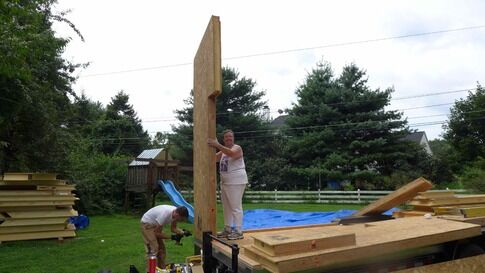
Hamilton resident Holly Hagy (right) holds one of the walls to her new, portable house. She said she looks forward to the freedom the home will bring her.
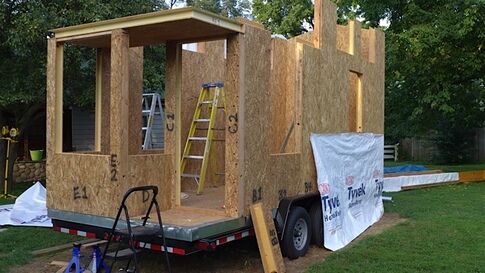
As of Aug. 2, the four walls of Hamilton resident Holly Hagy’s 150-square-foot home had been framed out.
Hamilton resident builds her own tiny house
For some, small houses are big.
Small as in, less than 200 square feet small. Small as in, smaller than any building code would permit small. Small as in, makes a motor home look like a mansion.
A growing number of people around the country are turning to dorm-room-sized accommodations for shelter, setting them up on friends’ properties or classifying them as trailers to avoid building code restrictions. Websites like tinyhousesforsale.com are filled with listings for residences that are no bigger than a garden shed in an average suburban setting, and architects are designing urban apartment buildings with units that are smaller than anything built since the days of the tenements.
But why on earth would a financially stable person decide to live in a house that is smaller than some walk-in closets? Ask Hamilton resident Holly Hagy.
When Holly’s husband, C. Richards Hagy, died in August 2012, Holly found herself living in a home that was suited for a life that was no longer hers. The ranch house in Hamilton Square was full of artifacts from the couple’s happy past.
“My husband has a beautiful conservatory grand piano, and it’s not something that most people walking through the door say ‘Oh, I have to have that in my house,” because it literally takes up most of our living room,” she said.
Holly and Dick had been married since 1984 and had worked together almost as long at Richards Hagy Marketing. The couple had met one day when Dick was riding his motorcycle and beeped his horn at a pretty girl he saw. He pulled into a parking lot and struck up a conversation with Holly. Later, after they were married, they worked side-by-side at the company Dick owned, working on marketing and advertising projects together.
But for Holly, that life ended when Dick died. She began to think about the next chapter. And when she thought about all the things that pleased her—travel, learning and visiting their small getaway cottage in Maine—she realized none of those things were compatible with having a big house.
So, she decided to downsize, and downsize dramatically. First, Hagy came across the Katrina houses—small shelters built for hurricane refugees.The efficiency of those units appealed to her. That discovery led her to find out about what is called the “tiny house” movement.
Hagy, 56, came across the website of Tumbleweed Tiny House company, a California-based outfit that builds and creates plans for those who wish to live in compact spaces. Holly took a workshop on building a tiny house, and got plans from another woman who had built her own.
“I always had a love for little houses,” she said. “I just think they’re adorable and I love the cuteness of little houses and sheds and those kinds of things.”
Now, she is building her 7.5 by 20-foot dream home.
Hagy, who grew up in Connecticut where her father was a policeman and her mother was a bookkeeper, said her dad built the house she grew up in.
“He taught my brothers how to build things, and didn’t teach me because I was a girl,” she said. “So, I’ve decided to build my own house so that I can learn to build, too.”
The home is built on a double-axle trailer and is one story high with cathedral ceilings and a loft for sleeping. The whole thing is just short enough to pass under bridges and overpasses. It has a bathroom with a composting toilet, hot water on demand, a two-burner stove, a steel sink and a small fridge. The interior is made of bamboo, and the walls are made of heat-efficient insulated structural panels. The house is powered by solar energy, with a generator back up. Water is collected off the roof for showers and washing dishes.
She anticipates the final cost of the project will be $25,000. That is more expensive per square foot than larger homes, but the tiny houses are built sturdily, with high quality materials, and they are built to last.
The best part, for Hagy, has been getting rid of all of her stuff.
All she can take with her in the trailer are clothes, a few personal items, sewing supplies, a small reading chair, two diner chairs, and some books.
With only a small space available to store plates and silverware, Hagy was left with an interesting decision.
“You know how everybody always keeps those fancy glasses and silverware and dishes for when the company comes? Well, I’ve decided the company has come, and I’m discarding all my everyday stuff and taking a few pieces of the good china with me,” she said.
To save space, Hagy has digitized everything possible and put it on her computer.
Although getting rid of unneeded possessions was not the catalyst for her decision to move to a tiny house, Hagy said she has realized how much unnecessary baggage she has accumulated over the years.
“What in the world was I thinking when I was buying all this stuff?” she said. “I have Christmas ornaments, but I haven’t put up a Christmas tree in five years. Yet, I still buy Christmas ornaments. That’s insane … once I started separating stuff that I needed, I was just appalled somewhat at my collections.”
Hagy plans to move the home from place to place once it is completed. Unmoored from a mortgage and property tax bills, Hagy hopes to enjoy a more freewheeling lifestyle.
“My idea is to be able to move anywhere in the country and still have my home with me, because I like feeling at home,” she said.
Hagy hopes to find a farm to live and work on initially. She wants her first destination to be Philadelphia, where she plans to attend nursing school.
* * *
The tiny house trend has caught the attention of architects. Paul Lewis, a New York-based architect, is an assistant professor and director of graduate studies at the Princeton University School of Architecture. Lewis is also a principal of LTL Architects.
Lewis says there are a number of factors driving the trend towards smaller houses. And while people like Hagy and DuPont set their mobile houses up with an eye toward rural areas, small houses make the most sense in urban settings, where space is at a premium.
“There is a lot of interest on the part of cities,” he said.
Last spring, New York City held a competition where they allowed architects to design a building with apartments smaller than currently allowed by code. The winner, nArchitects, designed a building composed of 55 prefabricated capsule apartments. Each 250 to 370 square-foot residence has a compact kitchen with cooker, fridge, pull-out pantry and space for a microwave and a living and sleeping space and a bathroom. The building also includes a laundry room, a gym, bike storage, a lounge, multi-purpose areas and an eighth-floor rooftop terrace.
Lewis said planners are looking at this kind of building as a potential way to solve a shortage of small square-footage housing that exists in places like Manhattan.
“They realize the quantity of apartments relative to the demand is not there,” he said. Well-intentioned building codes designed to prevent the construction of slums have resulted in a situation where multiple people crowd into a small apartment, he said. One obvious solution is to allow smaller apartments.
Lewis doesn’t believe the entire housing market will move in this direction, but he said there is a growing backlash against the overstuffed McMansions that dominate the suburbs.
“A typical postwar home was maybe 1,000 square feet,” he said. “Now it’s something like 2,800 square feet. It’s doubled in size. And with that comes the assumption that you have to fill it with stuff. There is less and less yard and more and more building to the point where in some places, McMansions exist where there is no front yard or back yard.”
This kind of development represents an outdated consumer culture that young people are moving away from, Lewis said. The trend is being driven by internet-enabled devices that allow people to spend more of their time entertaining themselves in virtual worlds. Since flat screens, phones and tablets take up so little space, this enables people to have less stuff but still not live an austere lifestyle.
Lewis said architects designing living spaces for this lifestyle have to design spaces very carefully.
“You have to think about multivalent functions,” he said. “Everything has to do more than one thing. Like, a kitchen counter also being a table. The old model was single use. You had a dining room you only use once at Thanksgiving and the rest of the time you eat in the breakfast room.”
The spaces are also designed to take advantage of ceiling height for storage. There are no blank walls in an efficient microunit.
“Everything is used to maximum efficiency,” he said.
The arguments for microhousing have been around for a long time—a hundred years or more, with architects designing hyper-efficient spaces for at least that long—but the advent of computer networks is making that choice more appealing to a larger set of the population.
“People don’t need all this physical stuff because they spend a lot of the time in virtual worlds,” he said.
Lewis said “microhousing” has also always existed on the lower rungs of the economic ladder, with trailer parks having been around for 80 years or so. What’s new is then officially sanctioned urban version of microhousing aimed at middle class consumers.
The microapartment lifestyle is vastly different than the vision of housing that prevails in the suburbs. A suburban home is meant to serve every need of the resident, from sleeping to eating to entertaining guests. A microapartment makes concessions to the reality of urban life.
“Almost all your life takes place in the context of the city,” Lewis said. “The apartment is not where you spend 60 to 80 percent of your time. It’s extending the logic of the hotel.”
Tumbleweed Tiny Houses is holding a workshop for those interested in building tiny homes Sept. 14 and 15 in Toms River. The workshop takes place from 9 a.m. to 5 p.m. both days. For more information or to register, go online to tumbleweedhouses.com/products/nj. The cost is $399.
,