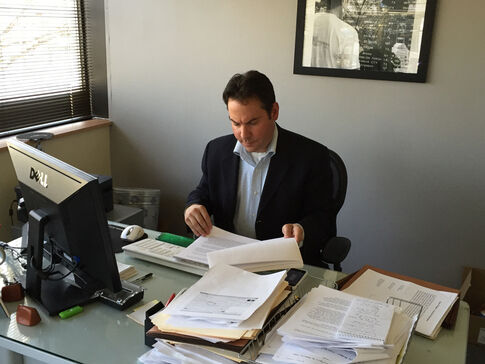
Centurion Ministries staff investigator Alan Maimon.
In Alan Maimon’s line of work, you don’t call ahead or send an email asking someone if it would be OK to stop by later for a chat. The best thing to do, he has learned, is to show up at the door unannounced and say: “Can we talk?”
Maimon is not after money. He’s after the truth. He is an investigator for Centurion Ministries, and his job is to dredge up the past, to reopen old wounds. His job is to right wrongs.
Centurion Ministries frees wrongfully convicted people from prison. Every time they take on a case, they must start over, reinvestigate it from the ground up. They work until they find something so compelling that the government has no choice but to overturn the conviction. Until then, all they really have to go on is an inmate’s word: that he didn’t do it, that he doesn’t belong behind bars.
The work is painstaking. Months of research might yield little new information. Many of the cases are decades old. Often, the evidence used to convict was so flimsy that it’s of little use for the purpose of exoneration. A lot of the people they need to talk to have gone off the grid. Many are dead.
Maimon has been with Centurion since 2012. One of the first cases he took on was Larry Walker’s. Walker had been convicted in 1983 of a murder that took place in Philadelphia, despite having had no criminal record before he was charged with the crime.
A year in, Maimon’s investigation had gone cold. He’d pored over hundreds of police documents, interviewed dozens of people, and it had all led nowhere. Then he found a new lead: a half-page statement a woman had given to police. The statement added no new information to the case, but the woman had known the victim, and she had been interviewed by police. So as a matter of course, Maimon set out to find her and find out if she knew anything besides what she had told authorities.
He tracked her down in Virginia Beach. Just showed up on her doorstep one day. She agreed to speak with him. All he had to say to get her going was the name of the victim, Clyde Coleman, and that Walker was in prison for the murder.
Her eyes got really wide, Maimon recalls, and she said, “‘They arrested Larry? And he’s been in jail for 30 years? You really need to find out about — ’” and she named someone. Someone Maimon had never heard of. Someone who was more likely, she thought, to have been the killer Clyde Coleman.
Maimon had never heard of the person she named, hadn’t seen it documented anywhere. But he trusted his new source. She had left Philadelphia less than a year after the murder to join the Marines. During her 30-year stint, she was promoted almost as high as an enlisted person can go. She had earned a master’s degree in nursing. “She just oozed credibility,” Maimon said.
So he looked into the new name, the one she had provided, and was shocked at what he found. A rap sheet a mile long. A crime in his past eerily similar to the one Maimon was investigating. The new suspect had been convicted of or arrested for numerous crimes just in 1983. And Maimon is now convinced that he was guilty of the one that had sent Larry Walker to prison.
“Here was a case that was starting to feel a little stagnating,” said Maimon, who lives in Hopewell Borough with his wife and two children. “And it was like, ‘Wow, we have new life on this one.’”
* * *
Maimon had been an investigative journalist prior to joining Centurion Ministries, an organization with the sole mission of helping wrongfully convicted people get release from prison. There are now more than 60 agencies across the continent doing the same kind of work, but Centurion is usually considered the first.
Founder James McCloskey was a student at Princeton Theological Seminary in 1980 when he began the work that would grow into Centurion Ministries. As a chaplain at Trenton State Prison, he met an inmate, Jorge De Los Santos, whose claims of innocence he believed. He took a year’s sabbatical from his studies to investigate De Los Santos’ case.
He was able to find enough evidence to get De Los Santos freed in 1983. That same year, he founded the agency as a nonprofit corporation.
In the last 35 years, Centurion has taken on some 87 cases, including that of De Los Santos, and 53 people have been freed as a result of their efforts. A number of cases are ongoing at any given time, each with a primary investigator. Maimon has three right now.
Inmates contact Centurion to ask for help. The agency gets around 1,500 letters a year from across the country, of which it can handle only a few.
The staff are civilians who spend weeks, months and years of their lives proving or disproving police reports and tracking down lost souls. Volunteer caseworkers, mostly retirees, do preliminary research to determine if cases have merit. Once the agency decides to take a case on, they will use every tool at their disposal to try to prove that a conviction should be overturned and a prisoner freed.
Maimon compared the job the caseworkers do to what was covered in the popular 2014 podcast “Serial,” in which reporter Sarah Koenig investigated a single case for the length of the show. Maimon said he hasn’t heard the podcast, but some on the staff have, and what they described seemed to him less like the investigation he does and more like the work that goes on before a case even reaches him.
Television shows and movies have us conditioned to believe that high-tech gadgets or DNA evidence can solve any crime. And Centurion uses those tools when they can. But they also specialize in non-DNA cases, on the basis that many people have been wrongly convicted on almost no evidence at all, because of weak eyewitness testimony or incompetent defense attorneys, among other things.
They also look at an inmate’s background and character, the evidence presented at trial, the quality of advocacy the convicted had in court. They ask inmates to give them everything they have on their cases. Some have boxes of files to turn over, accumulated over years of trying to prove their innocence on their own. All in advance of Centurion launching its own investigation from scratch.
At the end of Serial, Sarah Koenig was unable to draw any conclusions from her research, a result that would be almost devastating for Centurion Ministries, which spends as much as half a million dollars on a case. The agency is funded primarily through donations.
“We don’t want to be risk being wrong,” Maimon said. “And you know, we have been wrong a few times. But if during the course of an investigation we find out we’re wrong, we drop them like a hot potato.”
* * *
Alan Maimon grew up in Springfield Township, Montgomery County, Pennsylvania. He attended Brown University, where he majored in German and comparative literature. He spent part of his junior abroad in Berlin in 1994, and enjoyed the experience enough to return to Europe after graduating from Brown in 1995.
He spent a year in Vienna on a Fulbright scholarship, then a year in Magdeburg, a former East German city, on a fellowship from the Robert Bosch foundation. In 1997 he returned to Berlin, where he lived until 2000. For two years, he was assistant to Roger Cohen, the Berlin bureau chief for the New York Times.
He returned to the U.S. in 2000 as a reporter for the Louisville Courier-Journal Eastern Kentucky bureau. Based in Hazard, Kentucky, he covered 40 counties, mostly rural, sometimes almost lawless. In 2003, he did a series of detailed investigative stories on the failings of the court systems of Eastern Kentucky.
“I became acutely aware of the systemic problems in courts—how naïve I was up until that point,” he said. “I realized at that point that I’d like to do more longform reporting.”
The Gannett Company shuttered the Eastern Kentucky bureau of the Louisville Courier-Journal in 2005. Maimon had seen the handwriting on the wall and had already been looking for a job. In January 2006, he moved with his family to Las Vegas, where he became a special projects reporter for the Las Vegas Review Journal.
Several times in the course of that job, he reported on suspected wrongful conviction cases. One of his stories even helped lead to a new trial for the person he wrote about.
“I was able to look at a bunch of individual cases that shocked and bothered me because I saw how shoddy the investigations had been,” he said. “I saw how shoddy the defense lawyering had been in those cases. I realized, ‘I’m just skimming the surface here.’ Those were the stories I enjoyed doing most and that I felt most passionate about.”
In 2012, he saw that Centurion Ministries had posted an investigator job online. It seemed almost too good to be true.
“The work I would be doing sounded exactly like the work I had been doing,” Maimon said. “The only difference would be I’m not writing a newspaper story about it, I’m going directly to lawyers.”
For each case he starts by documenting the names of everybody who had a key role in the case who’s still alive. They become part of the initial investigative blueprint. Things snowball from there.
“You’d be surprised how quickly that list just grows and grows as you talk to more people and as you get more documents,” Maimon said.
Each strand of information is then followed until it can be followed no more. The work can be frustrating.
“It’s a cliché, but we leave no stone unturned. We have to go down every possible road, even if we’re pretty sure that that road is going to dead end,” he said. “So I can spend weeks going down a road that I’m pretty sure is going to dead end, but who knows? Because maybe, just maybe, I’m going to find that piece of evidence or that witness that’s going to be a game changer.”
He estimates that he’s on the road a third of the time, traveling all over the country on the hunt for crucial bits of information that could make a difference. On the Philadelphia case, he was off to Virginia Beach. For a case he’s working on based in New Orleans, he’s been to California and Illinois as well as the Big Easy.
Maimon hasn’t yet worked on a case that has led to exoneration. That’s how long the process takes, that someone who’s been on the job for three years can still be waiting for his first clearance.
But since he joined Centurion Ministries, the agency’s work has resulted in releases in several cases. Just last month, a 69-year-old man man named Richard Lapointe was freed in Connecticut after a court found that he had been denied a fair trial. Centurion’s director Kate Germond, who’s started with Centurion in 1987, was the investigator on the Lapointe case.
Without Centurion, Lapointe would probably have died in prison.
“I’ve been able to experience it that way,” Maimon said. “I’ve gotten to know the individuals we’ve helped free. I feel the thrill of that probably as much as I will feel the thrill when we are able to free some of the guys I’m working on.”
,

