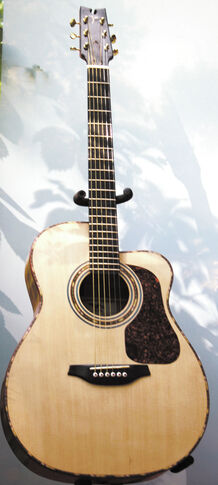
Ewing Luthier Tom Sommerville’s newest guitar, the T-Bone Special.
Ewing resident Tom Sommerville custom builds guitars.
By Madeline Maccar
With experience that includes (but is nowhere near limited to) carpentry, woodworking, drumming, and artistic pursuits of all kinds, Tom Sommerville has very literally tried his hand at all kinds of skills that require any combination of a discerning eye and a keen ear.
More than 10 years ago, the native North Carolinian reconciled his love of art and music into one job title: luthier, someone who makes and repairs stringed instruments. In Sommerville’s case, repairs account for the majority of work he does, but he said he “lives for the building commissions.” Using his Ewing home as the base of operations, Sommerville creates an average of 10 custom-built guitars a year and repairs countless more.
Sommerville has always loved guitars but said that his large hands and “fingers like carrots” made it difficult to play the stringed instrument. He turned to the drums in high school until that musical pursuit, too, took its last bow when a band saw put a career in percussion, as he says, “out of reach.”
It wasn’t until the birth of his now-high-school-age son, an occasion a friend marked with the gift of a guitar, that Sommerville was reunited in earnest with an instrument he’d always loved from afar.
“I thought that I’d tune it up and at least know how to show [my son] the thing,” Sommerville said. “I was seduced by it. It’s like having an orchestra in my lap.”
Growing up “banging nails” with his father and farmer uncle, Sommerville developed an early and keen interest in woodworking; he considers himself “a woodworker before anything else” to this day.
And given the manual perils of his chosen path, it’s perhaps for the best that an unfortunate long-ago run-in with a saw helped Sommerville choose to make music in a decidedly different way.
“I got into building because I’m a frustrated musician,” he said. “I don’t have the hands for music. To any musicians who ever expressed a desire to make their own instrument, I would say: don’t. Get us and we’ll do that; you concentrate on playing. You can have an accident with this, but the other thing is that your hands just get beat up from the work, from the splinters and everything. It’s not the sort of thing you want to see a good set of hands involved in.”
The work, indeed, can be hard on the body and is painstakingly methodical, with the actual build taking about a month and the finishing process lasting another. It’s also filled with risks, like exposure to chemicals that tend to reward frequent usage with skin allergies, and it’s also dependent upon an array of saws—band saws, coping saws, table saws—that are primed to nibble at even the steadiest hands. But aside from a few days of training with another luthier in New Hampshire to learn some tricks, Sommerville’s mastery of the trade was largely self-taught and initially acquired through a method that has worked well in other disciplines he’s aggressively and passionately pursued: old-fashioned books and blueprints.
“When I decided to make my own guitar, I got some wood and bought a set of plans for a nylon-string guitar,” Sommerville said. “I followed the ‘recipe’ and it came out nicely. That was the first guitar I built: I still have it and I love the way it sounds. After that, I said, ‘Maybe I’ll build just one more. And then one more.’”
The laborious and intimate nature of handcrafting a custom guitar results in an instrument that is quite unlike its factory-made counterpart, both in appearance and, more importantly, sound.
“When you buy a guitar from the maker, you’ve obliged that maker to make sure the thing satisfies you—so you buy more than the instrument, you buy the guy’s guilt,” said Sommerville with a laugh. “With factory guitars, they’ll get some wood and they’ll get these huge band saws, and they re-saw the wood, then they throw that wood through a big sander that takes it down to the proper width—usually about .1 inches, a little less than an eighth, and same with the top wood. They grade the top wood—they don’t do very much grading of it, they just run it right through and process it and thickness it, and quite a lot of that work is done with computer-numeric control now.”
Another key difference between a custom-made guitar and a store-bought one is found in the finish, which has a huge effect on the overall quality and richness of an instrument’s sound.
“That’s another thing about a factory-finished guitar: They usually finish those with polyester, like what you’d find on cars or at a bar when they have things embedded in this thick layer of varnish—it’s probably the most dampening finish,” he said. “I use traditional French polish [on the top], I use water-based varnishes, and more and more, I’m using an acrylic finish as a coat [for backs and sides]. The French polish—the shellac—I put on the neck and the back where there’s a relatively small amount of influence on the sound of the guitar.”
Sommerville is equally as deliberate in the wood he chooses for the body, weighing each for resonance, temperament, the way is ages, toughness, and even whether or not it comes from an endangered tree: “Wood is not a trivial thing to us,” Sommerville said, referring to himself and his fellow luthiers. “I don’t think you’ll find a group of people with a greater respect for nature.”
In the time since his first go at a nylon-stringed guitar, Somerville has now been married to his wife Laura for 30 years, raised two children—a daughter currently in college and a son preparing for college—and seen instruments pass through his workshop doors that include 19th-century reproductions, collector’s items from the ‘60s and ‘70s, a fiddle or two, items belonging to “guys who aren’t famous—yet,” and those that came to him as materials and leave as lovingly finished guitars.
He even has signature logos that adorn his hand-crafted offerings: a T-Bone steak (derived from a friendly nickname) and, for the more classical pieces, his last name with a stylized “S.”
While there are certainly enough serious musicians and aficionados around to keep Sommerville in business, the future of his craft is dependent upon each generation bearing a new crop of enthusiastic instrumentalists—which begins, he said, with finding each budding virtuoso an instrument befitting his or her passion to play.
“The only thing I would say to parents considering letting their kids study music is that if they’re serious about it, they should get a good instrument,” he said. “Even if you have to lease the instrument or buy a used one, get a good-quality—it doesn’t have to be professional quality—and well-voiced instrument. It has got to be something that pays the kid back for his effort.”

,