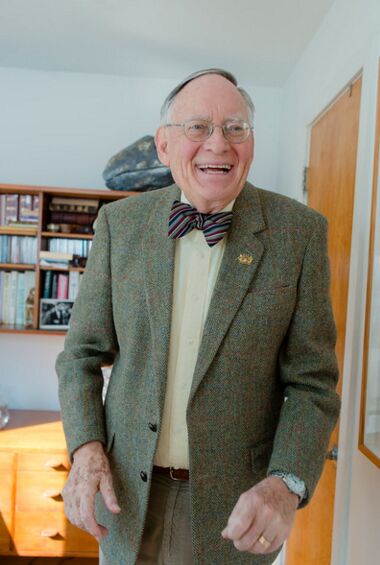
Writer, cultural leader and researcher Scott McVay’s face turned serious during a recent afternoon interview in the living room of his Province Line Road home. He leans his 6 foot-2 inch figure forward and asks that Hella, his wife of 58 years, be mentioned as a key contributor to his work. “She is involved with everything,” he said.
That includes solving a language mystery and the creation of his most recent book, “Surprise Encounters with Artists and Scientists, Whales and Other Living Things,” a 590 page work published in 2015 by Wild River Press in Stockton.
McVay, 82, will talk about the book during a number of upcoming appearances in the area, including a presentation and walk on the Scott and Hella McVay Poetry Trail at Greenway Meadows Park in Princeton.
As part of his story, McVay will talk about the scientists he has encountered during his years as a Princeton University administrator, Communication Research Institute employee, executive director of the Robert Sterling and Geraldine R. Dodge foundations and the president of the Chautauqua Institute. That includes astrophysicist Margaret Geller, ornithologist Ted Parker, biologist E.O. Wilson, primatologist Dian Fossey, Inuit naturalist Raymond Aguvuluk, and others.
During his interview, McVay addressed two of his seeming divergent passions: whales and poetry. For the former, he has dedicated years to bringing the lives and plight of whales to the attention of the international community. For the latter, he has guided the creation of the Geraldine R. Dodge Poetry Festival, the largest of its kind in the United States, writes poetry, and, along with Hella, established the McVay Poetry Trail at the D&R Greenway Land Trust on Rosedale Road. And in between there is a surprising world of convergence.
“I came to Princeton in 1951,” he said, sitting back in a chair before the coffee table topped with a copy of his book, a yellow pad, and pens. On one wall windows open out to surrounding woods. On the others paintings of landscapes with primates, photos of natural patterns by Hella, photos with the their two daughters, and a print of a scene from “Moby Dick” by Philadelphia artist Benton Murdoch Spruance add sparks of light and life.
McVay was born in Shaker Heights, Ohio, and moved to Denver, Colorado, when his father, who worked for GE, was transferred there. When he was 12, the family moved back east to the GE headquarters in Schenectady, New York.
He attended high school at Phillips Exeter Academy and then opted to go to college at Princeton, after considering Yale and Harvard, because of the courses and faculty. The fact that his father had also gone to Princeton might have also influenced his decision.
“He was an English major,” McVay said. “(Although an auditor at GE), my dad could quote a lot of poetry and create a lot of doggerel, but he could also quote Shakespeare.”
McVay’s mother, on the other hand, was raised in New York City, did not attend college, and became the manager of the E.F. Hutton office in Bridgeport, Connecticut.
The younger McVay also studied English at Princeton: plays by Shakespeare and George Bernard Shaw. “When it came to choosing a thesis I chose Shaw — the second strongest playwright in the English language,” he said. “Every one (of his plays) was focused on an issue. He saw the play as a crucible for dealing with an issue and seeking to reform with laughter. He was a music critic for many years, and there is music in the way he writes. He is quotable — ‘As long as I can conceive something better than myself I cannot be easy unless I am striving to bring it into existence or clearing the way for it.’ He would have this way of saying exactly what he thought and connecting with an audience.”
But the young scholar’s life-changer was the novel “Moby Dick” by 19th-century American novelist Herman Melville. “It is my Bible,” McVay said. “I can’t believe everyone (in the class) wasn’t as affected as I was.”
On the surface, the story is about a man and a crew searching for a white whale. Yet the details of the book — a tale told by a reflective and restless young man, a physically and emotionally scarred captain with an ominous Biblical name, a crew encompassing all humanity, a ship named after an American tribe that suffered under the Puritans, and a strange journey across the raw and unpredictable sea — can unsettle the fixed mind and stir the soul.
McVay shares some thoughts on the book’s impact on him, some directly, some obliquely. “I had a phenomenal teacher, Lawrence Thompson, who wrote ‘Melville’s Quarrel with God.’ His view was that it was a heretical anti-Christian work.”
McVay said that although he did not accept Thompson’s thesis, he did take his recommendation that students “don’t skip the science” or Melville’s inclusion of scientific observation alongside the symbolically charged tale-telling. Melville’s use of language to serve both the objective thing as well as the ineffable spirit seems to have a direct impact on McVay, who has written both scientific reports and volumes of poetry.
When McVay is asked about a line he wrote in his book about having religious questions while at Princeton and breaking with his Roman Catholic background and how Melville’s book may have figured into it, he smiles, considers the question, and answers with a quote from “Moby Dick”: “Let me make a clean breast of it here, and frankly admit that I kept but sorry guard. With the problem of the universe revolving in me, how could I?”
He then mentions his own “spiritual quest.” One that was both on land and in language — or languages — beginning with a stint as an agent in the U.S. Army Counterintelligence Corp in Berlin, Germany.
While the reason he enlisted in the intelligence corps was pragmatic — to address the potential of being drafted — the result, he said, was “the absolute turning point of my life” — including meeting young mathematician Hella Mueller at a dance and marrying her in Spain in August, 1958.
The turning point also brought McVay deeper into the world of language. He learned German, starting first with proverbs to “get into the pattern of language” and was immersed in an office that interviewed refugees from East Germany, with coworkers whose aural discernment were so keen they could accurately determine an individual’s native town and movements to other locales — in sequence.
What he did not know is that he would be immersed in another language — an interspecies one — a decade or so later, but first was a return to the United States.
McVay said he had a plan to move to San Francisco and find work, but he stopped in Princeton to visit his parents, who had moved there after his father left GE and took a position with Princeton University’s athletics department.
The visit included a surprise encounter. “Hella is offered a job right off the bat in the Fine Hall Mathematics Library (and later assisted with the Journal of Symbolic Logic). And I’m looking for work. Eventually I was offered a job at the university. I was the first recording secretary of the university,” he said.
As McVay writes, under the section “The Art of Listening,” noted medical doctor, neuroscientist, psychoanalyst and “soul sailor” John C. Lilly appeared at Princeton in 1961 to discuss his book “Man and Dolphin” and argue that dolphins had a level of cognition and awareness that rivaled that of human beings.
McVay said after the talk he jumped on the train with Lilly and began asking his list of 83 questions about dolphins and language. Nearly halfway through the informal interview, Lilly invited McVay to work with him.
McVay left Princeton in 1963 to take a job at the Communication Research Institute in Coconut Grove, Florida, and began to teach English to one of Lilly’s most prominent dolphins, Elvar.
“I worked directly with Elvar on a variety of experiments six days a week, morning and afternoon, for months on end,” he writes. “After Hella, I believe no other entity has had a larger influence on my subsequent life than Elvar, for he taught me how to pay close attention to the most subtle and oblique signals, and he always gave his best to experiments often not worthy of his capacity.
“I was happy to be among those to perform the experiments, but my interest actually lay in trying to figure out what is going on sonically among the dolphins — trying to eavesdrop on their very different aquatic world where they navigate entirely by sound,” writes McVay.
The experiments with Elvar — involving a blend of rhythm, sound patterns, and pitches — ended when the dolphin died suddenly from pneumonia in May, 1965. The next month, during his 10th college reunion in Princeton, McVay was offered a job as a special assistant to university president Robert Goheen and returned to this area, which has become his permanent home.
Yet McVay’s interest in cetology (dolphins, porpoises, and whales) continued with two groundbreaking articles highlighting the overharvesting of whales, especially by Japan, with “The Last of the Great Whales” for Scientific American in 1966 and “Can Leviathan Long Endure So Wide a Chase?” in Natural History, 1968.
That same year biologist Roger Payne — who had read McVay’s articles and knew his work with Lilly involved a sound spectrograph or a device to visually represent sound — arrived in Princeton with audiotapes of the humpback whale and the opportunity to explore their voices.
“In my spare time, nights and weekends, I made sonogram after sonogram,” McVay writes, adding that he made “hundreds, thousands of them. After some weeks, it became clear that out of the seeming cacophony of sound, clean patterns merged. Individual whales seemed to be singing long, complex songs, of seven to 30 minutes in duration. This was analogous to birds who sing brief repetitive songs. The whales then sing them again, hour after hour.”
A 2014 Wire article by musician and New Jersey Institute of Design professor David Rothenberg — who was influenced by McVay’s work and uses whale and other natural sounds in his music — provides a good account of what happened next: “Hella laid out primitive sonograms of fragments of the whale’s songs on their living room floor. Each 10 seconds of song took about one hour to spew out from a thermal-paper printing sonograph device that was designed during the Second World War to help break military codes, but by the ’60s it was used mainly to turn sound into visual data where it could better be analyzed by speech therapists and animal sound scientists.
“Hella was the first to notice that when the sound was turned into image, a structure immediately became clear. ‘Amazing. it repeats!’ she exclaimed, and we had visual proof that this great animal, the size of a New York City bus, was making something structured a lot like human music. (The) story appeared on the cover of Science magazine with at least one line quite rare for a scientific publication to include: ‘The humpback whale,’ wrote Payne and McVay, ‘emits a surprisingly beautiful series of sounds.’”
Rothenberg added that McVay and Payne also “were smart enough to release the original version of ‘Songs Of The Humpback Whale’, with a surprising ‘White Album’-style cover, which also included a 48-page booklet in English and Japanese detailing the dire situation many species of great whales faced. McVay took boxes of the albums to Japan, and when he played the whale music on radio and television, Japanese audiences were moved to tears.
“National Geographic mass-produced a portion of this original music 10 years later; the same recording ended up in Star Trek IV, when Kirk, Spock, and the rest of the Enterprise crew return from the future to save the whales. Indeed, ‘Songs Of The Humpback Whale’ in its many editions is the best selling nature recording of all time.”
When asked about the connection from whales to his interest in poetry and the Geraldine R. Dodge Poetry festival, which was founded in 1986, McVay said, “I get goosebumps from (hearing the whale songs). At the same time I discovered the song, I wrote a poem, ‘Whale Song’” — where he refers to the song as “The Song of Songs” and “The Hymn of Hymns.”
“I have always been working in both modes,” he said, occasionally glancing up at the image of Moby Dick. “I’m working both worlds. I’m finding that good science and poetry that catches your attention are both based on close observation and the perception of patterns — pattern recognition.
“Language, communication, and expectations — if your expectations are open, you are open and ready to receive information. What this book is about is surprised encounters. Poetry only occurs when something surprising happens. A poem starts where a good story starts.”
After a few moments, he said, “I was always thinking of a poetry festival.”
As the afternoon lights turns gold and the interview seems over Hella enters and the air unsurprisingly becomes charged as wife and husband begin to recall their experiences and a world arises out of their words, especially when they speak about poets at the Dodge festival.
“I was so surprised when I heard the (poets’) voices. As a mathematician I am interested in shape and patterns,” Hella said. “(And) I am always interested about nature and the connection to poetry. (It) is very close.”
Then she mentions the recording of people’s lives, thoughts, and challenges. “People are fascinated by stories,” she said.
McVay looks surprised, smiles, and said, “What are we but our stories?”
Upcoming appearances by McVay: Thursday, April 7, 7 p.m., Montclair Public Library, 50 Fullerton Avenue, Montclair; Sunday, April 17, Book presentation and Walk on the Scott and Hella McVay Poetry Trail, Community Without Walls at Greenway Meadows Park, Princeton, 4 p.m.; Thursday, April 21, 7 p.m., Sourland Conservancy, Hopewell Train Station, 1 Railroad Place, Hopewell; Wednesday, May 11, 7:30 p.m., Princeton Photography Club, D&R Greenway Land Trust, One Preservation Place, Princeton; and Saturday, June 25, 11 a.m., Medford Leas, One Medford Leas Way, Medford, New Jersey.

,

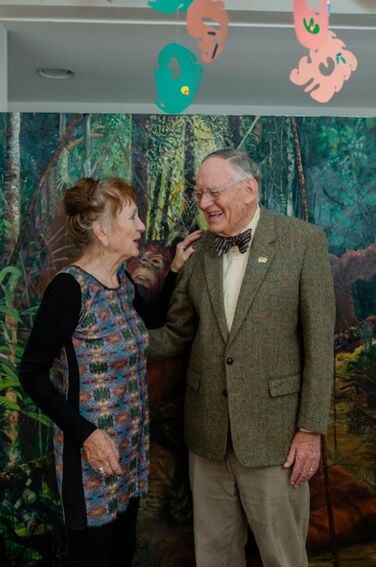
Dodge Poetry Festival founder Scott McVay. (Photo by Suzette J. Lucas.),