By Patricia Brewer
Editor’s Note: Patricia Brewer is the granddaughter of Perkins and Louise Broach, whom Hamilton Township honored last month.
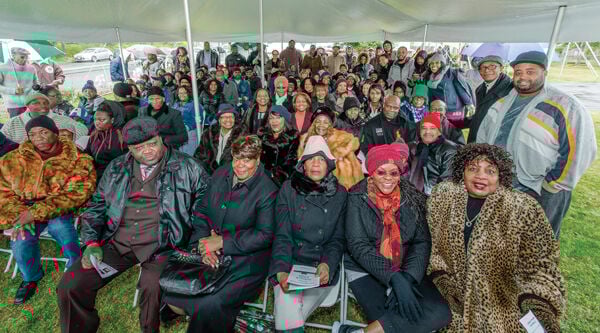
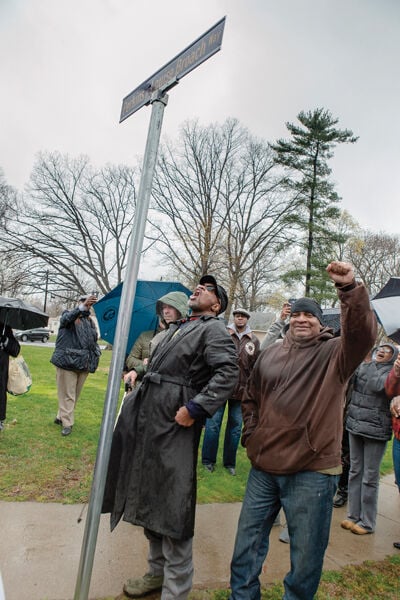
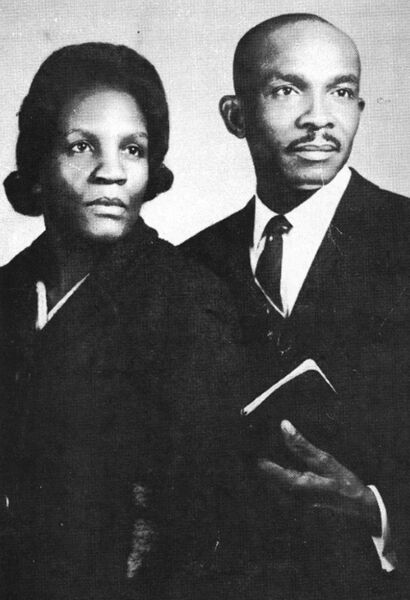
On April 9, Hamilton Township honored longtime residents Bishop Perkins Broach, Sr. and Mother Louise Broach by renaming a portion of Central Avenue in their honor. Four of Perkins and Louise Broach’s sons unveiled a sign at the corner of Central Avenue and Pitman Avenue—near the family home—as Trenton city council members, county freeholders, a state senator and township officials looked on. It was the culmination of months of coordination by our family, with the assistance of Hamilton Township officials.
Perkins and Louise Broach were community leaders, mentors and civic advocates. They were also faithful stewards who founded Trenton Deliverance Center Church in Trenton 50 years ago. They oversaw the opening and operation of the Hamilton Residential Center, which provided residential placement to people with mental challenges for more than 30 years. Although they were parents to 21 natural children—five boys and 16 daughters—they still found time to help others. The celebration last month paid tribute to this, honoring two individuals that worked tirelessly in the community to help improve people’s lives.
My grandfather passed from prostate cancer in April of 1998. Despite his pain and the certain knowledge that he was dying, he remained loving and retained his fierce sense of personality and humor throughout his illness. I remember visiting him at the hospital before he was released to go home to die, and he was still asking about me. How I was doing? How things were in my personal life? Telling me how much he loved me. He recounted a funny story from back in his youth. He claimed he was the best dancer in Trenton. He was full of life, until the very end. He never felt sorry for himself or complained.
My grandfather succumbed to a lengthy battle with congestive heart failure and died the day after Mother’s Day in 2008. In my estimation, her role was to act as my grandfather’s foil. Where he was jovial, she was serious. He was a dreamer and romanticist; she was a realist. That’s not to say that she only played the part of the heavy or disciplinarian, but they knew how to balance each other out, and they were made better because of this. They worked together; there was never a competition between the two, they knew who they were and what their strengths were.
My grandparents met in Meridian, Mississippi, and married in 1940. My grandmother was 14, and my grandfather was just 19.
Faith, family, and civic duty were the cornerstones of the principals my grandparents taught their children. My grandparents had a natural acumen for business, despite their lack of formal education. They made some very wise real estate investments, leveraged the finances made from them and utilized the funds to open several successful business ventures. The Broaches were also education advocates, who instilled the idea of hard work and academic achievement into their children, who today work in varied professional careers but all find time to give back to their communities.
The older Broach children were able to obtain work at some of the local factories and industries that once dominated the greater Trenton landscape, and helped to support and put their younger siblings through college, assisting and lifting the load of their parents. The second batch of kids persued careers in social services, so that other children would not have to endure what their older siblings experienced. Some perused careers in education, and a few followed in their father’s footsteps to become ministers. My Aunt Wanda pursued a medical career, obtaining nursing degrees and eventually a Ph.D.
The Broaches embodied the adage “where much is given, much is required.” All of their adult children are avid supporters of charities, civic institutions and have found representative ways to “pay it forward” as a living testament to the values instilled by their parents.
Faith
The Broaches unstinting belief in God prompted them to establish Trenton Deliverance Center Church at 1100 S. Clinton Ave. in Trenton in April 1966. Perkins Broach attributed his faith in God with helping to put his family back together, overcoming obstacles and inspiring him to become a better man and father.
At one point in his younger years, my grandfather—due to depression and some deep-seated personal demons—became an alcoholic. During this time, my grandmother fought a protracted battle against tuberculosis and was hospitalized for three or four years. The 12 Broach children born during that period were displaced and put into the foster care system. The children were forcibly removed from the family home in pairs of two, akin to the animals grouped together in the story of Noah’s Ark. My mother, Barbara Fay Brewer, said it was one of the saddest days of her life, and she tried to remain strong for the sake of her younger siblings. The oldest of the children, my mom was told that she would never be reunited with her parents since her grandfather had his issues with the bottle and her mother was expected to die.
A few years later, my grandfather went to work to getting his kids back. He had found religion, quit drinking cold turkey, reentered the workforce and started the laborious task of trying to get custody of his kids. Simultaneously, my grandmother made an unexpected and miraculous recovery, which she credited to God, and they both realized that a major life change was required.
My grandmother was released from the hospital, reunited with her husband and began the task of petitioning the state for their children. I know that the state gave them a hard time and required that they build or rent a house big enough where no more than two children would have to share a room. My grandfather worked his butt off to meet this requirement; ironically, no such stipulation was mandated of the various foster parents my mother, aunts and uncles had.
My grandparents eventually got all their kids back. It took them five or six years. Ultimately, they had other children, born from their union. My grandparents always attributed God for helping to put their fragmented family back together and giving them peace. God was and is a real and ever-present influence in their family and subsequently mine. I believe that this is one of the main reasons why there is so much reverence for God in our collective families. From a very close and personal level, we remember the stories of our grandparents and know God to be a mender of broken hearts, a healer and restorer of the family unit.
My grandparents knew that the best gift or legacy that they could leave with their children was to teach a strong moral code that would sustain them over the years.
Today, three of their children have followed in their father’s footsteps and work in the ministerial field. Pastor Mark Broach—their youngest son—is the current Pastor of Trenton Deliverance Center and is the President of Trenton’s Chapter of the Concerned Pastors Group. My mother is the co-founder and senior pastor of Interfaith Tabernacle Church in Trenton. Raymond Broach is the former Superintendent of Schools in Ewing Township, an education consultant and a church elder and associate minister at TDC.
Many of the Broaches’ children attend the church that their parents founded along with their children and extended family. TDC started many community programs, including a food pantry, prison ministry and computer literacy project. They are just a few of the programs that help support the disenfranchised and promote the Gospel.
Dr. Wanda Broach-Butts remembers her parents many words of encouragement and faith, which remains with her even today. They told her that she could do anything. There were no limits to her potential and not to believe the naysayers that would try to hold you down. She said her parents “spoke prophetic words of wisdom into my life, letting me know that I could achieve anything and not to allow anyone to tell me otherwise.”
Mark Broach said his parents taught him many different things, most of which revolved around the family’s core values.
“They showed me how to love people,” Mark Broach said. “They also demonstrated how to live your life as a giver. Their philosophy was, ‘If you are able to give, it is because God is blessing you.’”
Family
Raising 21 children was no small feat. The Broaches had one set of triplets, two sets of twins and 12 single births. At last count, there were approximately 50 grandchildren, 24 great-grandchildren and a growing number of great-great-grandchildren.
Life in a big family, is quite simply, bigger and a lot of fun. You get to learn diplomacy early on because there are so many people and personality types. You also learn to speak up fast; otherwise, it is easy to be ignored. You learn to work as a team, and you understand the value of family. There are certain commonalities that you innately understand because of your shared experiences.
My grandparents’ house was situated on about an acre, my grandfather built the house that had three bathrooms, six or so bedrooms. Home life was managed by schedule and loving discipline. The older siblings helped out with the younger ones. Life centered on school, work, church and volunteerism. We were made to understand the idea that we are our brother’s and sister’s keeper and that we have an obligation toward one another. And of course with the wide range of ages, not everyone resided in the house at the same time. My mother is 75 and her youngest sibling is 51, so they never resided in the house during the same period of time.
The Broaches were married for 58 years, and heavily emphasized the importance of family. To this day, most of the Broach family remains in Hamilton or the surrounding area.
My mother (Barbara Fay) and I live near to my grandparents home. My aunt, Barbara Ann, lives just around the corner, and my Uncle David lives directly across the street from my grandparents home at 117 Central Ave. Ray Broach has a home in Hamilton along with my aunt Sheila. My aunt Christine Broach Winrow is a Hamiltonian, too, making six total still in town.
Several others live in the greater Trenton area, and a few are in South Jersey. Only one aunt lives out of state, in Ohio. We have purposefully remained within a close vicinity to one another since we function as each other’s support system.
Other surviving children include Gloria (Broach) Harris, Carol (Broach) Byrd, Linda (Broach) Patton, Peter Broach, Perkins Broach Jr., Joan (Broach) Moore, Sheila (Broach) Mitchell, Penelope (Broach) Britt, Wanda (Broach) Butts, Marie (Broach) Reavey and Mark A. Broach.
We are a family of close bonds, who work to stay connected. We still host a weekly family dinner after church on Sunday.
Family dinner is loud, boisterous and fun. We have an affinity for good food, company and conversation. Family diners are also inclusive; it is not unusual to invite a guest, friend or to share with someone that may not have any place to go. Cell phones are discouraged because we want to talk and communicate with one another, and are only allowed for picture taking. Conversations held at the dinner table range from politics, sports, what’s happening in the local community, music, deaths/births and may center on discussions about people’s jobs, promotions, updates, etc.
Once thing my grandparents wanted to impart to us, was the notion to keep the family strong, not to forget “the family prayer”—which is an old gospel hymn—and that idea that family is all we have. Family dinner and spending time together help to reinforce these principles.
Civic Duty
My grandfather joined the Army and was stationed at Fort Dix in 1944. He joined to see the world, get out of the South and provide for his family. My grandmother followed him here the same year, so that they would not be separated. They wanted to leave their native Mississippi, and relocate to a place that had a better career and social advancement opportunities. They did not want to remain in the oppressive South during the Jim Crow-era of racial injustice, segregation, rampant prejudice and frequent lynchings. The Ku Klux Klan had made several threats against my grandfather, so staying in the South was never an option.
Still, my grandfather was proud of his service in the Army, and his time in the armed forces helped to mold him into the man that he would later become.
Both Perkins and Louise had a deep and abiding love of country and believed in America’s promise and opportunity. The Broaches wanted their children to be good citizens and to help shape the environment around them, making it a better place for the community at large.
“They provided a moral compass to allow us to make an impact and challenged us to go out and to make a difference,” Ray Broach said.
Perkins will always be remembered fondly for his big heart, charisma, loving personality and exuberant sense of humor. He had a way of making you feel like you were the center of the universe and the most special person alive. I remember him always saying, “Doll, you know you are my favorite.” When he spoke those words to you, you believed it. It was his way of imparting a positive word, boosting your self-esteem and providing you with a personal affirmation.
Louise was affectionately known as “Mother Broach.” She was concerned about the needs of others, not just her children and family. She stood in as a surrogate mother to all those she encountered. She functioned as a skilled homemaker and business entrepreneur well before the era when most women worked outside of the home. She knew how to balance home, family, work and made it look effortless. She is best remembered for her aplomb, patience, gentle and loving spirit.
My grandparents’ story represents one’s journey to hell and back. This is particularly true of my grandmother. She grew up poor, disenfranchised and was largely uneducated in the segregated South. She married, somewhat got on her feet before having to deal with issues of alcoholism, depression and major illness. She suffered what no loving mother should ever have to endure, having her children forcibly removed from her care and scattered to the winds. She also endured the pain of having a child predecease her.
Through her fledgling faith and miraculous intervention, she gets well, repairs her marriage and fights to get her kids back, all while defying the odds and establishing a viable and ultimately profitable business. She provided love and care for the mentally challenged, who in many cases had no voice and who were thrown away by their families. The environment that she created helped to provide them with dignity, safety, comfort and camaraderie. She exhibited a mother’s heart and concern, and she loved her clients. She made us respect the mentally challenged and to understand that except for the grace of God we could be in their shoes.
The reason why my grandparents could so easily connect with people is because they were real, authentic and had seen so much of life’s travails. How can you tell someone that it’s going to be alright if you’ve never undergone any of life unpleasantness from an up close and personal perspective? One of the reasons people were so inspired by my grandparents and gravitated to them is because they were unashamed of their experiences and never forgot where they came from. They could look you in the eye and tell you with conviction that despite your trials you could overcome your obstacles because they already had.
My grandparents’ reach was apparent at the April 9 event, which was attended by 200 people despite the cold, rainy weather. Economic development director Martin Flynn represented Hamilton Township at the event, and knew about our family through his career as a teacher in the Hamilton Township School District. He taught Mark Broach (my grandparents’ youngest son) and went to school with Ernie Brewer (the Broaches’ eldest grandson). There was a personal connection between the some officials in attendance, who knew the family on a firsthand basis.
Family memories were shared by my mother, Barbara Brewer, and Raymond Broach, the eldest son. Both gave stirring tributes about their parents and spoke about their dedication to family, community and their faith. Laughter, song, and heartfelt remembrance were the unifying themes of this often participatory program.
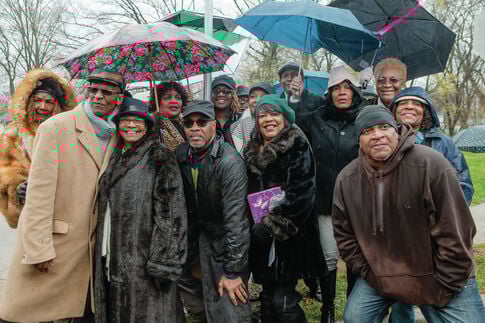
Although the group had to huddle under two tents and at times the rain was quite heavy, we were pleased by the outpouring of support. Our thanks to those who came out in the rain to help us inaugurate the unveiling of the street sign and to honor and remember two of Hamilton’s finest.
,
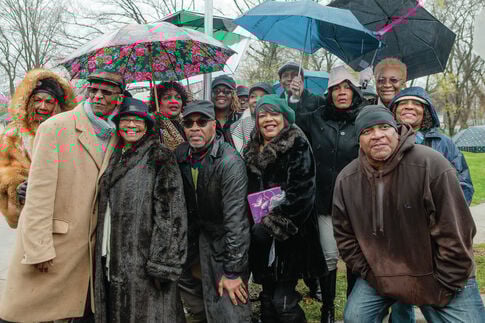
Hundreds gathered on a rainy, cold day for the April 9 street dedication in honor of Perkins and Louise Broach. (Photo by Suzette J. Lucas.),