If you hear tiny peeps, squeaks or meows coming from inside a storm drain, chances are Hamilton Township Water Pollution Control employees won’t be far behind, ready to assist with a rescue.
It’s not what they’re trained for, but WPC workers often perform tasks that are not in their job description. They, along with Township Animal Control and the Mercer County Wildlife Center are busiest from May to September—“baby season,” as Wildlife Center director Diane Nickerson said—but they are constantly on call, ready to go if an animal is trapped in a storm drain or under a grate.
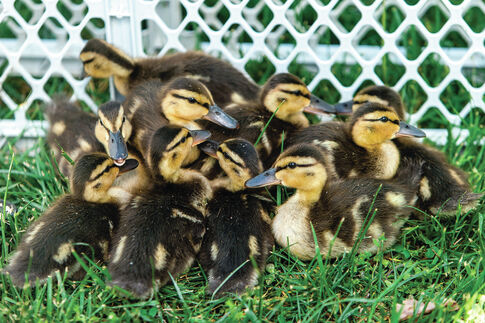
One such incident happened April 28, when a Hamilton Marketplace shopper called Animal Control after hearing small chirps and peeps coming from a storm drain behind Kohl’s. Nine ducklings fell into the drain—without their mother—and they had no way of getting out.
When Marion Munford, a Hamilton animal control officer, answered the concerned shopper’s call, she enlisted the help of Anthony Giannacio and his Water Pollution Control workers, and the two crews headed out to the site like they have done many, many times before.
Giannacio and crew members Charlie Wagner, Lou Pollard and Mike Lenhardt used the boom attached to their truck to remove the drain’s grate. Then, they flushed water into the drain, which helped the ducks swim with the current towards Munford, who was waiting with a net.
The nine ducklings were split between two drains, and Munford managed to rescue eight. One wouldn’t cooperate, though, so they all went back the following day and picked him up then.
“It’s all in a day’s work,” Giannacio said. “We have the means. If a township resident initiates this and they get animal control and they call me, I guess it is a part of my job.”
After they are rescued, most animals are taken to the Wildlife Center in Titusville, unless they are domestic. But the ducks are wild, so they went to the center where the plan was initially to keep them there another two to three months while they developed flight feathers, got waterproofed and learned to swim.
But this situation was different. During their first week at the Wildlife Center, the ducks went through the normal process—spending days in an outside enclosure grazing and getting sunlight and nights indoors staying warm. But shortly after they were brought in, the center picked up a female mallard with a broken leg. She laid eight eggs not long after she arrived—but all of them were infertile.
But she will never know. Once the mallard’s leg heals, Nickerson will replace the eggs with the nine Hamilton babies, and the mother will teach them the skills they would have otherwise learned at the Wildlife Center.
Animals, Nickerson said, are “great foster moms,” and the practice is common.
“You just walk in the middle, you put them down, and you walk away,” she said. “As long as they’re the same size, she can’t count. She doesn’t know, and she’ll take them. This mom just knows she has eggs, so when we take the eggs away and put these guys in her cage instead, she’s going to go, ‘Oh, okay!’”
Munford added that there are a lot of misconceptions associated with wild fostering.
“It’s a myth that if you touch a baby duckling or bird or rabbit, the mother won’t come back,” she said. “They always come back.”
Because of this, the Wildlife Center is often able to create new families, and that’s due in part to the efforts of animal control and public works crews.
Giannacio, who has worked for the township for 30 years, said the most common animals he sees in drains are birds, cats, and rabbits. Crowds often gather once they realize what’s going on, but Giannacio said it doesn’t add any pressure. Rescues usually take a couple of hours, but it can be longer depending on whether or not the animals cooperate.
“It can happen any time,” he said. “Part of me can’t believe it. We’re doing our job. It doesn’t matter when we do. We are employees of the residents of Hamilton Township.”
Giannacio, though, gives all of the credit to Wagner, Pollard, Lenhardt and the other crews. They often have to actually go down into the storm drains during rescues to block whatever animal is down there from going through openings.
“They all work so hard,” he said. “I just delegate. I’m there to watch and make sure everything’s safe. They do all the work. They’re the young guys. They say, ‘Tony, great job,’ but it’s all my guys.”
Sometimes, they all take this built-in part of their jobs home with them. Nearly two years ago, Giannacio and his crew were called to assist with the rescue of a single kitten—no mother or siblings were around. So, after convincing his wife (with a little help from his daughter), Giannacio adopted Gizmo, a van coon cat.
“My wife always says he hit the cat lottery,” he said. “He’s got it made. He eats good, sleeps. He’s in the air-conditioned house. And he’s the wackiest cat you’ve ever seen.”
When he comes across kittens, Giannacio said he often has to suppress the urge to bring Gizmo a brother or sister.
That love for animals is obvious with other public works employees, too, who feed and shelter strays at work. When they can catch the cats, they even take them to get them spayed and neutered.
“They get fed every day,” Giannacio said. “We’ve had many of them. Now, we’re down to maybe about four or five, but they’re all fixed.”
Because so many babies are born in spring and summer, Giannacio, Munford and Nickerson expect a heavy volume of rescues into September—the Wildlife Center brought in 100 animals in a single day in May—but they’re all prepared, no matter what the situation is. In fact, Munford said they had to go back to the Marketplace a week later because the same mother duck lost another set of babies in the same drain.
“I have to rescue all of them,” Munford said. “I have to get them all. I can’t leave anything behind. The determination is the hardest part, but just the fact that you rescued these little guys and brought them to safety is worth it.”
,

