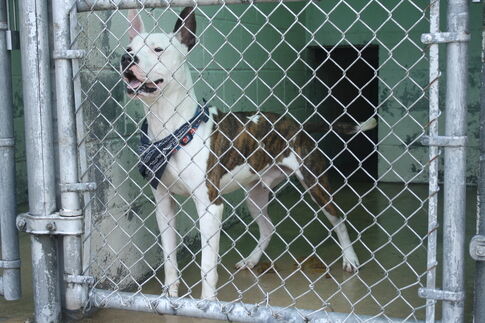
Robin, the dog with the longest current tenure in the Hamilton Animal Shelter, perks up when a car pulls into the parking lot. (Staff photo by Rob Anthes.)
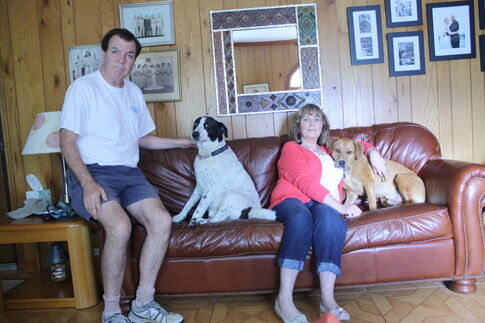
Fran, Jake, Margaret and Louis Duffy relax in their home. Fran and Margaret Duffy rescued Jake and Louis from shelters. (Staff photo by Rob Anthes.)
All the pens at the Hamilton Animal Shelter were full on June 11, 2013, and the dogs in the shelter were eager to vie for the attention of visitors. One dog (pictured) has been in the shelter since its owner died and no one stepped forward to care for it. (Staff photo by Rob Anthes.)
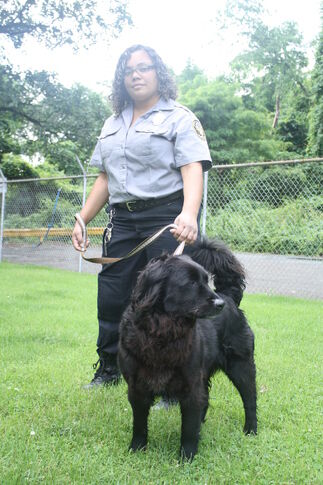
Assistant animal control officer Marion Munford stands with a dog only referred to as “No. 99.”(Staff photo by Rob Anthes.)
From walks to ear scratching, volunteers provide care for Hamilton’s abandoned dog population.
There are so many dogs going in and out of Fran and Margaret Duffy’s University Heights home some might mistake it for a canine hotel.
In the two years since the Duffys started volunteering for an organization called Animal Friends for Education and Welfare, the Hamilton residents have adopted two dogs and provided foster care to three others. They have allowed countless more shelter dogs to use their backyard as a place to stretch their legs, feel grass beneath their paws and breathe fresh air.
Months-long stays in animal shelters seem to be the norm for the dogs the Duffys brings home. One of Fran Duffy’s favorites, a Staffordshire Terrier mix named Jimmy, was found abandoned in Trenton, and has been homeless for nearly two years.
As Jimmy’s experience shows, it’s occasionally an arduous process getting animals adopted. But trips out of the shelter can brighten a dog’s life, improving the animal’s attitude and post-shelter prospects. Duffy has witnessed this firsthand, and, as long it helps the dogs, he said, he’ll keep doing it.
“It’s very gratifying when you see your effort helped one of these dogs get adopted,” Duffy said. “When any dog gets adopted, the whole group revels at the fact another dog has been placed in a good family situation.”
Since A.F.E.W. started in 1993, it has placed more than 2,000 animals in new homes. The organization’s volunteers work primarily with the Hamilton Animal Shelter and people who need to find new homes for their pets.
Volunteers help run adoption drives, act as foster owners for some animals or simply donate a few hours to get dogs out of the shelter and take them for walks. Recently, an A.F.E.W. volunteer checked a pregnant Staffordshire Terrier out of the Hamilton shelter and took it in as a foster dog, so the animal and its pups would have a cleaner environment and more attention. The dog had a litter of 12 pups in June.
Pregnant dogs need near constant attention, and as do pups, once they arrive.
“We really don’t have the manpower or the time to do that,” said Todd Bencivengo, animal control officer and supervisor of the township animal shelter.
With their 43-year-old facility jammed to capacity and few resources, shelter employees often depend on volunteers to provide any care beyond the basic food, baths, exercise and regular examinations. Currently, the shelter—on Sylvan Avenue, just off of South Olden Avenue—has five employees, three of them full-time.
A $700,000 expansion of the building expected to start this summer will add needed facilities, as well as more area for the employees to cover. Bencivengo is looking for a part-time, second-shift worker, but said he doesn’t know if he’ll be able to expand his staff along with the building.
The renovations will give the shelter space for 36 dogs and 40 cats—nearly doubling its capacity—as well as a quarantine room for dogs, an adoption room and a veterinary examination room. Once completed, the renovated and updated facilities likely won’t diminish the importance of organizations like A.F.E.W. to the Hamilton Animal Shelter, though.
Volunteers allow shelter animals to have personal attention and interactions with the outside world, socializing experiences both Bencivengo and Duffy said are vital to the animals’ chances of being adopted and adjusting to permanent residence outside of the shelter. Along with the shelter staff, volunteers provide human companionship for animals who have had a fair bit of trauma. They are animals like the pair of dogs animal control officers found abandoned, in the rain, at the dog park in Veterans Park, or the dog brought to the shelter after its owner died. It had no one to care for it.
Volunteers often act as advocates for the animals, too, developing relationships with a select few and keeping an eye out for issues. Such was the case with the latest extended-stay guest at Hotel Duffy, an older Staffordshire Terrier-Boxer mix named Emma.
Staffordshire Terrier is a type of pit bull, and is among the most common breeds found at the Hamilton shelter. About 9-years old, Emma entered the Hamilton Animal Shelter in April 2012 and quickly became one of Duffy’s favorites. Duffy, 64, goes to the shelter a few times a week to walk dogs, and he would often take Emma on a two-mile loop in the neighborhood near the shelter.
As one of Duffy’s favorites, Emma also made periodic trips to Duffy’s house, where she could run around in his backyard. She usually chose to instead use the time as an opportunity to sit alongside Duffy, or sometimes even on his feet.
When Emma developed a nagging respiratory infection in the winter, Duffy knew the shelter wasn’t the place for a sick, older dog. Duffy had worked as CFO for a brokerage firm, but lost his job in a downsizing a few years ago.
He has stayed in retirement and devoted his spare time to his family and A.F.E.W. Margaret, his wife, works part time with special education groups in Hamilton and tutors students. Their three children are grown and have moved out, and another dog, named Maggie, had just left their foster care.
The Duffys had the space and time for Emma. They took her in as a foster dog.
“You’re always in transition,” Duffy said. “When we first heard Emma was in a tough situation, we figured we have this great, big house. She has a 900-square-foot area just for her to run around in. We have a fenced-in yard.”
At the same time, A.F.E.W. began a marketing blitz to try to get Emma adopted, hoping someone would take her before a full year passed since she first entered the shelter. Emma spent two months living with the Duffys and their dogs Jake, a Border Collie mix, and Louis, a hound dog mix.
Emma seemingly had adjusted to life outside the shelter, with people and other dogs.
“If I would sit for five hours, she would sit here right with me,” Duffy said. “I let her out in the backyard; she lays down, maybe runs around a bit, does her business … Her requests and demands are negligible. Her request is she be with people. That is all she asks, that she be part of the family. I couldn’t in good conscience bring her back because she had done nothing wrong.”
Emma stayed with the Duffys until, in early April, a couple from East Windsor adopted her.
“Thank god that she was adopted, or I would have wound up with three dogs,” Duffy said.
Duffy has since turned his attention to a pair of his other favorites: the aforementioned Jimmy and a young German Shepard-Staffordshire Terrier mix named Robin. Robin now has the distinction of being the dog with the most seniority at the Hamilton shelter, living there since he was found—lost and wandering—in April 2012.
In May, someone tried to adopt Robin, but the potential owner had another dog, and A.F.E.W. could not verify Robin would be suitable for the home. He was not released, and still lives in the Hamilton shelter.
With Emma adopted, though, Duffy has made it a point to visit Robin more often at the shelter, take him on walks and bring him home more. During a walk in March, Robin happily padded down the street, sniffing trees, grass, fences and anything else that crossed the path of his nose. When a yappy Chihuahua tried to get his attention, Robin paid him no heed. He greeted another dog on his route by sticking his nose near a chain-link fence and taking a whiff the dog before continuing on his way.
As Duffy and Robin neared the end of their walk, a pickup truck slowly pulled up alongside them. The driver rolled down his window.
“That’s a good-looking dog,” the man said.
Duffy sensed an opportunity for Robin, smiled and said, “He’s ready to jump in right now.”
The pair shared some more pleasantries until the truck driver began to pull away, bemoaning the inaccessible, hidden-away nature of the animal shelter.
“You don’t know what they got if you don’t see ‘em,” the man in the truck said before leaving.
And it is hard to see what animals are in the shelter the way the building currently sits. The shelter is on a dead-end street, and some of the dog runs are behind the building, not visible from the road.
The space inside is also small, and sometimes makes it difficult for interested parties to look at some of the animals in the facility. The shelter renovations should fix that issue, with more space and a dedicated adoption room, but it’s a problem Duffy could only shake his head at in March.
Aside from devoting several hours a week to walking dogs and lending their house and backyard to select animals, the Duffys also volunteer on weekends at adoption events A.F.E.W. holds around the area. Fran Duffy said he desperately wants to find “his” dogs homes, and he has devoted much of the past few years to the cause.
As Duffy has found, life as an ally of shelter dogs isn’t easy or glamorous. There are the trials and heartache of bonding with good dogs that don’t have homes. There are close calls with more aggressive and unadoptable dogs, like the one that ripped a seatbelt out of Duffy’s car and ate it during a ride to Mercer County Park. There are the hours of effort distinguishing which dogs belong in which group, the early mornings preparing for another Saturday of walking dogs or sitting at a farmers’ market trying to get animals adopted.
It’s a lot, but to Duffy, it’s worthwhile.
“Do you wake up on Saturday morning wanting to go?” Duffy said. “Absolutely not. But when you get there, you’re glad you did it.”
The Hamilton Animal Shelter is located at 2100 Sylvan Ave. It is open Monday-Friday, 9 a.m. to 3 p.m., and Saturday, 9 a.m. to 2 p.m. For more information, call (609) 890-3550. For more information about A.F.E.W., go online to afewpets.org.
,

,