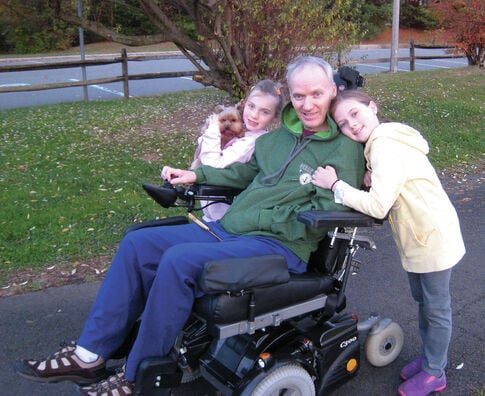
Emma and Sophia Phelan stand in Village Park with their father, Tom, who has ALS, in November 2013. Emma and Sophia were named ALS Association Volunteers of the Month in January 2014 for their fundraising efforts.
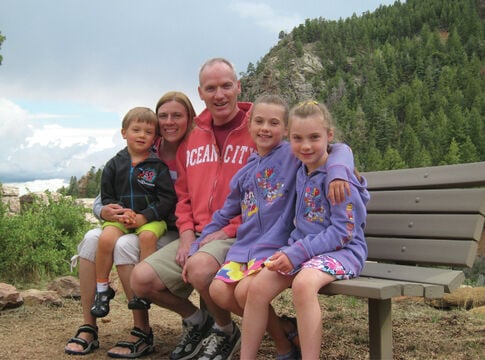
The Phelan family—Zack, Karolina, Tom, Sophia and Emma—on a trip to Colorado Springs in August 2013. Tom was diagnosed with ALS Jan. 11, 2013.
Lawrence family hopes awareness one day leads to cure for Lou Gehrig’s Disease
Tom Phelan never imagined before a year ago that he and his wife Karolina would be praying that he had cancer.
But when, after months of tests and endless doctors’ visits, the only other diagnosis was ALS, cancer seemed to be the lesser of two evils.
“Many cancers aren’t curable, but at least you have a fighting chance,” Karolina said. “And there are cancer survivors, but there are no ALS survivors. So that’s why we came home, and we were praying for cancer, just to have a fighting chance.”
But on Jan. 11, 2013, the Phelans were crushed to learn their prayers had not been answered.
Since then, life has been turned upside down for the parents of three: Sophia, 11; Emma, 8; and Zack, 3. Just a year later, Tom, 49, is confined to a wheelchair with almost no mobility or speech and needs a feeding tube because he cannot swallow food.
Before the diagnosis, Tom had kept the household running. He washed the dishes after dinner, played with the kids the minute he got home from work, and could fix the roof, the cars and anything in between.
“Everything was Tom,” Karolina said. “It was amazing. He could do physics problems and fix the car and the plumbing under your sink if it’s leaking. He could do everything.”
Tom had worked for 12 years as the Director of Technology at Peddie School. In 2007, the family moved from the Peddie School campus in Hightstown to their current home in Lawrence, just two blocks away from Karolina’s parents and closer to Stuart Country Day School in Princeton, where Karolina taught chemistry and Sophia and Emma attend 5th and 2nd grades, respectively.
But in fall 2012, Tom noticed a recurring twitch in his bicep. As the twitch began to spread to other muscles in Tom’s arms and chest, the Phelans addressed the issue with one doctor—then another, and another, and still no one had a definitive answer as to what was wrong. When a doctor finally guessed that ALS was a possibility, the Phelans were not ready to accept that diagnosis.
Unlike many people, the Phelans were already familiar with ALS and how the disease progressed long before it revealed itself in their own family. Several years earlier, a Kindergarten teacher at Stuart had died from the illness.
They sought a second opinion at University of Pennsylvania, where an ALS specialist—now Tom’s current doctor—ran the final tests to rule out any other possibilities.
* * *
About 30,000 people in the U.S. are living with ALS at any given time, said Tony Heyl, communications and public policy manager for the ALS Association Greater Philadelphia Chapter. An estimated 500 patients live in New Jersey.
ALS stands for Amyotrophic Lateral Sclerosis, but the illness is commonly referred to as Lou Gehrig’s Disease after the famed New York Yankee who died from the disease in 1941.
The neuromuscular disease causes the degeneration of motor cells in the brain and spinal cord, weakening the body’s muscles and eventually leaving a patient unable to move, swallow or speak. The disease also affects breathing ability, one of the most serious symptoms.
ALS is most commonly diagnosed in patients 35-70 years old, but cases have ranged from patients younger than 20 to as old as 95. Patients typically live 2-5 years after diagnosis; about 20 percent of patients live 5 years or more, and up to 10 percent will live more than 10 years, according to the ALS Association. There is no cure for ALS.
While the disease primarily affects the physical capabilities of patients, a small percentage of cases have shown diminished mental capacities as well from a condition called Frontotemporal Lobar Degeneration, or FTLD.
For Tom, the symptoms progressed quickly. He began losing mobility first in his fingers, then began to slowly lose energy and other functions like swallowing, speaking and the ability to move his other limbs.
The major concern now is for Tom’s breathing, Karolina said; his lungs are losing strength each month, and he needs an assisted breathing device when he sleeps.
Though Tom has lost most of his speaking ability, Karolina and her daughters are able to understand, with trained ears, a few words and phrases that Tom attempts to speak. When the family can’t understand him, Karolina uses a paper with the letters of the alphabet organized into groups. She can see where Tom is looking on the sheet of paper, and point to each letter in a certain group to spell out words; Tom will blink once if Karolina points to the right letter, and twice when he wants to start a new word. The system allows Tom to communicate words and sentences that he can’t physically enunciate.
But the process is slow, and far from easy.
After several minutes one afternoon spent trying to decipher her husband’s words, Karolina sank back onto the couch, pausing to rest her head in her hands while she allowed Sophia and Emma to finish translating their father’s sentence.
“It’s a frustrating problem when we cannot communicate,” she said.
However, the Phelans are able to turn to a few organizations for help with Tom’s care.
The ALS Association is a major resource available to individuals diagnosed with ALS and their families and caregivers. The nonprofit organization is the principal charity of the Philadelphia Phillies and aims to raise money for ALS research and fund services and programs for patients.
One of the main benefits for the Phelans was the coordination of doctors’ appointments every three months; the association worked with University of Pennsylvania to consolidate all of Tom’s many doctors’ visits into one 3-4 hour appointment with all his caregivers in one place.
“Physical therapist, occupational therapist, nutritionist,” Karolina said, counting out all the individuals necessary to care for Tom, “neurologist, social worker, mental health nurse, respiratory therapist, patient care coordinator, clinical trial nurse…you need a whole team of people.”
The Phelans also receive assistance from the VA because Tom served two years with the Air Force, and ALS is listed as a service-connected disease.
“People who serve in the military, no matter what branch or time period, are twice as likely to develop ALS…other diseases are connected to the military, but this is the only one connected across all feeders,” Heyl said.
Through the VA, the Phelans were able to get a wheelchair for Tom and a home health aide, who comes to the house from 9-11 a.m. daily.
But as Tom’s condition worsened, Karolina had to leave her job as a chemistry teacher at Stuart after Thanksgiving to provide around the clock care for her husband.
“It’s an awful disease,” Karolina said. “It rips the whole family apart, and it’s awful what it’s doing to us. We are powerless, and we are just watching Tom suffer. We are just watching him suffer, and we are totally powerless to stop it, to help him, to make it any better.”
Now, Tom cannot be left alone at all, and in mid-January, Karolina was planning to set up hospice care because there was simply too much to do.
“I knew it would be tough, but I never imagined it would be like this,” she said. “I never imagined how consuming it would be to care for Tom and then the whole house.”
As the 2013-14 school year started in September, Karolina relied on Sophia and Emma to be responsible about getting their homework done, and the girls often assisted in the evenings by entertaining Zack while Karolina tended to Tom’s needs.
And while the girls continue to dote on their father and want to help in the fight against his disease, Karolina also worried that they still needed time to be children.
“[Hospice care] will allow me to be a mom to them because I really wasn’t the last few months,” she said. “I didn’t really have time to be a mom.”
* * *
But small glimmers of comfort have been present throughout the Phelans’ struggle in the form of friends, family and local and regional support.
“Honestly our friends are so amazing, the help from school, the help from Stuart, from other teachers, the help from family and friends,” Karolina said. “Bringing us dinners, asking us what needs to be done around the house. It seems to us that our house has a revolving door of people coming in, helping us, asking us what they can do to help, so we are so blessed for that.”
Ready-made dinners always seem to arrive at their home in the evenings, and a neighbor put up all the Phelans’ Christmas lights outside and took them down a month later. Even cards and words of encouragement remind the Phelans that they are not alone.
And while the support of friends and neighbors has been overwhelming, so has the support from other families at the ALS Association. Karolina said the events they attend through the association have connected them with families from all over the state, and that sometimes the most comforting conversations come from speaking with others who can truly relate to the same experiences. One of the Phelans’ closest friendships is with a family from Cherry Hill, with whom the Phelans set up monthly visits to see each other.
Yet some of the most uplifting efforts have come from the Phelan family itself.
Almost immediately after Tom’s diagnosis, the Phelans got involved in spreading awareness, traveling as a family to Trenton and Washington, D.C. to speak with legislators about ALS.
One of the biggest awareness events is National ALS Advocacy Day in May, when advocates travel to Washington, D.C. and meet with members of Congress and their staff to encourage them to support the fight against ALS, particularly by advancing research funding to find a cure.
From May 8-11, 2013, the Phelans were among nearly 1,000 advocates who made the trip.
They set up meetings with New Jersey Congressmen Rush Holt—who represents Lawrence—and Jon Runyan, and met with the staff of Frank LoBiondo.
The trip was also the start of Sophia and Emma’s own contribution to fighting ALS and the achievements that earned them the honor of being named ALS Association Volunteers of the Month in January. The girls did much of the speaking when they met Runyan, and on June 15 the following month, the girls participated in the ALS Express Bike Ride in Wildwood to raise money for research.
Leading up to that day, the sisters had had a friendly competition to raise money through sponsorships to support the cause; in the end, Emma and Sophia raised more than $1,500 each, and their entire team raised $11,000.
In October, the fundraising efforts picked up again, this time at Stuart. Sophia and Emma spoke to school administrators about selling student-made rainbow looms, friendship bracelets, beaded bracelets and a few other items to raise money for ALS research, and the project took off in the 5th and 2nd grades.
The classes spent 15 minutes each morning in homeroom working on the bracelets, and Emma and Sophia also gave up their recess to design flyers to promote the event.
On Oct. 28, they put the finished items on display, most with prices between 5 cents and $1, for a goal of raising about $300.
It wasn’t long before the students met that goal—and then surpassed it.
“They would be counting and say, ‘We already reached 300, we’re at 400,’” Emma said about the process of counting all the proceeds. “So I said, ‘Let’s see if we can get to 500,’ and then we reached 500.”
The total amount raised was $1,065.32. Students also participated in a dress down day for $1 that helped contribute to the total amount of money raised.
As part of the preparation for the fundraising event, Sophia and Emma also spoke at assemblies about the nature of ALS and why they were raising the money.
“It felt good when I was explaining it to other people,” Sophia said, “like I was raising awareness that there was this disease and it doesn’t have a cure and that we want to find a cure.”
Despite the hardships faced in the past year, Karolina said Tom, even in his severely weakened state, has also remained a source of strength and confidence for her in times when she needs help.
When the vacuum belt broke in mid-January, Karolina felt at a loss of what to do or who to call. But even with his limited speech and lack of strength, Tom could still be there to help his wife.
“Tom coached me from his chair. With his speaking ability, he coached me how to change the vacuum cleaner belt, and I did it,” Karolina said. “And I was like, ‘Wow, he’s telling me what I can do, he’s giving me the confidence that I can take care of the house and the kids and everything.’”
Sophia and Emma are already planning for the next ALS Express Bike Ride, scheduled for June 14, and the family also plans to continue raising awareness with the ALS Association. For more information about ALS, the ALS Association and future fundraising efforts, go online to alsa.org and alsphiladelphia.org.
,