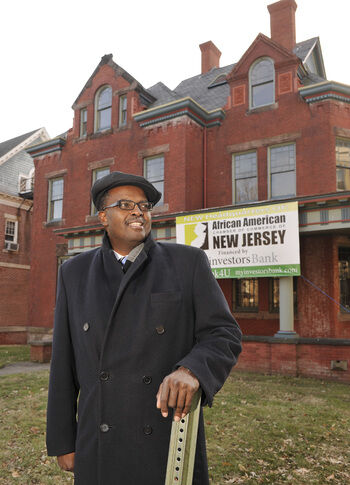
African American Chamber of Commerce CEO and Founder John Harmon at home of new headquarters. (Photo by Mark Czajkowski.)
African American Chamber of Commerce of New Jersey ready to makes moves in 2014
“We’re hitting the ground running for 2014,” says John Harmon, the CEO and founder of the African American Chamber of Commerce of New Jersey.
One big item on the agenda is the non-profit organization’s move from its office at 110 W. State St. to the 5,000-square-foot building at 379 W. State St.
The chamber recently paid $150,000 for the 19th century brick mansion, which has been empty for nearly a decade. An additional $150,000 is expected to address repairs and renovations.
“Renovations are being done in house. We have a number of contractors [who] are part of the chamber, and this is an opportunity for us to practice what we preach. We advocate for minority and women contractors, and that is who will be renovating the building,” Harmon said.
Investor’s Bank (formerly Roma Bank) is financing the project. “This is business, not charity,” he said.
The chamber’s goal is to open the building this March and start networking events, the Minding Our Business Market Fairs, a training institute, and job readiness and advocacy programs developed in partnership with the New Jersey Department of Labor, the U.S. Department of Labor’s Office of Disability Employment Policy (ODEP), and the Statewide Hispanic Chamber of Commerce of New Jersey. The building also provides the opportunity to generate income through space rental.
As renovation plans advance, so do two other projects. The first involves the Washington, D.C., based First Book learning project and a model business and learning initiative at Burlington County College. There, students will gain credit and work experience for creating a distribution center to disseminate free books to low income students.
The second is ACCNJ’s fourth annual Circle of Achievement Awards Gala set for Thursday, Feb. 20, at the Hyatt Regency New Brunswick.
Harmon says that the annual event could move to Trenton if there were a partner to provide support as does the Hyatt, which works with and helps the chamber.
The Trenton-born resident also shares other thoughts on how to improve business in the capital city.
“Number one is safety. People won’t go anywhere until they felt safe. Second is education. We must acknowledge the fact that the education system in Trenton has been a failure. The resources are here, but need a better delivery and accountability,” he said.
And third, the city government “needs to be truly committed to being nonpartisan,” and the “city needs to be more interconnected with the region. Trenton is a very small city and has very great assets. We need to have folks in the region think that we’re all in it together,” he said.
Harmon, born in 1961, grew up in Trenton’s North Ward and attended Wayne Avenue Baptist Church. When he was 12, his family moved to the 600 block of Riverside Avenue, and today he lives on the 800 block. His father owned the Trenton-based business Harmon Trucking.
A Trenton Central High School graduate, Harmon received business degrees from Mercer County Community College and Fairleigh Dickinson University. In 1983, Bowery Savings Bank in New York City recruited him as a management trainee and assigned him to the bank’s real estate division. He later moved to Chemical Bank, where he established its affordable housing loan program.
In 1989 Harmon left Chemical and founded the Trenton-based Harmon Transfer Inc. a food-transport company. The divorced father of three sons also became involved with the newly established Metropolitan Trenton African American Chamber of Commerce, or MTAACC, and became its president.
Harmon, who also made unsuccessful bids for Trenton mayor in 2006 and 2010, left the MTAACC in 2010 to head the AACCNJ. This year he also becomes chairman of the National Black Chamber of Commerce.
“If you improve the position of African Americans, you improve the financial life of the state,” Harmon said. “Mainstream chambers have been in existence for 50 to 100 years. They have long-term relationships. It’s easy for them to leverage to relationships when times are tough.”
Creating an African-American Chamber has allowed for an alignment with the mainstream with the goal of improving businesses and practices so they are consistent with the mainstream.
“It’s in our collective interest that we are speaking a common language and (have) a common goal,” Harmon said.
Other improvements need to come from government and investment centers.
“There are trillions of dollars that sit in the banks, and the stock market has been heated. Someone is making a lot of money, but it should be putting the money back out on the street like a research and development program. I think that has hurt the economy and culture,” he said.
During a discussion of the economy, the topic turned briefly to the reality that the U.S. is being run by its first African American president.
“It has done a number of things. As a black man and coming up and never seeing as black president as a kid, (Obama) dispelled a long term myth that a black man would never be a president. That box has been checked twice,” Harmon said.
Obama “has the intellectual ability and the right temperament for the job and is the consummate professional. I am respectful for seeing what he can do with the unprecedented level of opposition both legitimate and manufactured,” he said.
Harmon then turned the topic back to the state.
“There’s no question that the economy and Hurricane Sandy have adversely impacted not only African-American business, but all businesses. I’ll submit that African-American businesses find it more difficult to recover because they don’t have the capital base or the relationship that some of these other (businesses) have,” he said.
“The role of the African-American chamber is important because people do business with people they know. Our goal is to build those relationships and extend them to our members.”
The efforts of the chamber, which has a $350,000 a year operating budget, must be working.
“Our membership revenue is up 58 percent from last year, yet we’re the new kids on the block, and we’re the anomaly because [we are] the only black group in the state,” Harmon said.
Harmon feels that frank talk about diversity is a key to improve all businesses.
“Corporations will tout their minority participation, but when you ask how blacks are figured in, folks get real quiet. I’m OK if your spin with the black community is small, but let’s talk about it and see if it can improve. Not talking about it in a real dialogue hurts the state and companies,” he said. “I believe that by having more people around that table that you not only share interest and ideas, you can (also) bring practices to floor that don’t exist. What I found over the year is that at a distance there may appear to be a vast difference between people, but magic happens when people sit together in a room and find out they have so much in common.”
,

