When Peter Bell found out his son was autistic, he set out to make the world a better place for him
Peter Bell often wonders what the future will hold for his eldest son, Tyler.
At 20, Tyler is a popular kid with a knack for painting. His bright, colorful abstract acrylics have been displayed at Sumo Sushi, Pennington-Ewing Athletic Club gym and are sold on his website. People who know Tyler well say he has a great sense of humor. He is a fixture around Hopewell Valley, where he once attended public school, and he earns money by working at Hopewell Valley Bistro and Hopewell Valley Vineyards.
But Peter Bell said that for all he has going for him, Tyler is continually frustrated by his limitations in communicating with language. Tyler Bell is autistic.
“He’s very challenged and will require some level of supervision probably for the rest of his life,” Peter Bell said.
Tyler was diagnosed with pervasive developmental disorder at age 3. Although he attended public school in Hopewell, today he is homeschooled and attended to by a team of people, including therapists who help him build his language skills.
Autism is a neurological disorder. People with autism are impaired in their ability to socialize and communicate with others, to various degrees ranging from minor to severe. According to the Centers for Disease Control, about 1 in 50 American children are somewhere on the autistic spectrum, which includes autism, Asperger’s syndrome and Pervasive Developmental Disorder.
Still, Peter hopes that Tyler will have the same opportunity to live a fulfilling life as his two younger siblings, Derek and Avery.
Bell works every day to change the world to make it a better place for Tyler and other people who have autism. As executive vice president of the nonprofit group Autism Speaks, Bell helps direct a research budget of $20 to $30 million each year. He also leads the branch of the group that provides services to autistic people and families of children with autism. Often, he serves as the group’s public face.
“He is probably our best ambassador,” said Autism Speaks president Liz Feld. “We never miss a chance to put Peter out there as spokesperson.”
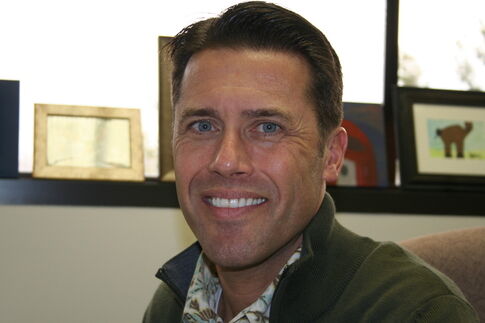
Bell, tanned, neatly groomed and flashing a winning smile at 49, looks like he is perpetually ready for a TV interview. When news broke in January that the gunman who killed children at Sandy Hook Elementary school had been diagnosed with an autism spectrum disorder, Bell appeared on news shows to denounce the idea that autistic people were more likely than others to be violent.
“Autism did not cause this horror,” he told CNN.
Today, Bell spends his days immersed in autism advocacy and research. Autism is now his life’s work.
It wasn’t always that way.
Bell’s life before Tyler’s diagnosis had nothing to do with autism or nonprofit groups. He was born in a suburb of Chicago, where his father was an investment banker and his mother is a real estate agent. He earned a bachelor’s degree at Cornell, where he met his wife, and went on to earn a master’s of business administration at Northwestern.
After grad school, Bell moved to Pennington and became a product director for Johnson & Johnson’s consumer product division, which is best known for Tylenol. In 1993, Tyler was born. At first appeared to be an ordinary child.
Bell said when Tyler was a toddler, he began to lose words that he had previously known. At first, doctors at the Children’s Hospital of Philadelphia thought his speech troubles were due to life changes like having a new brother in the house. But by age 3, it was clear that something else was happening. CHOP diagnosed Tyler with pervasive developmental disorder, not otherwise specified, which is a disorder on the autistic spectrum.
Bell’s life was turned upside-down. He wanted to help his son as much as possible. He wanted to do more than that: he wanted to cure autism. In 2004, Bell left Johnson & Johnson to become the president of a group called “Cure Autism Now,” which was raising money to fund autism research. When that group merged with Autism Speaks in 2007, Bell joined the board of directors of the latter organization. He has been involved with numerous other autism advocacy groups over the years and is now serving his second term on President Obama’s Committee for People with Intellectual Disabilities.
Bell said that in recent years, having realized that any “cure” for autism would take many years to develop, he has focused more of his efforts on helping people who have autism live the best lives they can.
“We want to create a future for those who have autism that allows them to live a life that has the most meaning, purpose and dignity,” he said. “And while it’s important, and we absolutely continue to fund research to, to use the analogy of our puzzle piece logo, put the pieces together, we want to do whatever we can to create a life that our children who have autism can look forward to right now.”
Bell said he thinks of Tyler constantly when working on programs for adults with autism.
“On the one hand, we are very proud of who he is and everything. But we also to a certain extent mourn the loss of what might have been if he didn’t have autism.”he said.
Autism Speaks has gone to great lengths to raise autism awareness, and Bell said those efforts have paid off. The group has lobbied for various bills in the federal government that have resulted in $2.5 billion being spent on autism research and programs and a vast expansion in the number of researchers studying autism, Bell said.
“When Tyler was diagnosed in 1996, probably a couple dozen scientists were studying autism, and today that number is probably 4 to 5,000 worldwide,” he said.
Most recently, Bell has been lobbying to make insurance companies cover autism services in their policies. Today, 32 states including New Jersey, require health insurers to offer policies that cover services for autistic people.
As head of the group’s family service division, Bell manages a crisis hotline, directs community grants and after-school and summer programs. Much of his work, he said, is helping educate parents about what to do if their child is diagnosed with autism. He said about three-fourths of Autism Speaks’ programs and services spending goes to research and the rest to family services.
Feld said that in his role as an adviser to the science division, Bell works closely with Geri Dawson, the chief science advisor.
“He’s not part of the scientific review panel, but he’s so well respected here that he certainly influences the direction of the research,” Feld said.
Some of the grants given by Autism Speaks support researchers who are trying to understand the causes of autism.
Bell said the consensus right now is that the brain is wired differently in autistic people, that the brain of an autistic person operates differently than in someone who does not have the disorder, and that research was revealing promising avenues for treating the disorder.
Bell said pharmaceutical companies are now developing drugs that could one day be used to treat autism.
Some of the autism research over the last decade has led to dead ends. In the late 1990s, following an infamous study published in The Lancet by Andrew Wakefield, researchers explored the possibility that autism was linked to vaccines.
“The reason it existed in the first place was that in the first years of life when most people receive vaccines is when the symptoms of autism start to appear,” Bell said. “Many people felt like it must have something to do with it because it coincided with the timing of the vaccines.”
The link between child vaccines and autism is now discredited. Wakefield’s study turned out to be fraudulent, and he was stripped of his medical license in Britain. Over the past 15 years, all the largest, best-designed studies of the issue have found no link between autism and vaccines.
Most recently, in January, the Institute of Medicine published a study reviewing the safety of the standard childhood vaccine schedule of the United States, in particular looking for evidence that vaccines were linked to autoimmune diseases or developmental disorders, including autism.
The study concluded that the recommended schedule of vaccines, which protects children from a growing number of illnesses, is safe and is not connected to autism or any other health problem.
“Clearly, the evidence at this point in time does not support that there is a connection between vaccines and autism,” Bell said.
That is also the position of Autism Speaks. Today, a statement on their website recommends parents get the full schedule of vaccines for their children.
The statement was posted in 2009, after Autism Speaks board member Alison Singer and scientific affairs adviser Eric London resigned because of the group’s continued funding of studies exploring the discredited vaccine-autism claim.
However, in a recent interview, Bell stopped short of ruling out funding more research on the subject.
“I believe and most people believe there will be multiple reasons why people develop autism,” Bell said. “Until we know what some of those causes are, I believe we should keep everything on the table. We continue to look at the research to see if there is a subset of the population that might be at risk. We are in favor of making sure that vaccine policies and products are as safe as possible.”
Bell said he recognizes that while all the scientific research has made great strides in helping people cope with autism, any potential pharmaceutical treatment is a long way off. Bell said he is focused on securing the best possible future for Tyler and other children and adults with autism. He wants Tyler to have a job and friends and feel like he is loved and appreciated by the community. And Bell believes there is no better community for Tyler than Pennington. Bell lived in Pennington from 2001-2004 before moving to California to lead Cure Autism Now. Bell said he could have moved almost anywhere in the country after the merger with Autism Speaks in 2007. He chose to move back to Pennington and work in the group’s Princeton office.
“We decided to come back to Pennington because it’s a community that very much embraced us for who we are,” he said. “It was a really good environment for all our children. We wanted to live in a community that is small enough for people to know who Tyler was and be an extra set of eyes and ears for him. Pennington offered that.”
In 2008, with an eye towards Tyler’s future, Bell co-founded the group called Advancing Futures for Adults with Autism. Tyler currently has some services provided by the Hopewell Valley Public Schools, but those services will come to an end when he ages out of the system at 21. Bell believes Tyler, and others like him, will have better lives if they can do productive work. Bell said he has been working to persuade companies that it is good business to hire people like Tyler who have autism-spectrum disorders.
“They can absolutely be very effective, skilled and capable workers,” he said. “They just need to give them a chance, and they can end up being really great employees. We’re doing everything we can to make companies and businesses realize that.”
Feld said Bell has brought seriousness and relentlessness to that task just as he has with many others over the years.
“He’s dogged about this,” she said. “He’s just as committed to this as anybody you could ever meet.”
,

