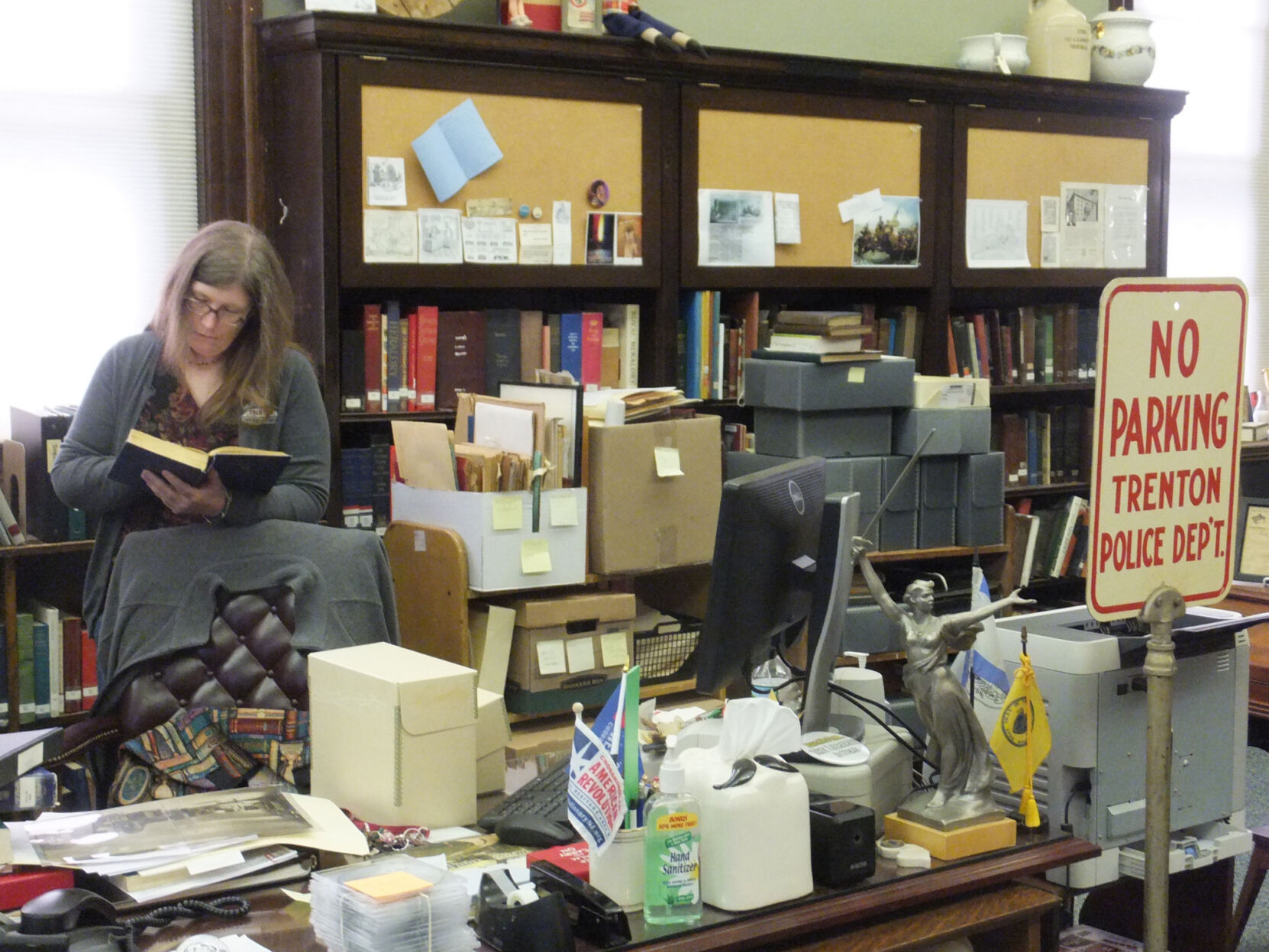
‘I’m looking for a photograph of Needham Roberts,” says Trenton Free Public Library archivist Laura Poll.
She stands in front of several boxes on a cart behind her desk and turns over photograph after photograph. “He’s an African American World War I soldier who received the Croix de Guerre (from France). I’m not having much luck,” she says about following up a New Jersey State Archives request for a photograph of the Trenton-raised war hero.
Poll looks up and says she will have to search elsewhere in the library’s Trentoniana Collection, a large room located on the ground floor of Philadelphia architect Spencer Robert’s 1902 American-Renaissance-styled building.
It’s a Friday afternoon and the time worn room with long work tables, card catalog files, and rows of books is quiet — not to disturb readers (there are none at the moment) but because there is a lull in the requests.
“It was crazy town in here earlier,” she says about the series of community members appearing in front of her desk with requests. One wanted images of storms and weather. Another was looking for information on buildings. Yet another was doing some general historic research. And then someone else “just wanted to look around” — perhaps to get a peek at the Trenton pottery collection displayed on shelves, the long-gone Trenton Academy’s device that showed its scholars how electricity works, or it could have been part of the wooden ceremonial arch that greeted George Washington during his 1789 Trenton stop — on his way to New York to be inaugurated as president.
Poll says it is surprising how many people have a passion for the room and its contents. “Sometimes they call it a hidden gem. Some are overwhelmed by what is here.”
Haven taken over the Trenton Public Library’s Trentoniana Collection in September, 2015, after 20 years at the Monmouth County Historical Society, Poll reflects the same feelings as those visitors.
She is enthused about the library’s hidden gems of history, including two books from the library’s original collection. The second subscription library in the colonies, it opened in 1750. Its founder was Thomas Cadwalader. His friend Benjamin Franklin purchased the collection’s first 50 books.
Yet she is also challenged by being a solo operation in charge of maintaining more than 200,000 photographs, hundreds of directories representing decades of names and addresses of city residents and businesses, a collection of nearly 100 pieces of art, rows of history books, files of newspaper clippings, and a card catalogs with thousands of handwritten notes that help keep track of everything. Yet it’s just part of an archivist’s Sisyphus-like routine, except the task keeps expanding as time and history continue.
“The collection is the only thing of its kind,” she says sitting down amidst the boxes and stacks of paper. “It represents the entire history of Trenton — from its founding to its industrial glory and to what is happening now.”
Part of what is happening now is that people are restoring their Trenton homes and looking for information on what their house may have looked like. “We have the 1930s tax records, which has a picture of all the houses. I think they go to the mid-1950s. So people can see if there was an addition or if something was changed. Then we have the regular photography collection of houses. They’re arranged by street. So a lot of people want to see what (the house) looked like before they moved in, to see what was there.”
Another regular research request deals with business. “We have people looking through business directories to find where a business was at a certain point. It’s amazing. It’s just directories that provide the information.”
The idea of looking and looking deeper is something that got Poll connected to the public this past winter when she gave her first public presentation at the William Trent House. The subject was the library’s collection of six paintings owned by Joseph Bonaparte and later given to the library. Her story was something more.
“I was going though our fine art collection,” she says. “There was a box that said Bonaparte paintings, and I thought that was interesting. And I did some research and tried to figure out what they were.” Then her detective story started.
The physical paintings had no indication that they belonged to the Bonaparte collection and descriptions were vague. Then there was the question of works being loaned or stored in other library offices or even other city buildings. “I thought it would be easy,” she says about hours upon hours of looking at works, looking at notes and other resources, comparing dates, and looking at styles. “But I could only identify three. The others may be somewhere in some office. But (the talk) got people interested. So (the search) is ongoing.”
That art piqued her interest wasn’t incidental. Poll, who was born in Red Bank and lived in Middletown Township, has a background in visual art.
“I wanted to be a photographer and went to a community college and worked in a photo lab,” says the daughter of a mechanic and a secretary. “When I didn’t think I could make a living being a photojournalist, I went to get an art history degree (from Montclair) and started working with the Monmouth Historical Society. I wanted to go into museum studies, but the librarian (there) said if you got a degree in library science you could get a job in museums or the Library of Congress or the Smithsonian.” Poll attended Rutgers University and received a master’s in 2002. When a colleague told her about the opening in Trenton, she decided she needed a new challenge.
While stating she’s “no Wendy Nardi,” the knowledgeable and loquacious Trenton historian who oversaw the collection for 15 years and for whom the Trentoniana room is now named, Poll calls herself an archivist who uses research skills to answer questions about the city. “There is an answer to everything if you just keep looking” is her motto.
The archivist in her also makes her think about the best way to share the collection with the largest group of people while preserving the objects, especially the photographs and documents.
“If someone is looking through the photographs, you have wear and tear,” she says pointing to the boxes. “But if the photos are digitized, you can put in a key word (and find it). My job is to make sure things are preserved for the next generation.”
Her job also requires her to write grants, including the one completed earlier that day to request support for scanning.
Poll’s work extends beyond the files and boxes and into the community. To help people know about the collection, she blogs about objects on the library’s Facebook page, provides presentations for community groups, arranges for groups to meet at the library, and welcomes artists and collectors to exhibit art or collections in display areas — including the cases outside the Trentoniana room and small gallery upstairs. “We had a little display by someone who drew dragsters. Someone came in during black history month and had a stamp collection. And I am hoping to get a display of old typewriters. If anyone has a hobby, they should contact me,” says Poll, who lives in Freehold with two dogs.
Since a frequently asked question is “what is the most important item in the collection,” Poll brings up the letter that President George Washington sent to thank the women of Trenton who greeted him at the arch. “It’s in a vault,” she says handing over a facsimile and saying, “It’s interesting that he refers to himself in the third person.”
After saying “You haven’t asked what my favorite object is,” she points to the library’s painting of George Washington crossing the Delaware River. “It’s by William Pedrick, an instructor at the School of Industrial Arts in Trenton and publisher of Acme Magazine, and illustrator. This painting was a controversy because he was challenging the more familiar painting (German artist Emanuel Leutze’s famous painting at the Metropolitan Museum of Art). Leutze uses German ice flows. There was no American flag at the time. And they are going in the wrong direction. The painting that Pedrick did is accurate. The ice is more accurate.”
Then thinking back to her early studies, Poll smiles and says, “Pedrick’s my art history crush.” She then sits quietly and looks at the boxes where the elusive Roberts photo waits to be found.
The Trenton Free Public Library, 120 Academy Street. Trentoniana Collection open Monday by appointment, Tuesday through Friday, 10 a.m. to 4 p.m., and the first Saturday of each month, 1 to 4 p.m. (609) 392-7188, ext. 20 or trentoniana@trentonlib.org.
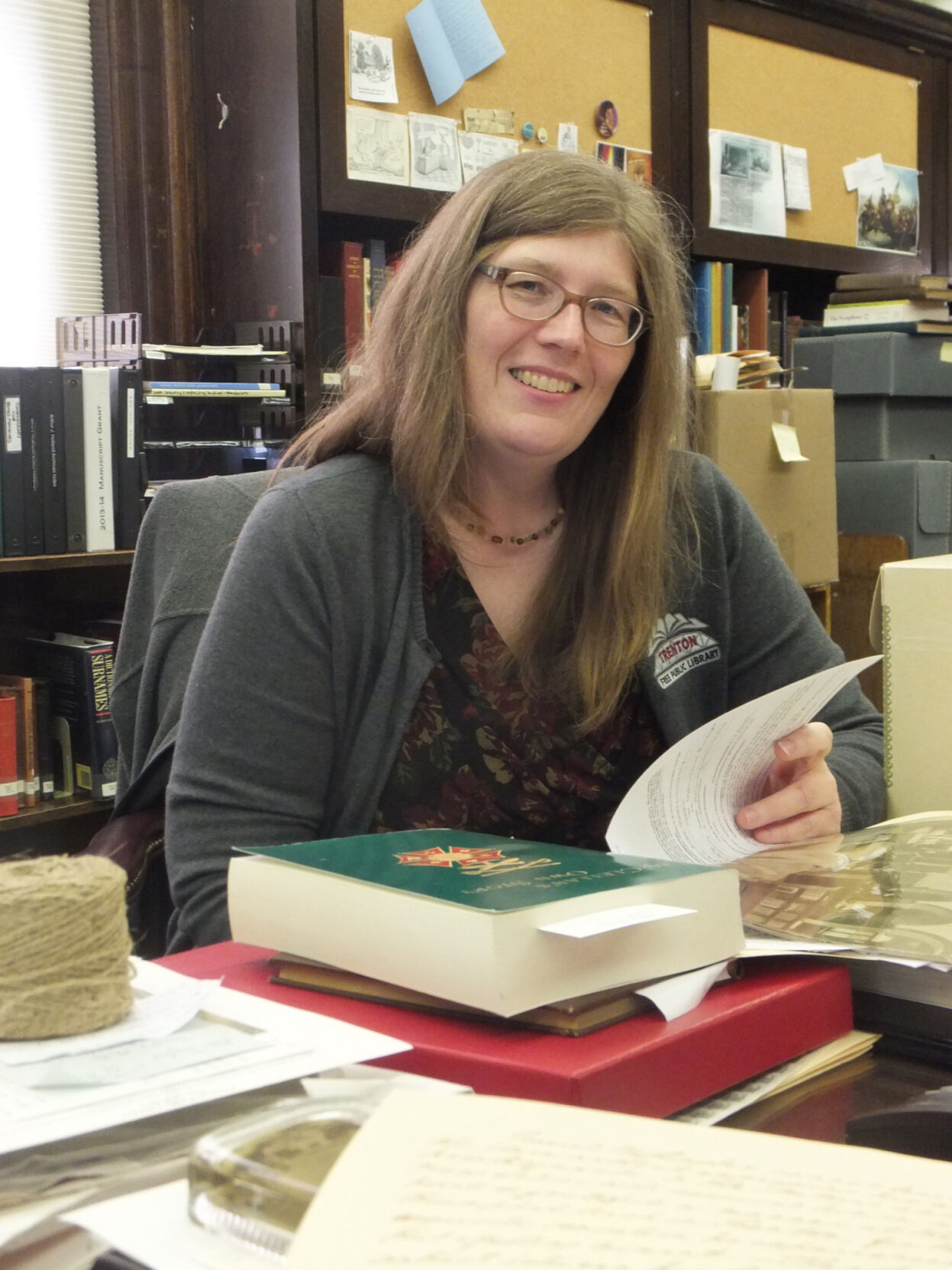
Laura Poll brings her art history background to the Trentoniana collection.,