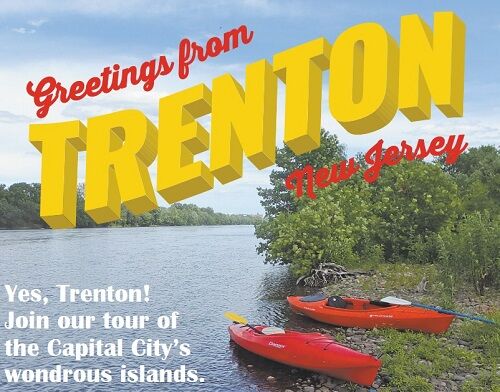
Trenton residents and workers daydreaming about an escape to an island can wake up — the opportunity is just a stone’s throw from the shores of the Delaware River.
It is no fantasy. The city of Trenton has at least three defined islands in its borders — including one easily spotted from state office buildings. And while they are mysterious islands for some, they are regular stops for others — one is even a piece of private property.
Long intrigued by the isles of Trenton and hearing tales of a hospital-camp on one, I took my kayak and followed the tide for my own island adventure. Here’s what I learned.
The largest of the Trenton islands — and the one with a ready amount of documentation — is Rotary Island. Upriver at the northern line of the city’s limits, its approximately 30 acres run parallel to the city’s Glenn Afton region and stretch south towards the Trenton neighborhood called the Island — part of the city once cut off from the mainland by a canal that was eventually filled to create Route 29.
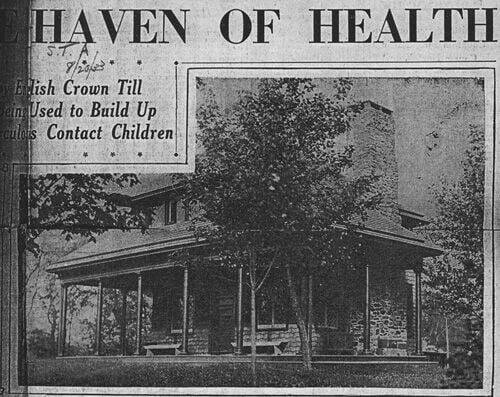
Rotary is a good place to start the tour — but first, some intriguing history. A 1933 Trenton Sunday Times-Advertiser front-page article capsulized the island with the headline “Trenton’s Paradise Haven of Health — Rotary Island, Owned by English till Days Revolution, Being Used to Build Up Strength of Tuberculoses Contact Children.”
While a good start, the banner line and story fall short by forgetting the Sanhicans. That’s the Native American group who lived along what is now the Trenton and Morrisville shores. They are mainly remembered in the town by Sanhican Drive and — in an ironic turn — Sanhican Liquor Store.
The Sanhicans are also missing in another important Rotary Island history account: two reports written in 1954 and 1964 by Trenton Rotary Club member Joseph Kessler, who documented the island’s highs and lows in the 20th century. The papers are part of the Trentoniana Collection in the Trenton Free Public Library.
Kessler leaps over the 18th and 19th centuries — when the island was named for the Gould and White families — and starts his report in 1917 with Trenton Rotary Club president William Maddock proposing the club purchase the island from the Park Island Canoeing Association, which had purchased the island in the late 1800s and built some clubhouses.
Maddock’s plan called for the island to be renamed after the Rotary Club and used to help “the anemic and deserving children of Trenton.”
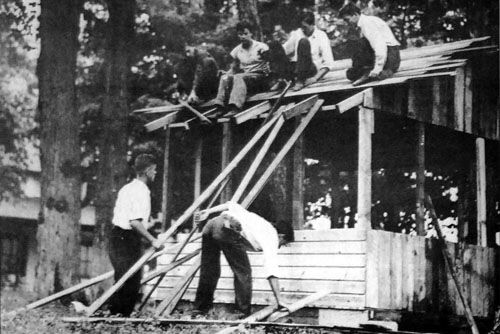
The club, in partnership with the Mercer County Health League, embraced the plan, and all seemed to go swimmingly for the next 20 years — an era that still lives on in the age-yellowed Sunday Times-Advertiser story with photos of period camp buildings with verandas, stone chimneys, and electricity, and scores of children in bunks in open wards and on the beach.
Those golden days were followed by changes in operations, starting with the Trenton Rescue Mission, which rented the island and made renovations and improvements “to make a top flight camp.” They also used an “army duck” — an amphibious vehicle — to bring youngsters to the island.
However, by the late 1940s the camp’s economic fortunes went out with the tide. Participating groups couldn’t pay the bills, and plans to improve access to the island and fresh water supplies were turned down because of heavy costs, noted Kessler.
Meanwhile Rotary expenditures mounted up, thanks to general upkeep, insurance, and the cost of a caretaker — “necessary for insurance reasons” — who died while trying to escape the island by boat during a winter storm in 1951. By the end of 1952, the organization was dealing with lack of member interest, property vandalism, and city taxes.
Wrote Kessler: “Real estate developers had evinced some interest in the purchase of the 31-acre island which is wholly inside the limits of Trenton. These interests never developed in anything approaching an agreement. The City of Trenton likewise showed interest, but because of restricted funds, could not promise any immediate development of the grounds for community use.”
Then, as Kessler wrote in 1964, there was “one ray of hope.” The city’s planning director introduced the idea of the island becoming part of the state’s “Greenacres.”
Today the Rotary Island is part of Washington Crossing State Park. Since plans to build a bridge to Rotary Island never materialized, a trip to it — and the other Trenton islands -— requires planning.
Yes, the islands are close — perhaps a few football field away — and one can perhaps wade or swim. Yet danger is close too, and the Delaware River’s fast-moving waters, slippery rocks, drops and holes, undercurrents, and sometimes low temperatures can strike unexpectedly — as attested by the newspaper articles reporting a spike in deaths in the river in 2015.
Light crafts are the better ticket for passage. Yet launching can be a challenge. So unless one lives along the river, like the Island section residents, explorers will first discover that a launch from Trenton’s riverbank is impeded by concrete walls, steep bluffs, difficult river access from the road, and problems finding parking.
Likewise, across the river in Morrisville and Yardley, bluffs, acres of private property, lack of street parking, and “keep out” signs can leave a potential river traveler high and dry. And while there is an easy public river access in Morrisville, it is a few miles from Rotary Island.
So what did I do?
After a fact-finding drive along both sides of the river and looking for that elusive easy-river entry with close proximity to the Trenton islands, I — accompanied by my intrepid wife, Liz — launched at the northern tip of Stacey Park. That’s the mile or so walkway starting at the Trenton Water Works and heading north between the river and Route 29. With easy street parking and a path that — while steep — provided easy access to the river, we were quickly on the river and starting our Saturday afternoon expedition, paddling north against a strong, fast-moving current and exploring from the north down.
A half-hour or so later, Rotary Island stood silently before us. Think of it as a green beguiling sphinx — one whose high banks, twisting poplar trees, and dense vegetation rising out of sparking blue waters challenge a visitor to remember that he or she is still in the capital city of the most densely populated state in the nation.
My wife and I stopped several times on Rotary’s uneven shore. Sometimes it was to listen to the musical sound of water rushing over exposed stone beds, sometimes to walk along the island’s rocky perimeters, and sometimes to attempt to penetrate the interior and search for the remains of camp buildings — an effort thwarted by dense undergrowth and a need for clothing more protective than shorts and water shoes.
Yet other discoveries presented themselves. One was that the river cut off one section of the island to form another smaller one. According to land maps, that’s the section owned by the city.
Another discovery was the presence of clams, small while shells gleaming on rocks. While there is a native fresh water clam with an elongate shape that can reach over four inches, the ones I found were the invasive Asian clam. As New Jersey State Museum natural history curator David Parris told me later, “the Asian clam is especially common around Trenton, coming up into small drainages. They are reproducing here in vast numbers and are considered a pest, clogging waterways and pipes and crowding out native species.”
Then there were the tracks of deer that swim to the island. Their presence in turn attracts a special type of predator — hunters who come to the island to legally track game and leave behind shotgun shells glowing gold and red in the shallows. The hunters, according to various newspaper articles, also cause Trenton riverside homeowners to get the jitters and call the police to protect them from errant gun shots.
This all got me to wondering how the island was monitored, and I contacted the New Jersey Department of Environmental Protection to find out how it was maintained and if there were any plans for its future. The answer is “not much.”
An e-mail from the State DEP noted, “Due to its location and lack of facilities, the island is a passive use recreational space only. As such, the island is not staffed by (Washington Crossing) State Park personnel. The DEP does not have any plans for Rotary Island.”
I also got to thinking about Trenton people hunting and returning to the wild on the islands, but I discovered that it was not a new idea. In fact, it was something already connected with the next and very close island, Blaugard Island. The name, according to “Paddler’s Guide to the Delaware River,” refers to the island’s old time reputation as “a favored resort of indigent gentlemen of leisure.”
Quick research shows the name as a derivative of “Blackguard” — or a bad person — and another variation is the colloquial “blaggard.” Shorter in width and length (just short of 9 acres), less lush, and more easily approachable than Rotary, Blaugard, on this particular afternoon, was attracting visitors whose comings and goings indicated they were mostly from the Pennsylvania side.
As we approached the island we spotted groups of adults and children — mainly Caucasian — playing ball and barbecuing near the area where they pulled their inflatable rafts ashore. Nearby young men and women — some wearing “thongkinis” — came ashore in kayaks and disappeared into the woods.
And at another point of the island, a group of adult men and women had raised several tents and were cooking. As my wife and I came closer, the “islanders” stepped back into the trees, watched us, and waited for us to pass — all in eerie silence.
What makes Blaugard Island even more of a puzzle is that despite having no water, electricity, or signage, it is a privately owned city property and is up on its taxes. According to a City of Trenton official, the island changed hands several times in the 1900s with a paper trail showing William Wychoff acquiring it in 1928, James Russell Clark in 1948, Joseph Coccia Jr. in 1970, and then Phillip and Genevieve (Coccia) Nicastro of Whippany, New Jersey, in 1999.
Since it was unclear if the owners knew about the activity on their island, had insurance, or were developing plans for the island’s future, I attempted to communicate by telephone and mail. The answer was more silence and a growing sense of mystery.
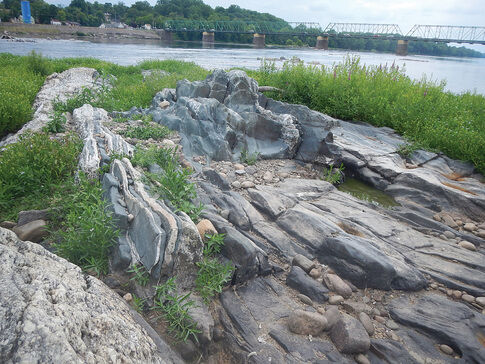
The third island is the smallest — perhaps an acre or so. Yet with its proximity to the Capitol Complex, Route 29, and the Calhoun Street Bridge, it is the most visible. While city records have no name for it, the “Paddler’s Guide” calls it both Yards and Fishing Island. And since flooding frequently submerges the island, the city and state do not consider it a place. But the eye and foot tell a different story.
Whatever it is or called, it is a mile and a half from the southern tip of Blaugard Island. Since the tide was moving hard to the south and would add considerable time and effort to reach it from the north, I decided to re-start this portion of the trip from a small public launch area close to the Calhoun Street Bridge on the Morrisville side of the river. This time I went solo.
Again in a matter of minutes I was island-bound and moving south under the car rumbling bridge. Heeding the “Paddler’s Guide” about the swift currents coursing through the wing dam between the island and the city, I paddled in from midstream. I also used a helmet, in case I tumbled in this generally shallow and rocky section of the river. Within 15 minutes my kayak reached the island with no or two names, and I was standing on a bed of rock surrounded by fast-moving waters.
As I stood there alone I remembered that the Sanhicans referred to the area as “assunpink” or “stone in the water.” I also thought of how many of us in Trenton had become cut off from the river — and not surprisingly found that the phrase “river of life” was running through my thoughts.
As I moved into a small section with shin-high flowers, I looked over to the Capitol Complex with its gleaming statehouse dome and the New Jersey Department of State and State Museum buildings where I had worked years ago and would often gaze out at this small island and fantasize about it.
Now I was on it, staring up at the other side of that window. In the fresh breeze and amidst the bright sound of running water, I enjoyed the sensation of finally escaping to these forgotten islands in the stream — and returning with a tale to share. I just wonder why it took me so long to wake up.
trentonnj,
,