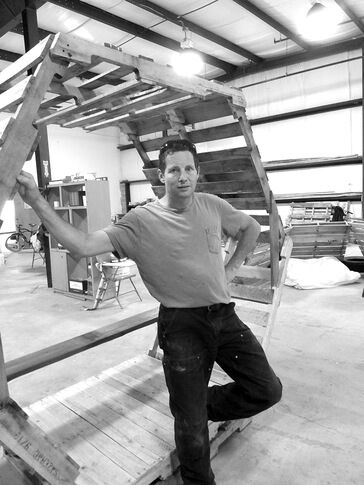
Peter Abrams shows off a bee-inspired B House in the Hive.
By Dan Aubrey
The Hive – the flat utilitarian metal building at 307 North Clinton Avenue in Trenton – is a bee-inspired space that organizers hope will also be inspiring.
The work place for several downtown Trenton activist-artists — including muralist Will “Kasso” Condry, bicycle-artist Wills Kinsley, the art candle-maker artist known simply as Messiah, filmmaker Anthony Juno, community organizer Jonathan Gordon, designer and community activist Graham Apgar, and artistic-designer Peter Abrams – the Hive is a nest of creativity.
Officially called the Hive Community of Art and Design, the effort’s mission statement says the idea is “to connect the Greater New York City area generally and the City of Trenton specifically to the space, tools, materials, and educators that lead to an empowered community by way of craft and self-guided design education. In addition to providing an industrial-size workspace to artists and designers excelling in their fields, The Hive will also provide to users of the space post-consumer and post-industrial materials sourced locally from which to perform their self-guided experiments in product development and mentorships.”
Juno, who is exploring a nonprofit structure for the groups, says that the project builds on the paths that have been laid down over the past few years in the Trenton art scene. “While there has been much success in putting art out into the city through SAGE Coalition and Art All Night, The Hive aims to bring the city and surrounding areas into one creative workspace where they can experiment, create, exhibit their own work. Artists and designers in the area will find inexpensive studio space, common workspace/tools and a knowledgeable community of creatives. We will also be hosting workshops and openings.”
One connection to the recent past is Pete Abrams who provides a glimpse into the activity and personality of the space.
On a recent afternoon, Abrams gestures to the small hexagon-shaped unit that mimics a honey bee cell and hive, and says, “There’s a social aspect with a beehive. And there is a sense of community and structure that we are trying to make in this space.” He is talking about his current work – the B Homes, the portable structures that he — along with Graham Apgar — is manufacturing.
Abrams – stimulated by the potential of the fluid language as well as the opportunity for puns — calls the bee-inspired structures and his company B Home LLC. The “B” in the name, he says, “started as ‘bee,’ and then went to ‘B’ as in ‘Plan B’ to serve as an emergency shelter.” He adds there is also the idea of “be,” as in “being.”
Abrams connects the B Houses – using an architectural design to maximize simplicity— to a variety of uses, but mainly the social, “Everyone deserves decent shelter. I see (the structures) as an emergency shelter.” Or easy-to-build and affordable buildings created for the homeless or displaced.
Their affordability is based on the fact that they can be made from handy, often recycled materials — mainly 40-by-48-inch discarded shipping pallets. The houses are also easy to build, thanks to the design plans the B Home provides online at thebhome.com.
“On our website we have the rendering and plans and as much detail as possible, including measurements and angles. We are open-sourcing everything we do regarding copywriting. It is the best way to get the project out there and get feedback. I would like to see how others do (the units) and get some feedback from them. It’s cross-pollination to get other ideas. I want to disseminate ideas and create a buzz.”
Abrams says that his entry into creating B Homes was with the mobile bread truck. He and a graduate student from the Parsons School of Design were commissioned by Princeton University cultural anthropologist Nadezhda Savova. As a UNESCO consultant, Savova looked for an art form that crossed international boundaries. During a visit to Bethlehem — the name means “house of bread” — she realized that bread-making and bread-breaking were universal and had the power to engage.
Now the B Bakery is a familiar presence in the region, seen over the past month at the Roberto Clemente and Gandhi Garden parks in Trenton, the annual Art All Night event, and monthly at the D & R Greenway. “It gives people an opportunity to get together in a neutral territory, a place where you can sit and talk. And kids in this area (of Trenton) don’t have an opportunity to connect with their food. So there’s an educational aspect.”
In addition to making the B Homes that he also sells to clients, Abrams is busy working on commissions, including creating decorative planters from used tires for the Trenton Downtown Association.
While known to many in the region for his design work that uses metal cables to create fire pits and furniture – exhibited at the Trenton City Museum — and for his establishing the influential Trenton Atelier, Abrams, 53, was born in New York City and raised on 77th Street and Columbus Boulevard, near Central Park. His father was a salesman and his mother worked for First Women’s Bank.
He says a lot of the sensibilities that he uses to think about designs and their social applications “might come from growing up in a very diverse neighborhood and city and being exposed to certain realities at a young age.” His decision to study design and art history includes study at Cornell University, Evergreen State College in Washington State, and the University of Wisconsin – where he became a member of the sustainability-oriented Nottingham Co-Op. He also studied glassblowing in France.
Abrams – who is married and has three children – readily chronicles his journey from New York to Trenton, including a move to Princeton where his wife’s family was located. “I got a job at the Johnson Atelier in the fabrication department, making other artists’ work. It was a great place after hours. You could work on your own stuff. But I got fired, moved on, and opened up a shop at the blacksmith shop on Olden Avenue (in Trenton and one of the only blacksmith shops in the state). I was doing fire bowls out of wire rope. It was a natural synergy. Trenton’s the birthplace of wire rope. I was also making things out of iron and found objects: picture frames, furniture, couches, chairs, coffee tables, fire bowls.”
Accustomed to city life and work, Abrams eventually became more and more involved in Trenton and rented studio space in the building owned by the late city entrepreneur, artist, and two-time mayoral candidate Frank Weeden.
With an interest in having his own space in Trenton, Abrams discovered an abandoned property nearby at 20 Allen Street. He — along with two partners — purchased the property for $10,000 and in 2005 created the Trenton Atelier. It was an enterprise that brought artists into the center of the city and a community that involved artists, college students, recently released prisoners, and anyone wanting to join in.
While it created an arts movement, it also created headaches: when the partner relationship went sour, Abrams faced bills and back taxes alone. “I got burnt out. I had been working with Princeton University and was moving on. My wife was not interested. I was trying to make everyone happy. The shop had issues. It was broken into five times in one month.”
Abrams says his recent return to Trenton is simple and that the new place suits him. “Princeton is not for me. Trenton is where I belong. There is not really a place in Princeton to throw them around and make the mess that I make. The space is a great place.”
With safety in numbers and experiential wisdom, the Hive is setting up some formal arrangements for members to keep the doors open: incoming members will make a commitment to pay a monthly workspace fee ($100 per month was mentioned) and agree to work cooperatively. The group is also devising a plan for visual art exhibitions, small venue concerts, and stylized dramatic events or readings.
“We want to encourage those who value creativity and have a strong desire to enact positive social, cultural, and economic change to apply,” concludes the Hive’s mission statement — an inspiring beginning.
The Hive Community of Art and Design, 307 North Clinton Avenue, Trenton. For more information, go to www.facebook.com/thehivetrenton.
,

