By Dan Aubrey
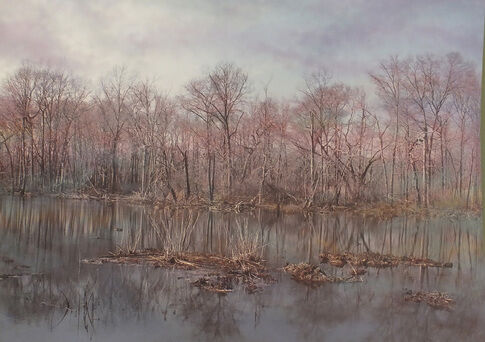
The great outdoor expanse of the Abbott Marshlands (formerly known as the Hamilton-Trenton-Bordentown Marsh) is the focus of an indoor exhibition on view through Sunday, November 16, at the Trenton City Museum in Cadwalader Park.
The exhibition features art work, archival objects, and artifacts to highlight a natural and historical phenomenon and grew from the efforts of the Friends of the Abbott Marshlands, the new Tulpehaking Nature Center in Hamilton (at the entrance of Roebling Park), and the Trenton Museum Society. The New Jersey State Museum is participating through the loan of artifacts.
The exhibition’s title “Abbott Marshlands: More than Meets the Eye” makes sense.
While many people in the region know the approximately 3,000 acres of tidal wetlands between Trenton and Bordentown by traveling over it on Interstate 195, what they most miss are the features that make it one of the most historically and ecologically important places in the state.
Below the highway are waterways that have been used by men and women for 13,000 years, and on its shores are buildings and structures that serve as testaments to region’s history. That includes the oldest house in the region (the 1708 Isaac Watson House) and the remains of the mansion built by Joseph Bonaparte, the former king of Spain, brother to Napoleon, and area resident for nearly two decades.
The wetlands’ environmental importance is connected its ability to provide a habitat for wildlife, contain floodwaters, recharge groundwater, and remove pollutants.
What is also missed is that a marsh site of the farm once owned by archaeologist Charles Conrad Abbott (whose name is now tagged to the region) is a National Historic Landmark that recognizes the continuous Native-American presence from times before European civilization.
National Historic Landmarks are designated by the United States secretary of the interior because a site possesses “exceptional value or quality in illustrating or interpreting the heritage of the United States.” The site received the designation in 1976.
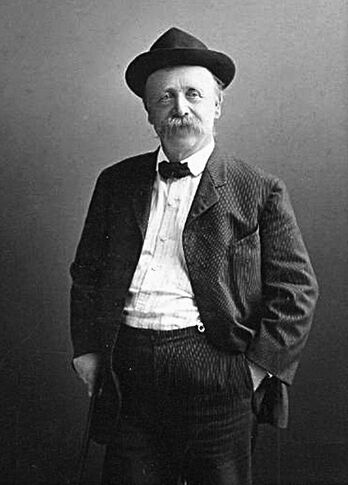
Abbott was born in 1843 in Trenton and lived a major portion of his life along the wetlands between the capital city and Bordentown. Though he graduated with a medical degree from the University of Pennsylvania in 1865, he devoted himself to being a naturalist, archaeologist, and author.
An abundance of Native American artifacts in the Trenton region fueled his interest, and in 1872 Abbott wrote the article “The Stone Age in New Jersey” for the American Naturalist. Abbott’s voracious collecting and studying spawned a theory that Native Americans had been in New Jersey far longer than anyone had previously thought and that the Trenton artifacts were comparable in age to the most ancient human artifacts found in Europe and Africa.
Abbott shared his ideas with other archaeologists and geologists, including the influential anthropologist Frederick Ward Putnam of the Peabody Museum at Harvard. Through Putnam, Abbott’s Trenton sites became the focus of a 20-year field research program, attracting leading American and European scientists. While he was proven wrong, Abbott was a well regarded scientist whose theory attracted attention and turned Trenton into an important archaeological center.
Abbott’s unprecedented work helped pave the way for Dorothy Cross, a notable figure in American archaeology and New Jersey history. Cross came to the New Jersey State Museum in 1929, conducted archaeology at Abbott Farm during the WPA, wrote volumes about New Jersey’s archaeological history, and added artifacts to the New Jersey State Museum collections.
Some of the site’s artifacts on view in the museum exhibition include pieces of pottery, which presents yet another mystery: design. Since there had been little design work previously found, it bewildered and enchanted researchers, with an archaeologist from the Museum of Natural History saying in 1910 that they are some of the most beautiful and intricate designs east of the Alleghenies.
In addition to the artifacts and related materials owned by Abbott, the exhibition features images by 38 regional painters and photographers. Trenton Museum Society member Jack Koeppel curated.
Since the current show is based on the Friends of the Marsh’s ongoing exhibition called “Voices of the Marsh,” many of the artists have frequently gone to the marsh for subject matter. And while some internalize the images to create expressive art, others take a documentary approach and bringing the outdoors in.
The works are more than meets the eye.
Abbott Marshlands: More than Meets the Eye, Trenton City Museum, in Ellarslie Mansion in Cadwalader Park, Trenton, continues Tuesdays through Saturdays 11 a.m. to 3 p.m., Sundays 1 to 4 p.m., through Sunday, November 16. Free. 609-989-1191 or www.ellarslie.org.
On Sunday, November 2, 2 p.m. William D. Guthrie, a noted authority on the Lenape people, will discuss how the Lenape Indians lived at the Abbott Marshlands. The presentation will include authentic materials and artifacts including primitive tools and describe how the Lenapes gathered and prepared food, made leather to be used for clothing, constructed their homes, and used music. $10.
,