If you concentrate on a story, staying mindful of its nature as a living, breathing vessel for keeping traditions alive or unpacking trauma, then you might be able to hear when the speaker, once given the chance to share without judgment and forge interpersonal connections, exhales in relief. The words used still have meaning but no longer bear their heavy weight alone, newly empowered by a mutual sense of community and revitalized by human interaction.
Everyone has the right to express themselves in their own syntax, but only a few people have the opportunity to amplify that point of view with complete control over the language used. Reaching that loud volume, like any tale worth telling, is always better with company.
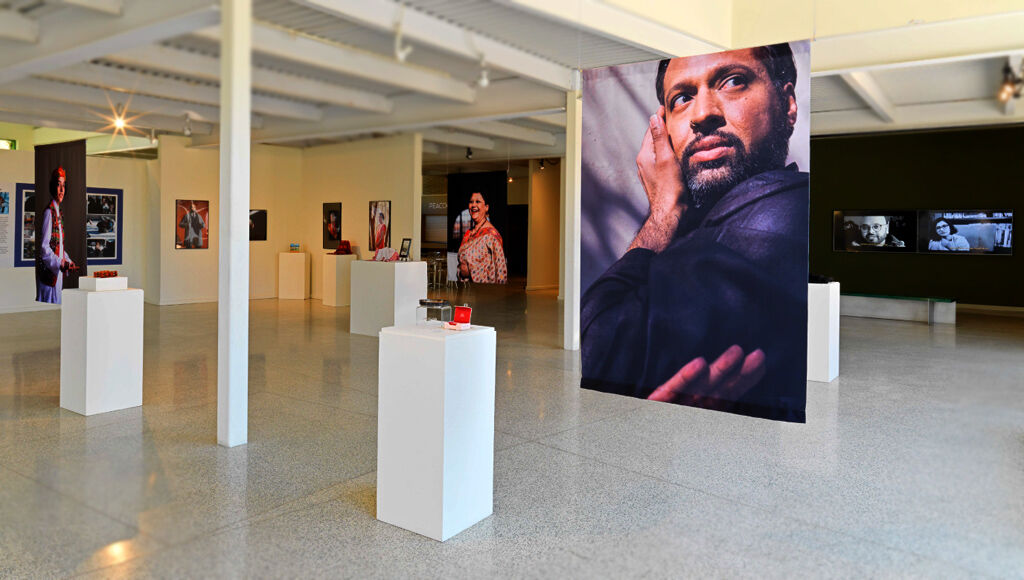
Grounds for Sculpture in Hamilton presents this platform to members of New Jersey’s Indian diasporic community for “Local Voices: Memories, Stories, and Portraits,” a living exhibit that opened on the ground floor of the Domestic Arts Building in April and runs through January 7, 2024.
This project, along with “Spiral Q: The Parade” on the upper level, are the first to debut in GFS’ new “Perspectives” series, which draws from the creative practices of the artists at its helm as well as the accounts of the people who bring it to life.
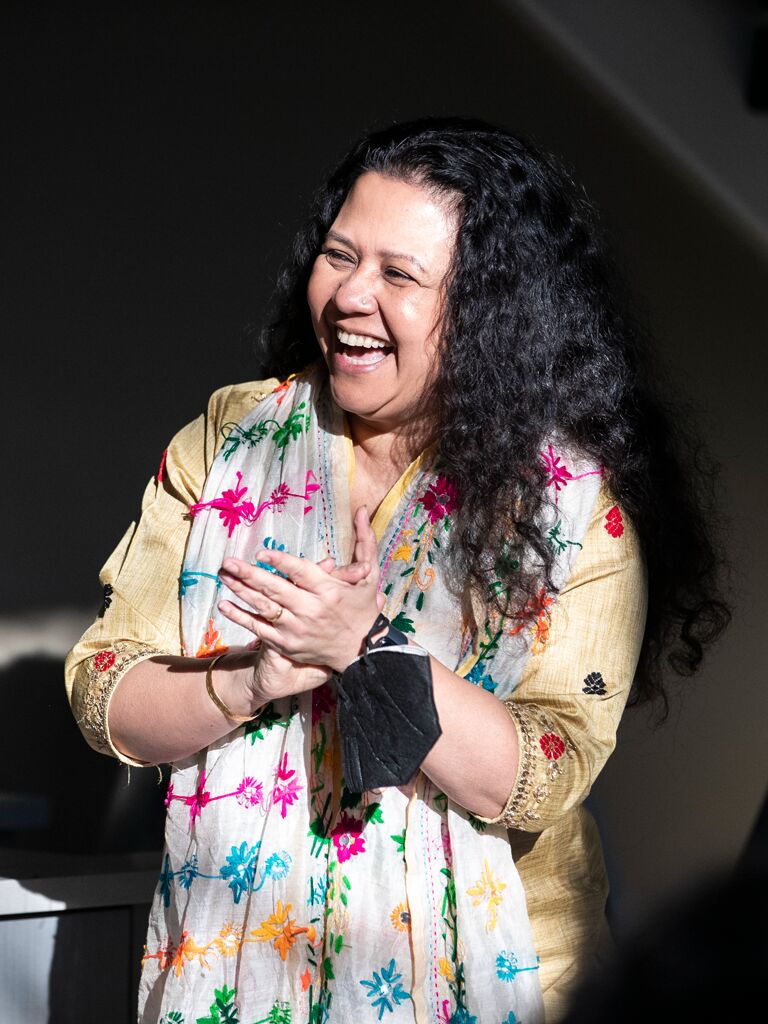
Madhusmita “Madhu” Bora, a folk and traditional artist, journalist, educator, writer, and dancer, organized the exhibit in partnership with co-curators Kathleen Ogilvie Greene, the chief audience officer at GFS, and Quentin Williams, the founder and CEO of Dragon Tree Media Group, to ensure personal autonomy and authenticity. The 15 subjects actively participated in and led the process of chronicling their lived experiences, doing so through video interviews, photography, and by choosing objects that held significance to them.
This range of deep, emotive stories maintains the vulnerabilities that make them unique without being exploited, and the exhibit leaders hope to bridge the conversational gap between individuals of different backgrounds and demonstrate the importance of dialogue.
Upstairs, “Spiral Q” conveys the creativity behind activism via puppets and protests, with the Philadelphia-based group organizing processions on social issues from transgender rights to affordable housing.
Virtual walkthroughs of both exhibits are available online, with the “Local Voices” page on the GFS website, groundsforsculpture.org/exhibitions/local-voices-memories-stoaries-and-portraits, linking to the YouTube videos and audio-only interview segments for each storyteller.
According to the exhibit materials, Grounds for Sculpture developed this project in response to the museum’s 2021 audience demographic census, which revealed a correlation between its attendees and the United States Census for those who self-identified as Asian.
To interact and engage with a specific community from that group, GFS collaborated on an exhibit in which people could share their stories as a look at the Indian community in New Jersey, described as “the largest ethnic group among the Asian diaspora” in the state.
According to the Indian American Impact Project, an organization that was founded to promote the voices of Indian Americans and South Asian Americans in politics, “nearly 5 percent of New Jersey’s population is South Asian, more than any other state in the nation.”
The website continues that “over 1 million Asians live in New Jersey, with Indian Americans making up the largest ethnic group,” particularly concentrated in Middlesex County — Edison and Iselin’s Oak Tree Road, known as “Little India,” is a bustling shopping district at the cultural center of the community.
According to a May 2022 Washington Post analysis of Census Bureau data from 2020 in “An American life: How Asian migrants built unique communities,” Mercer County itself recorded a 48.2 percent growth of Asian American and Pacific Islander, or AAPI, populations since 2010.
The four storytellers from the Mercer County area are Shazard Mohammed, Hamilton/Ewing; Shivani Patel, Princeton Junction/West Windsor; Yogesh Sharma, Lawrenceville; and Shoba Panoli, Pennington.
“My whole intention was to uplift and celebrate the diverse tapestry of India,” Bora says in an interview, noting that she worked alongside the GFS team, especially Greene, to identify demographic “lenses” such as age, language, religion, economic status, immigration, ability, region, caste, and sexual orientation to incorporate a wide spectrum of storytellers. Each subject was then liberated from these labels, symbolically unchecking the boxes, as the exhibit materials explain, and prompted to recount a story that affected their life.
“Local Voices” expanded as Bora began to see the emerging pattern of personal agency in each narrative, creating a colorful mosaic of people with roots across India and the globe who collectively followed at least seven religions and spoke more than 10 languages.
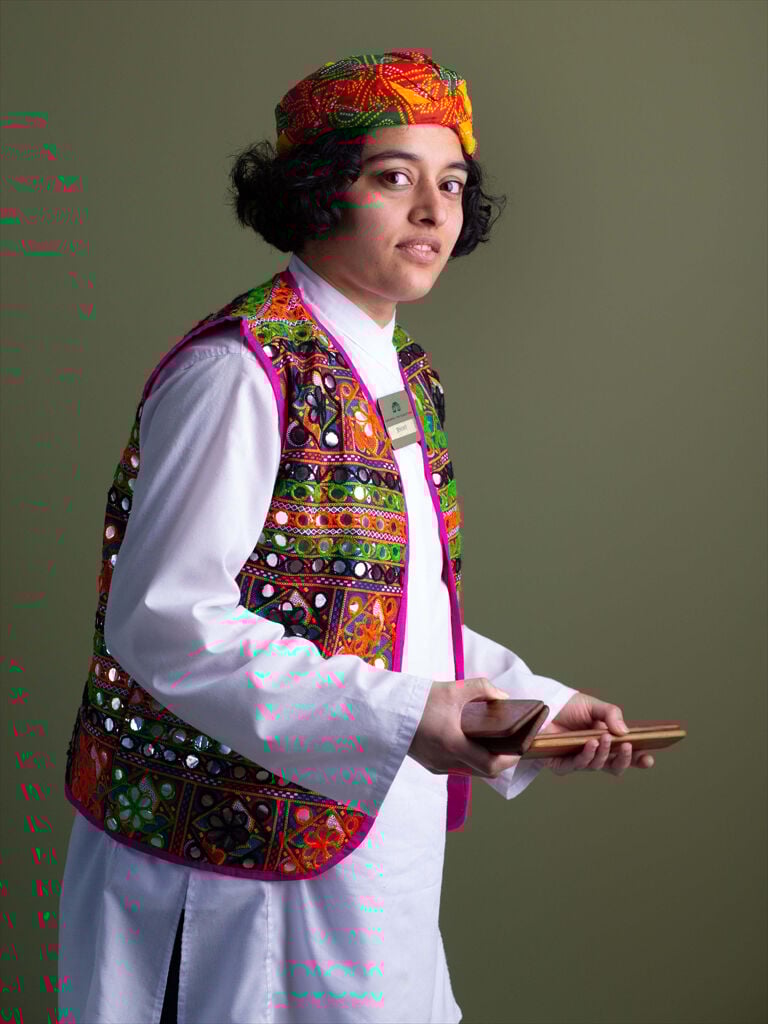
After seven months of planning, the group gathered at Grounds For Sculpture for an all-day retreat in February that included storytelling workshops and training, as well as individual photography sessions in which the subjects “were asked to arrive in clothing [that] made them feel powerful and celebrated,” according to the GFS exhibit page.
The speakers then collaborated with female BIPOC (Black Indigenous People of Color) photographers to envision portraits capturing their most authentic selves, selecting which image would be on display. At the end of the retreat, many of the storytellers left behind objects of significance and scheduled their respective video sessions.
Although the subjects spoke for hours at a time with Bora and photojournalist Danese Kenon, the managing editor of visuals for the Philadelphia Inquirer, the exhibit could only feature a single three- to five-minute story from each person.
Bora discloses that the full versions would be preserved in a personal copy for the participants as well as in the archives of the exhibit partner, the South Asian American Digital Archive, or SAADA, to document the comprehensive oral histories.
“Local Voices” is a “living exhibit” focused on cultivating relationships over the program itself, but the theme of art with a pulse is familiar to Bora and a natural extension of her own craft.
Originally from the Northeastern Indian state of Assam, Bora received undergraduate and master’s degrees at two institutions in New Delhi before continuing her studies at Northwestern University’s Medill School of Journalism, where she earned another master’s degree.
Bora has worked in newsrooms around the country, tackling business and technology at papers from the Philadelphia Inquirer to the Tampa Bay Times. She lived in places like Washington, D.C., Iowa, and Indiana, even settling in Cape May for a three-year period where she wrote for the Press of Atlantic City. She has lived in Philadelphia since 2008.
While she continued to freelance, Bora decided to experiment with her artistic inclinations and co-founded the Sattriya Dance Company with her sister-in-law, Prerona Bhuyan, in 2009.
Sattriya is a living dance tradition that originated in the Hindu monasteries of Assam more than 500 years ago. Although the art form had been traditionally practiced by celibate monks, the Indian government recognized Sattriya as a major Indian classical dance in 2000, which led to more women “embracing” the art form, Bora says.
Bora is currently an adjunct instructor at Lincoln University and has since returned to the newsroom as the managing editor of suburban coverage for WHYY, a Philadelphia public radio station.
“As a practitioner of this art form, I am drawn to stories. I’m also deeply aware of what it means to not be represented in mainstream art tapestries; it is so specific and nuanced. I guess it makes me a lot more sensitive to folks who are in the margins, because I feel like I operate from the margins, too, with my art form. My journalism is a sense of inquiry and curiosity, and that training of being objective, listening to people, and asking questions is what informed and drove this project,” she explains.
“Everything I do informs how I move in this world. As a trained journalist, I’m always curious about the world around me. I was raised in a household of storytellers and disruptors,” she adds. “I grew up with my grandparents in a very rural Indian town, surrounded by art and culture and discussions of politics. Both my grandfathers were freedom fighters, and so I was raised in this atmosphere where culture and stories were always part of my education in this world.”
“Then, as an immigrant living in diaspora, I’m always thinking about what it is like to be an immigrant, how important our stories are, how important identity is, [and] how important stories are in terms of also passing our experiences and wisdom to the next generation and connecting us to our habitat. Stories connect us in very, very deep ways as humans.”
“When somebody’s sharing a story with you, it has a very spiritual overtone, because it’s something very sacred that somebody’s trusting you with their vulnerabilities and their experiences,” Bora says. “Especially when people who do not have a chance to tell their story are invited to share their story. They are transformed, and we are transformed from listening to their experiences.”
The response has been “overwhelming” from both local and Indian media, according to Bora, with the exhibit having attracted about 500 or so attendees on opening night alone.
Bora says that because of her initial focus on the practical, behind-the-scenes aspects of the project, she rarely had the time to consider the tremendous “impact and outcome” the stories might carry. But seeing the subjects take “collective ownership” over their stories and embrace the empowerment that comes with that, she adds, deeply impacted her as well.
Now, Bora noted that she takes comfort in knowing there is this extended family of people to support each other, and the resilience she has personally learned from them has been invaluable.
“To be on this journey with them, in sharing their joy and their sorrow and their trauma and then how they overcame so many of life’s hurdles, I was on all those journeys with them, and so it’s been really, really beautiful,” she says.
“It’s important to tell your story. It’s very crucial for each one of us to record the stories of our families, of our elderly people, [and] of our own stories. Stories are magical; stories are transformative; stories help form community and allow us to really be better people,” she says, adding that everyone should tell and claim their stories, as well as place that same value on actively listening to what others share.
At its core, Bora emphasizes, “Local Voices” is a “connective project.”
“It is owned by the community; it is driven by the community; and again, it’s an offering that speaks to love, loss, and resilience that connects us all as humanity,” she says.
Shazard Mohammed
Born in the island nation of Trinidad and Tobago, Shazard Mohammed, better known by his nicknames “Todd” or “Toddy,” immigrated with his family from the town of San Juan to the Mercer County area in 2000.
Mohammed lives in Ewing but owns Roti Plus Caribbean Restaurant at 1147 South Olden Avenue in Hamilton, which he opened in 2021 after helping his uncle, Ramesh Hayban — the then-owner of Trenton’s Hot on D Spot, now under new ownership and the name of Annie’s Hot on D-Spot Roti Shop — run the Trinidadian restaurant.
In his “Local Voices” interview, Mohammed explains that he had never previously traveled outside his country before deciding to take “a page out of history” and follow in the footsteps of his “forefathers who left India to come to Trinidad to become something better and make a better life for their family. They had a 90-day journey, and I was only getting on a plane for five hours.”
As a high school dropout, Mohammed shares that he was unsure about his future in America, but after landing on a Wednesday, by that Monday, he “started working at a factory for eight bucks an hour.”
“By the time I left in 2009, I was making almost triple digits,” he says, but the “pressure” of the workplace began to weigh on him, with the “insults” negatively affecting his state of mind. “Being called ‘highly paid morons’ and having to do dirty work that no one else wanted to do, I felt like I was in slavery. It was taking away from my mental health, so I decided this [was] no longer going to work for me, so I left that and had no idea what I was going to do to support my family.”
After learning through reading his trusty Home Depot books and watching videos, Mohammed took up a job as a handyman, eventually becoming a self-taught licensed contractor in the construction business.
Mohammed then expanded on the troubles of his economic situation, which included veering into the restaurant industry after making an ultimately ill-fated agreement with a family member and having to pick up the pieces himself when it fell apart.
Without this person in the picture, Mohammed “was a housing inspector for hotels and multiple dwellings,” forced to “juggle both jobs, working full-time, and coming to the restaurant afterwards,” he says, starting to get visibly upset from speaking about the toll it took on him.
“There [were] days I drove home and didn’t even know how I got home. It was just all muscle memory,” he continued, breaking again with emotion. “I told my wife, ‘I have to choose. Either we sell the business or I give up the state job.’”
In the end, Mohammed had to forfeit his retirement plan with the state and continue investing in the business, but as Bora says in her interview, he was able to create “a place that’s home away from home for so many people,” not just the local Trinbagonian population.
“At times I want to quit. I want to give up, but then I see people come in sometimes — and I’m a humanist, and I also struggle with depression — and some days I see sadness walking in the door, and I just say a few kind words, I serve them with a smile, I ask them how their day [is] going, how’s their family, is everything okay, and by the time they leave, most of them [have] a smile on their face,” Mohammed says. “That brings joy to me to know that I’m not just running a business; I’m running a business where someone can feel safe when they come in here.”
Some speakers in “Local Voices” were asked additional questions, such as the meaning of their names and why they chose their objects. Shazard, for example, means “prince” in Arabic, a suggestion from his mother’s best friend, who assumed a grandmotherly role for Mohammed and remarked that he “looked like a prince” at birth.
Meanwhile, his nickname, “Toddy,” came from his older brother, who gave him the title after a young Shazard would ask for a milkshake of the same name.
“Coming to America, people just started calling me Todd. Because I was intimidated or shy to let people know my true name, which is Shazard Mohammed, after 9/11, I just carried the name Todd, so most people thought I was American when they [spoke] to me over the phone, not knowing that I was of an immigrant culture,” he says.
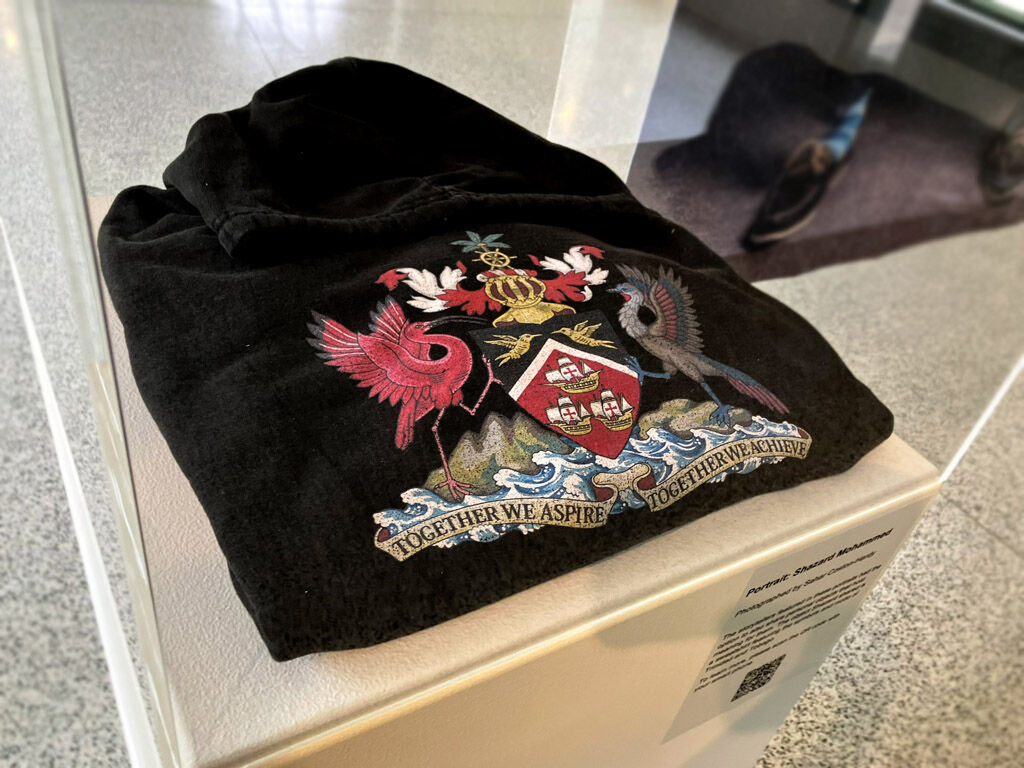
Mohammed’s object is a hoodie with the coat of arms of Trinidad and Tobago, which bears the motto “Together we aspire, together we achieve.” When people ask what it means to him, Mohammed says that he encourages them, again, to be humanists and to tackle greater challenges as a community.
“I take that to heart, because my interpretation of it is, ‘If we unite, we can conquer; if we come together as people, we can overcome any obstacles in our way,’ so I do wear that hoodie with pride,” he says.
Shivani Patel
Shivani Patel, also known as “Shivu,” was born in New Jersey and spoke about her experiences as a young person with autism and epilepsy, as well as the difficulty of managing both conditions while grieving the death of her beloved “late dada” or “dadaji,” which means paternal grandfather.
“When he died, it was so tragic, and it was so sad,” Patel says, adding that it also felt “humiliating” for her because her grandmother “knew nothing” about her autism. Without his comforting presence, Patel found it “really hard to understand everything after losing dadaji and being with only her” during visits to her grandparents’ house in London.
“But after losing him, I have learned — thank God — how to control myself, etc., how to even control my own medical issues when having a super moment, like [an] unspeakable, un-breathable type of episode of high blood pressure issue when something doesn’t make me feel like, ‘Okay, I’m not comfortable in this position. I need to run away,’ or ‘I need to scream my head off, and I’m about to feel like I’m going to faint.’”
“Thanks to God and Grandpa, remembering all that and praying all that, I know how to handle those issues, because Dada used to tell me when I was younger that, ‘If you don’t calm down, you’re going to have a heart attack or a seizure, try to calm down,’ and I would manage it, I would calm down,” Patel explains, adding that in the time since his passing, she has worked on remembering the techniques he taught her to cope with stressful situations.
In her interview, Bora described Patel as “a beautiful spirit” who arrived at the retreat in “her full, glorious self,” eager to embody that strength for others.
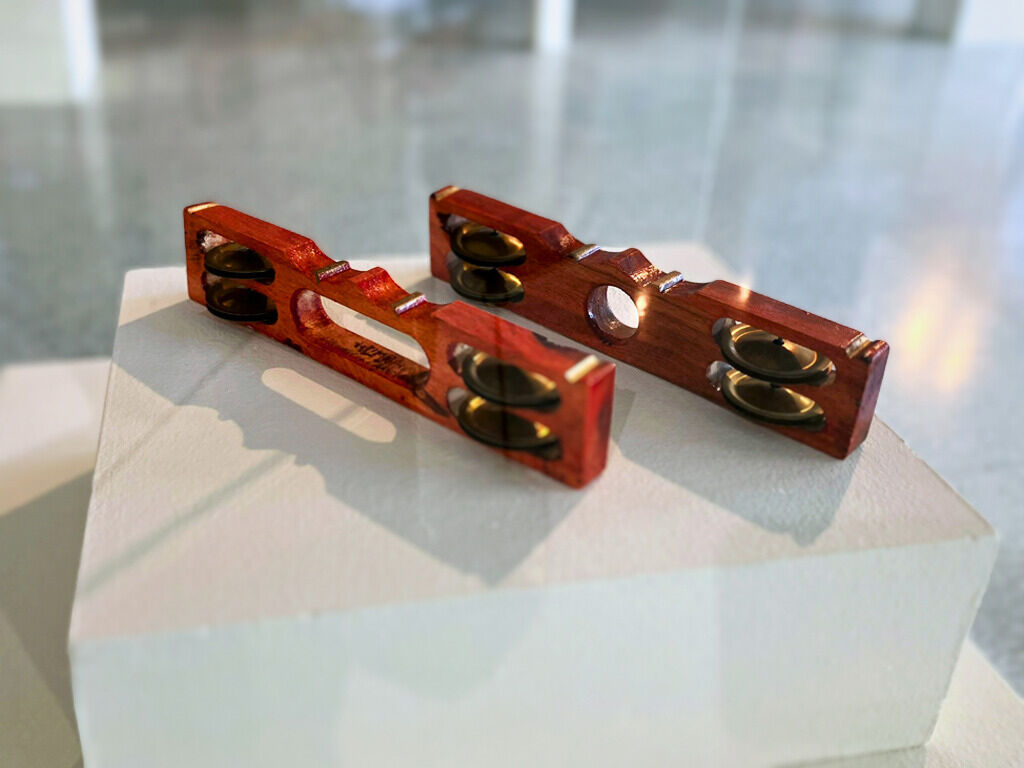
Patel’s object is the khartal, a two-piece percussion instrument from Rajasthan, India. To play it, a pair of “wooden blocks with small dimples are held in each hand,” then “clapped together when devotional and folk songs are performed,” she says. The sound comes from the meeting of the cymbals, typically brass plates, adorning the two parts.
Yogesh Sharma
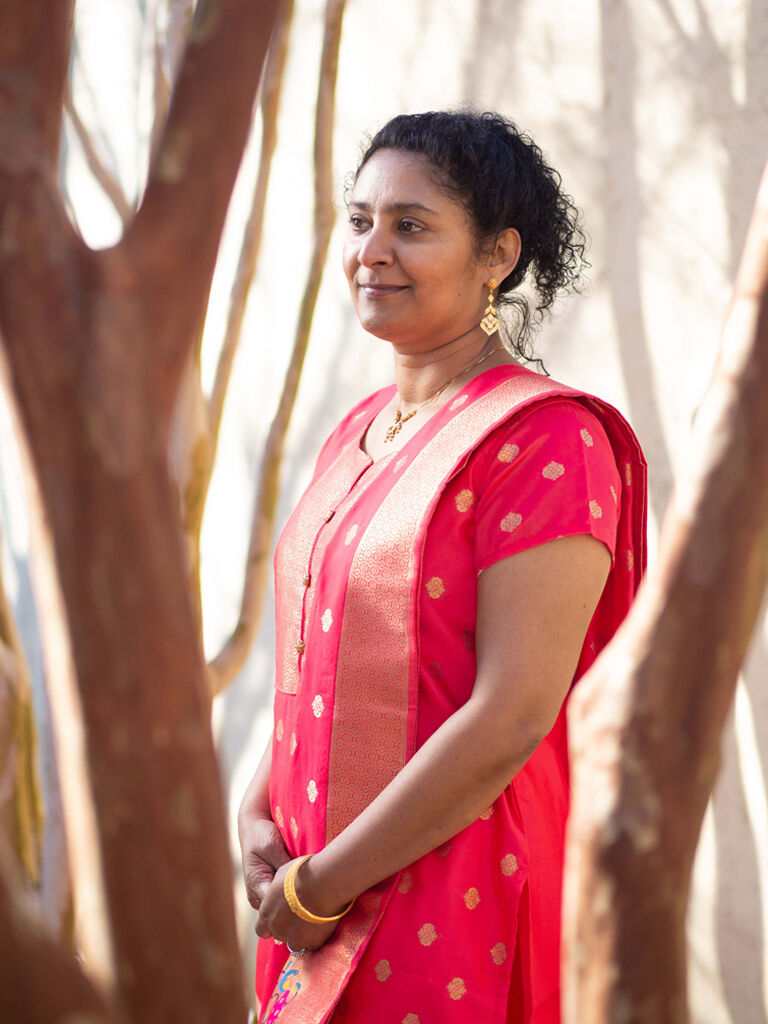
Yogesh Sharma founded Lawrenceville’s Radha Krishna Temple, “one of the oldest Hindu religious and cultural centers in Central New Jersey,” in 2002, according to its website. Located at 357 Lawrence Station Road, the temple provides “Hindu and Vedic services, poojas, and ceremonies,” having expanded from one room to four buildings over the years.
Sharma says that while she started the sacred space to assist priests and others in need, the temple only came to be because another living being close to her needed help — after neighborhood complaints about her dog’s barking reached the courtroom, a judge ordered its euthanization.
“I started going to another temple to pray for his life,” she recalled. “There, I met a priest who was in trouble in that temple. He asked me to help him out, and after a few days, he asked me to start a new temple where he [could] get his green card or visa, but I said, ‘Well, we don’t know anything about the temple, and so therefore we cannot do it,’” she explains. “But he tried to convince me that, no, he will ‘take care of everything’ and ‘it will be a great thing for [the community].’”
Sharma says that she and her husband did not have the background to run a temple, but the priest insisted, beginning a pattern of broken promises from people she assumed to be “very honest and honorable people” due to their religious backgrounds. Although they were initially shocked to encounter the opposite, the Sharmas built the place of worship together and recruited those of the faith who kept their word.
In addition to having grown the Radha Krishna Temple from these uncertain beginnings, Bora noted that Sharma “is just a force of nature and has also overcome so many challenges in her life.”
“My dog was saved with my prayers, and [the] community is very happy with that little temple,” Sharma reflects, noting that now, “We are like one big, huge family. We all love each other in that temple and try to do the best for the community.”
Sharma says that in the future, she hopes to bring in even more priests, particularly Indian women — a new addition for most temples — as part of her mission to keep growing the community at Radha Krishna.
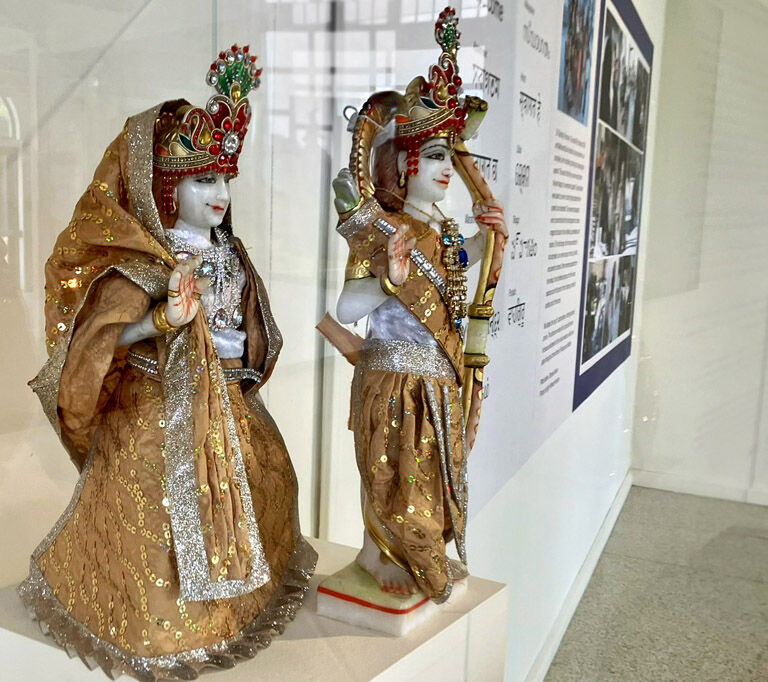
Sharma’s objects are “a silk sari and figurines of Rama and Sita,” the latter being two figures from the Sanskrit epic poem “Ramayana” who are incarnations of the Hindu gods Vishnu and Lakshmi.
As the most common adaptation of the story goes, Rama rescued his wife, Sita, from the clutches of an evil king named Ravana, and the day of their return is now celebrated each year through Diwali, the festival of lights, to signify the oil lamps members of the kingdom lit to welcome the couple home.
The tale is a classic testament to the triumph of light over darkness, or good over evil, as conveyed through holiday legend.
Shoba Panoli
In her interview, Shoba Panoli introduces herself as “a Malaysian American of Sri Lankan and Indian heritage” who dreamed of settling down in Australia like her aunts but would end up in the United States as the result of an unexpected romance.
“But life sometimes has surprising twists, and you end up in a different place,” she says, sharing how their paths first crossed. “One day I was bored, and I was surfing the web, trying to look up the place that my dad was visiting in India. As I was reading up on Kerala, I stumbled upon a chat room, and there were only a handful of individuals in that room. A guy says hello to me, and we started a small conversation, and he was attracted to my Sri Lankan Malayali background, and he found that a bit unique since he hasn’t met anyone with that background; little did I know that this would be the guy that I would one day get married to.”
Even when Panoli moved to Switzerland, she “continued chatting every day” with him, exchanging “hundreds of emails” that the two never deleted and still treasure today.
“After finally chatting for about two years, we decided to meet face-to-face, so I flew to New York to meet him, and as the plane was touching down, I was feeling very nervous, and I was thinking to myself, ‘What if everything that he’s told me was a big lie?’ ‘What if he was a fake?’” Panoli says.
This worry escalated as she spent over an hour searching for his face among the airport crowd, unable to find the man she was supposed to meet until Panoli spotted him — dressed in the exact outfit he had described to her — and immediately recognized her future husband.
“I was in the United States for only a week, and he took me places; we saw a lot of things, and he took me to the top of the Empire State Building and asked me to marry him,” she remembered fondly. “I believe this was fate. If my dad wasn’t visiting India, I wouldn’t have gone online that day trying to look up the place that he was visiting, and we’ve been married for 23 years and have two wonderful boys.”
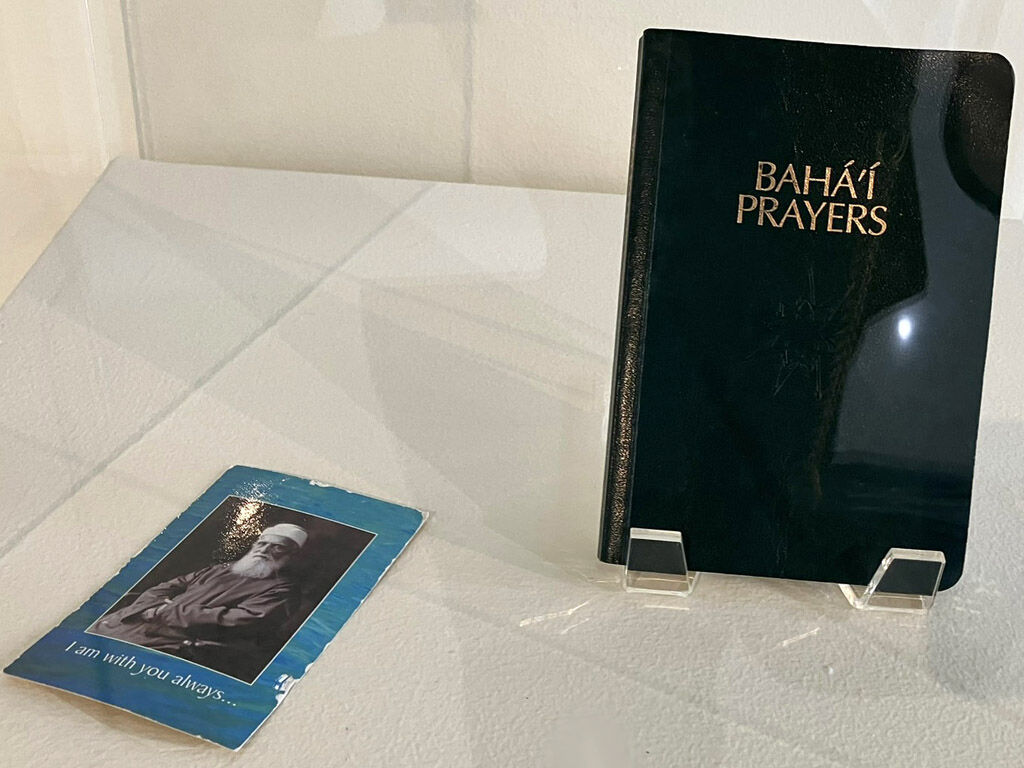
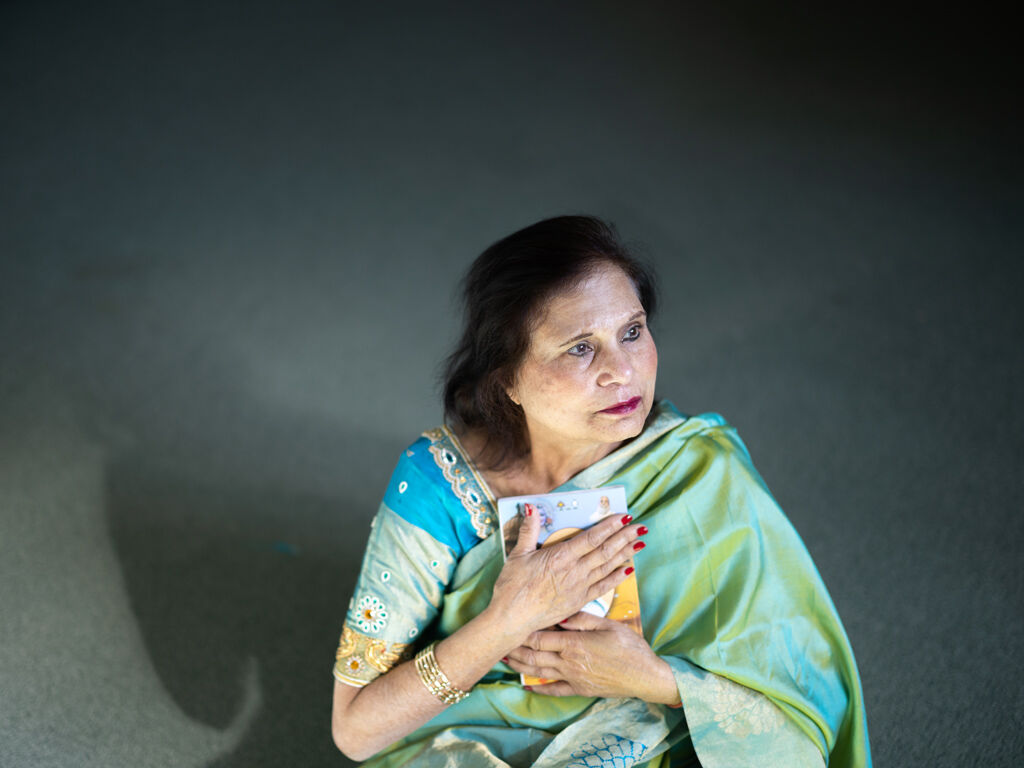
Panoli, characterized by Bora as a mother with “a very tender, sweet family,” received her name, meaning “light,” from her great-grandfather. Panoli’s object is a prayer book and photo card of ‘Abdu’l-Bahá, an important figure to her as a lifelong member of the Baha’i Faith.
“‘Abdu’l-Bahá is the master of the Baha’i faith, and he showed us how a Baha’i should live his life. I always carry that picture with me to remind myself of how a Baha’i should act,” Panoli explains in the audio interview.
Panoli adds that prayer has always been an “important component” of her life, connecting her with God and guidance, and she has had this book for at least 15 to 20 years, which contains prayers for a variety of purposes and applications.
On the exhibit page for “Local Voices,” Panoli says that the following quote from the founder of the Baha’i Faith, Bahá’u’lláh, is always an inspiration for her:
“Do not be content with showing friendship in words alone; let your heart burn with loving kindness for all who may cross your path.”
“Local Voices: Memories, Stories, and Portraits” runs through January 7, 2024, in the Domestic Arts Building at the Grounds for Sculpture, 80 Sculptors Way, Hamilton. Exhibit artist, Madhusmita Bora; co-curators, Kathleen Ogilvie Greene and Quentin Williams. For more information, call 609-586-0616 or visit www.groundsforsculpture.org.
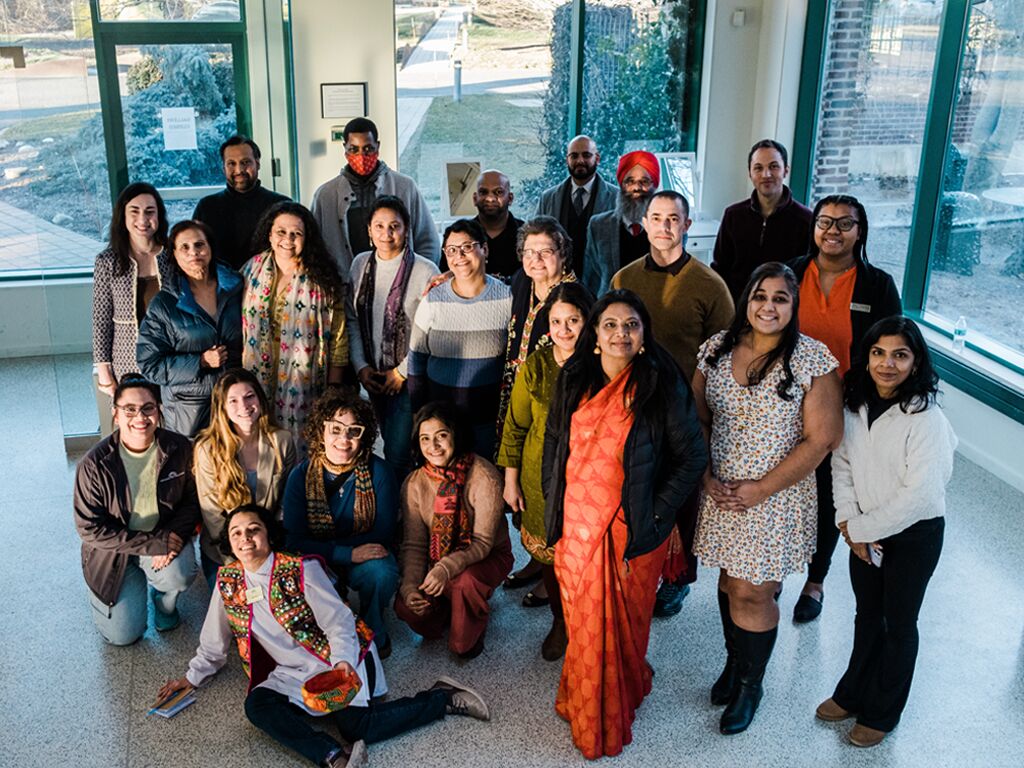
A group photo of the participants in Grounds For Sculpture's 'Local Voices: Memories, Stories, and Portraits' exhibit, now on view through January 7, 2024. (Photo by Gabriela Bhaskar),
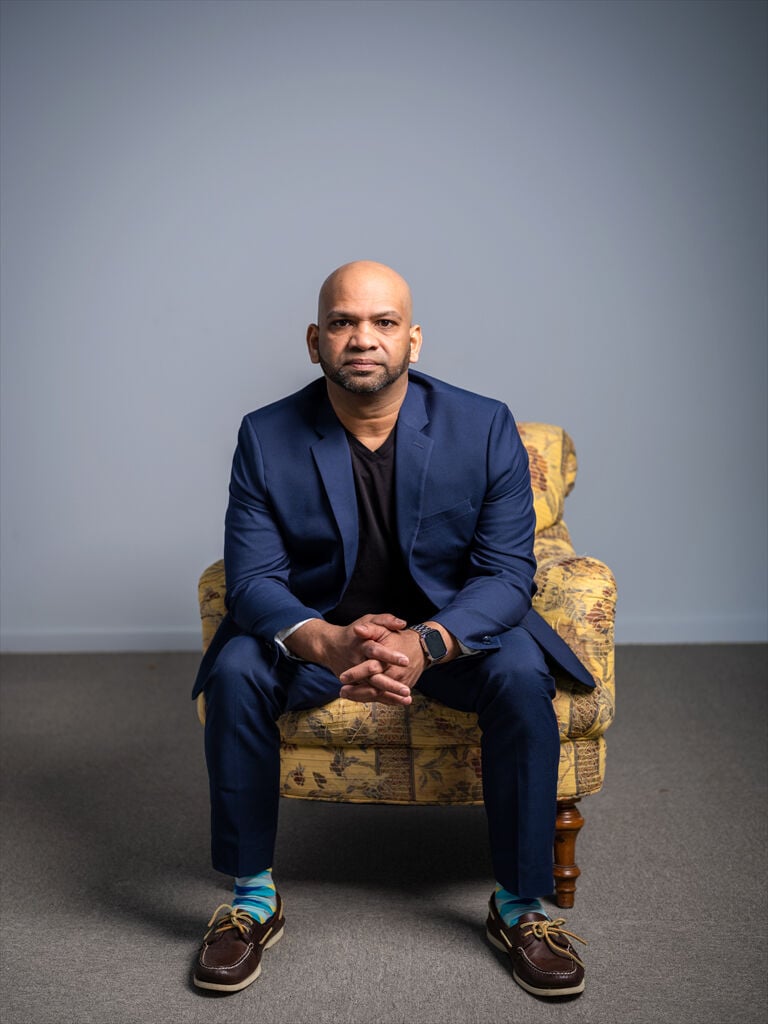
The installation view of 'Local Voices' at the Grounds for Sculpture in Hamilton. (Photo by Bruce M. White),
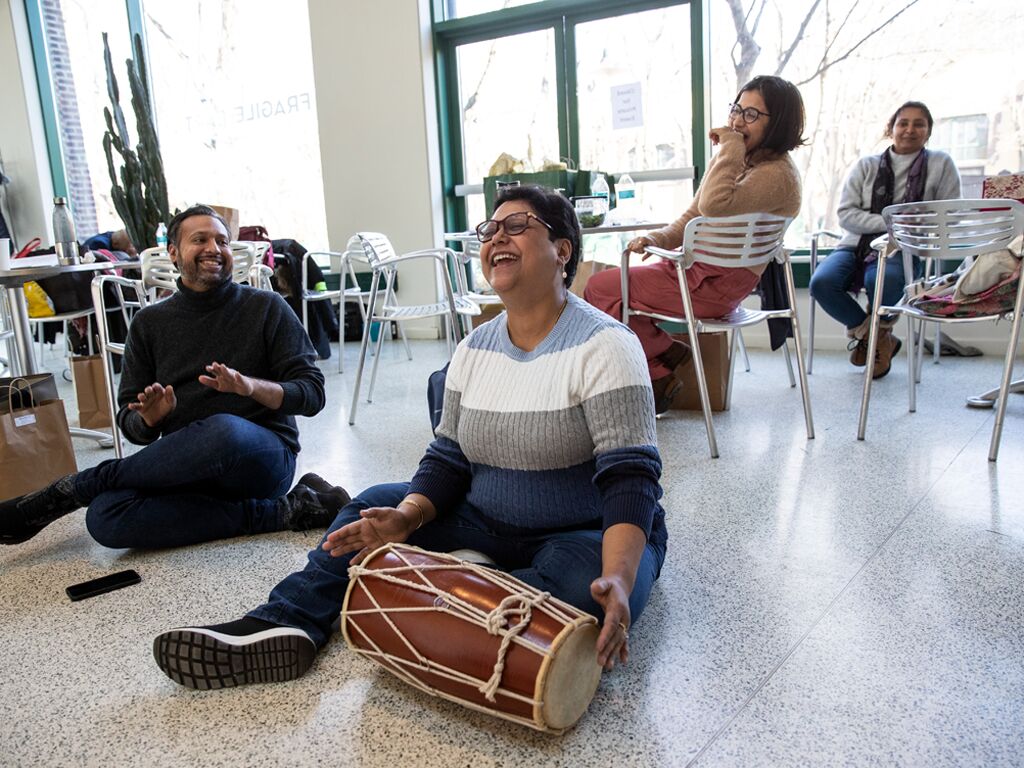
'Local Voices' was curated in partnership with artist and journalist Madhusmita 'Madhu' Bora, pictured here at the GFS storytelling retreat. (Photo by Monica Herndon),
Yogesh Sharma loaned the Grounds for Sculpture a pair of figurines depicting Rama and Sita, the avatars of Hindu deities Vishnu and Lakshmi.,