By Ron Shapella
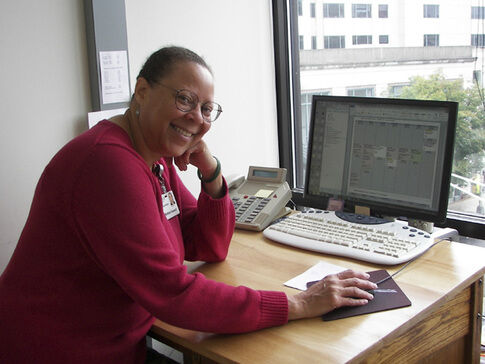
Winifred Howard, program manager for Mercer County Community College’s JazzOn2 radio, is not just cueing up the next item for her listener: she’s cueing up for the future.
A project of the college’s WWFM radio, JazzOn2 has a mission: serve as a voice for Trenton’s jazz heritage. Fittingly Howard’s operations are at the college’s downtown Kerney Campus. Howard, 61, has been with WWFM for 17 years, but the last several years have been devoted to jazz, something that she says is part of Trenton’s past and present.
It is mid-morning, and as Howard prepares the next program the studio is filled with the sounds of one of the station’s public radio programs: “PubJazz” hosted by Chuck Leavens, a public radio denizen out of Pittsburgh known for his dulcet tones and for the up-tempo jazz standards he purveys.
JazzOn2 isn’t your father’s radio studio. While there are cubicles, there are no reel-to-reel tape decks to be seen. Nor any turntables. Not even a CD changer. They are all back in the studio on the main MCCC campus in West Windsor (where college students and volunteers still use them to learn).
In Trenton the broadcasting is about new technology: HD (high definition) digital signals that bounce off satellites and subscription service (Pandora, Sirius, XM). “You can also listen to JazzOn2 online or on your smartphone,” says the project’s website.
Although Howard’s cueing takes place at a vintage drafting table that provides her with a view of Broad Street, her talk is all current.
“HD radio is in all the new cars now,” Howard says. “Seven years ago we went HD, when our engineer found out it was multi-cast capable, that our transmitter can broadcast more than one signal. Now you can break up your bandwidth into more than one frequency. We’re pretty much an all-digital format,” Howard says, adding that the software she uses on her laptop computer is “Digital Audio Delivery,” produced by Enco, a company located near Detroit.
Says Howard: “I always loved radio. When we were growing up radio was the predominant force. It just inspired me.” She got started at WWFM after taking classes at MCCC in 1982, and her story is similar to many others in broadcasting: she volunteered long enough until she was able to get on the air.
That experience is another part of JazzOn2’s vision, and the project hopes to encourage participating MCCC students to stay in school and keep music alive. “Many teens play in jazz band in high school, then put away their instrument and leave behind the creation of music for the rest of their lives. By providing the students with positive role models — successful adults from music, academia, and other professional positions — we want to encourage the students to stick with education and to stick with music,” says the project’s website.
After the jazz project started in 2008, the 2010 move to Trenton made sense. “We wanted to have a presence on the Trenton campus,” Howard says, where she can send programming changes to a computer at the main MCCC campus.
Her abiding musical interests are jazz and the blues, focusing her jazz tastes on the fabled era between World War II and the 1960s. When asked for her personal jazz Mount Rushmore, she says, “It would have to be the entire mountain range,” but that three obvious candidates would be Louis Armstrong, Ella Fitzgerald, and Miles Davis.
The three musicians — and numerous others — are fingertips away in the studio. Along with the analog equipment at the MCCC studios, WWFM keeps music on LPs. “We get a lot of donated records,” she says. “We have several musicians who have a studio at home. They send us their music via File Transfer Protocol, and we download it. It’s really neat.”
The transition from records and tapes to digital has taken more time and energy than expected, Howard says. “The challenge is trying to find people in the community who really love the music and teaching them about radio.” She adds that often on Saturdays she is in the studio training new radio hosts.
JazzOn2 promotes the music as well as the Trenton community. “We try to introduce people to jazz, because a lot of people when they think of jazz they think of ‘smooth jazz.’ There are people in this business who have a passion for this music, celebrate the history of the music, and give jazz a forum, because a lot of jazz stations are going by the wayside. When we started we had someone who just played Dixieland jazz, and we had shows all the way up to contemporary jazz. We do jazz, blues, and gospel. We do straight-ahead jazz and contemporary jazz,” she says.
“Trenton was a jazz hub. The music scene is growing,” she says, mentioning the Candlelight Lounge, an active live jazz location in Trenton. “A number of places are doing regular monthly shows, which is nice.”
“We’re community radio,” she says, “so we try to keep people abreast of the arts, culture, and what’s going on in Trenton.”
Despite its local focus, the station takes Trenton beyond its borders. “We have listeners from all over the world. It’s always interesting to see where are listeners are from,” Howard says. In addition to West Windsor (where listeners can find the station at WWFM 89.1 HD2), the project’s digital signal is also broadcast from Toms River, Cape May, Pen Argyl, and in Steamboat Springs, Colorado. Listeners can also find the station on the web at www.jazzon2.org.
While digital radio allows for CD-quality broadcasting, Howard says the catch is that listeners have to purchase an HD multicast radio to hear the HD signal and all the extra channels from any radio station broadcasting in HD.
“Our satellite is used to receive content from other services, like National Public Radio, and to deliver our radio content to our transmitters in other areas, like Steamboat Springs,” she says. “We bring in some of the NPR programming. We want to preserve jazz and open our airwaves to new music. And give a voice to new performers. We are community radio and our vehicle is jazz.”
Howard was born in Trenton to a millworker father and a health care worker mother. She now lives in Hamilton.
“I believe Trenton is poised for a renaissance,” she says. “We want to help any way we can, on the public information side, on the community affairs side, and with music.”
While WWFM receives facility and security support from MCCC, it gets no direct funding from the college. Yet like so many public radio stations, WWFM needs contributions. “We seek members and we also get grants,” Howard says. “The Corporation for Public Broadcasting gives us some revenue. We have people who rent space on our tower. The satellite dish is for us to send and receive programs. We received revenue from cell phone providers who use our tower. And, of course, we have underwriters for our programs.”
The classical programming has a deep roster of deejays; the jazz side, however, relies more on students.
“A lot of programmers are from the community so there’s a training period,” Howard says. “It’s ongoing.”
She says she is the only paid staff member. Everyone else is a volunteer.
“We have a number of folks who are musicians,” she says of other radio hosts, some of whom are performers and personalities from the Trenton area. Joe Cataldo is a trumpeter and arranger who has a show Tuesday evenings. “We also take NPR offerings, so we air Marian McPartland, Deedee Bridgewater, and the Beale Street Caravan,” she says.
Jazz continues to have a following in Trenton, Howard says. “It’s received well at the Candlelight. When I went to Joe’s Mill Hill Saloon it was packed,” she says. “I think the trouble with Trenton is that we don’t get the word out well enough. We just have to get the word out. Unfortunately, there’s the rub.”
For more information or to listen, go to www.jazzon2.org.
,

