. From his studio at the Grounds for Sculpture Park, Ward creates sculpture with references to geometry, figures, mythology and texture.
His work is influenced by global cultures such as African, Australian, New Zealand and Native Americas. The figures show motion, grace and awareness of history.
How and when did you get started with your career in the arts?
I embarked on my career in the arts after leaving corporate America, where I had a territory in the publishing industry covering northeast PA and NJ. The disconnect and dissatisfaction with the stress, formalities, excessive travel, and corporate culture led me to quit in pursuit of a more fulfilling life.
Despite the initial struggles of my “new” life, the turning point came when I discovered my artistic passion.
What subject matter most interests you and why?
My artistic inspiration is drawn from a diverse array of observations. While my earlier work featured dancers, bowls, vessels, and combinations thereof, I discovered that the true common denominator in my creations was the love of improvisational designs in my paintings. The finish on my pieces, influenced by African mud cloth, reflects a color scheme rooted in ritual protection and courage.
Geometry and West African masks play a pivotal role in shaping my ideas, as does a deep affinity for science-fiction and futurism, particularly the genre of Afrofuturism. Originating from Sun Ra’s definition, Afrofuturism has left a significant imprint on my work. This genre, now more widely recognized, is reflected in various art forms, including music and literature.
How did you choose sculpture as your primary art form?
Sculpture uniquely allows me to physically shape materials, a process that resonates with my love for molding and manipulating three-dimensional forms.
The in-the-round nature of sculpture captivates me, enabling the creation of artworks that invite interaction from all angles.
Beyond its tactile appeal, sculpture offers a rich playground for experimentation with a wide range of materials and objects. The versatility of sculpture extends to large-scale works that can become landmarks in public spaces, enhancing the physical presence and interaction with the audience on a grand scale.
How do you choose the material to use, and when do you decide the piece will end up as a bronze?
Initially, I started with paper mache but found it messy, leading me to use plaster bandage for reinforcement. Clay is a primary choice when I intend to cast in metal, and sculpting in clay is intentional for such pieces. The decision to cast depends on the effectiveness and size of the piece. Bronze casting is a deliberate choice, influenced by the desired outcome and the nature of the artwork.
Who are some of your inspirations or influences?
Recently, the senior artists at West Beth, an artist colony in a converted public housing building in New York, left a lasting impact on me. Witnessing these artists, some in their late 70s and 80s, continuing their creative journey with as much zest as ever, fueled my hope for the future as an artist.
Among my favorite artists are Richard Hunt, Martin Puryear, Jacob Lawrence, Elizabeth Catlett, Rodin, Alexander Calder, Romare Bearden, Ernie Barnes, and Jacob Epstein. Yet, my deep affinity lies with West African antiquity, ancient Egyptian art from Kemet, and indigenous cultures from Nigeria, Benin, Mali, and Ghana.
Tell us about Afrofuturism.
Although the concept of Afrofuturism has been around since the 1950s, it hadn’t been defined until the mid 90’s. It was first coined by cultural critic, Mark Dery, in an essay called, “Black to the Future.”
Afrofuturism is a cultural, artistic, and speculative fiction movement that explores the intersection of African diaspora culture, history, and identity with themes of science fiction, fantasy, and technology. It encompasses a range of artistic expressions, including literature, music, visual arts, film, and fashion.
Afrofuturism imagines alternative and futuristic realities that center on the experiences and perspectives of people of African descent.
How does your work at the Johnson Atelier affect your personal work?
In 1997, I embarked on a transformative journey by joining the Johnson Atelier Technical Institute of Sculpture as an apprentice. Over the years, my role evolved, progressing from a dedicated staff member in metal chasing to eventually becoming an instructor within the esteemed technical teaching staff. This professional experience became a pivotal force in shaping my artistic endeavors.
One of the most enriching aspects of my time at the Atelier was the diverse community of artists that I encountered, hailing from various corners of the globe. The exchange of ideas and techniques with this global cohort significantly broadened my artistic horizons.
Moreover, working on the projects of clients and collaborating with fellow artists provided me with a firsthand understanding of the art world. Each project served as a lesson, contributing to my knowledge and comprehension of art processes, styles, and the broader dynamics of the art industry.
The exposure to diverse artistic projects not only expanded my skill set but also deepened my appreciation for the multifaceted nature of the art world.
What are you working on now?
My primary focus is on showcasing my installation, “Animism.” This collection comprises 12 pairs of sculptures, totaling 24 figures, each ranging from 6 to 9 feet in height.
Rooted in improvisational painting and mud cloth-like designs, characteristic of my signature style, these sculptures are crafted using plaster bandage—a medium I have consistently employed throughout my entire art career. As of now, 22 figures within the series are completed.
Inspired by the Terra Cotta Warriors of China, “Animism” emanates a life force, connecting the 12 pairs collectively while emphasizing individual similarities within each pair.
What is on the horizon?
One of my most cherished aspirations is to bring to fruition a project/show titled “I’ll Make Me A World.” At the heart of this endeavor lies a profound artistic creation – a 24-figure army known as “Animism,” a labor of love that has consumed my creative efforts over the past 12 years. The essence of this dream project is not only to showcase the intricate details and depth of “Animism” but to present this significant body of work in major museums across the globe.
Instagram: @cliffpicafrica. Email: cliffordward614@gmail.com.
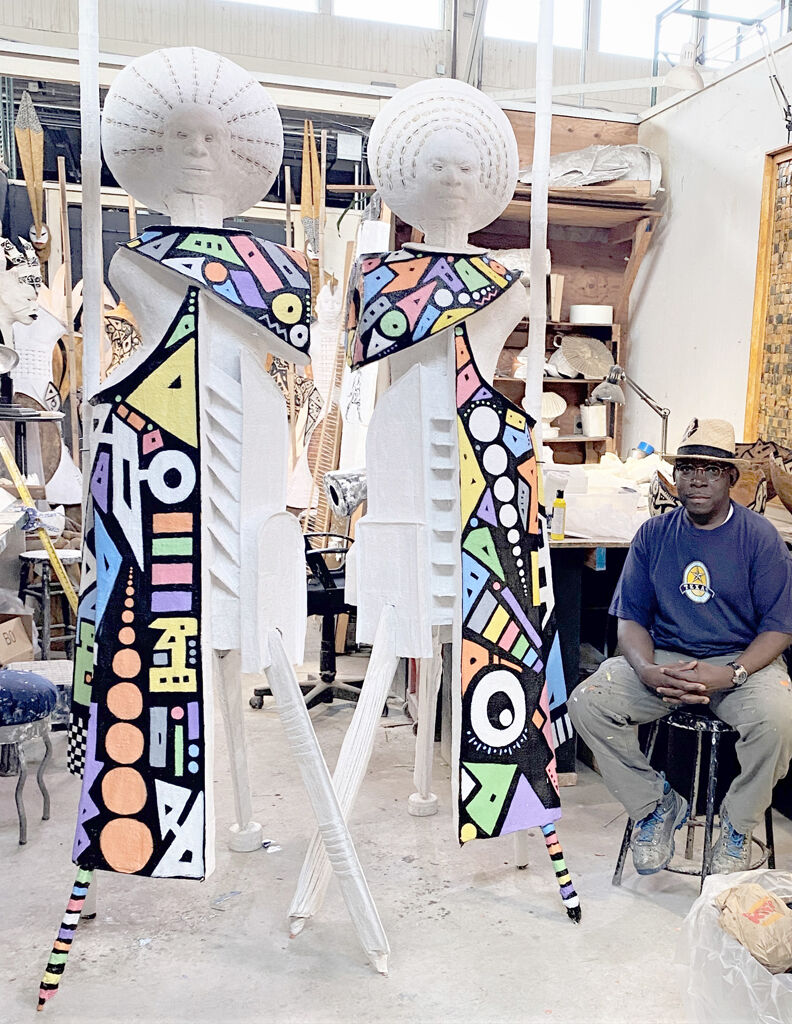
Cliff Ward with two of his sculptures at the Johnson Atelier.,

