Greg Zanoni is a photographer who learned on his own. He put in the time, effort and capital. The results are stunning. He photographs in the macro, which are very special close ups, wildlife in action and faraway landscape shots.
Utilizing both color and black and white, the results show that all his patient learning is really coming to fruition.
What is the origin of your photography work?
My passion for photography traces back to my father, an engineer and co-inventor of the LCD display at RCA Institute in Princeton. In his spare time, he would take photos all around the Trenton area where we grew up. My father instilled in me a love for photography, teaching me the basics of photography and the techniques of developing prints in our home darkroom.
A pivotal moment came when my father introduced me to the work of my cousin, Carl Zanoni. Carl’s stunning floral, wildlife, and landscape images left a lasting impression, inspiring me to explore the world of fine art photography.
What are you communicating with your art?
In my macro photography I strive to show the details of a flower that are not typically seen by the naked eye. They really come alive when you photograph the flowers under high magnification and ultraviolet light. The magic lies in the use of UV light sources, making the invisible visible. Flowers photographed under controlled UV lighting exhibit ultraviolet fluorescence. This unique technique causes certain petals and pollen to glow in the visible spectrum, revealing a hidden world of beauty. My collection of “Floral Fluorescence” reveals the intricate details that escape the naked eye.
Have you had formal training?
I have had no formal photography training. With the internet and YouTube you can learn almost every aspect of photography. My cousin is a huge resource for me. I strive to create photos that emulate his work.
In my first attempt at wildlife photography, I captured some wonderful images, or so I thought. My family loved them. When I sent them to him for critique, he told me that it was a “good start.” I was taken back, but he followed up explaining what was wrong with all of my photos.
After digesting his comments, I realized that my photos were not very good. He not only critiqued the images, but he also told me what I should do to create better images.
Is travel required for your work?
Travel is required in some of my photography. Not my flower images. I try to grow the flowers that I photograph in my garden. It is imperative to pick the flower just as it blooms. If you wait a couple days, rain or insects can damage the flower. You are also able to pick the flower in different states of bloom.
I also love to photograph wildlife, especially bald eagles. Some of the parks in Mercer County have nesting eagles. I will travel to the Jersey shore, Maryland and Delaware to find higher concentrations of eagles. Recently I have a new interest in photographing grand landscapes. I recently took a trip to the French and Swiss Alps with a group of photographers. It was an amazing experience.
Are you always framing subjects in color and black and white before shooting?
I typically shoot in color and expect to edit the image in color. When I was in the Swiss Alps, I photographed the mountains from a helicopter. Flying over the mountain peaks gave a unique perspective. When I returned and tried processing the images in color, I was not satisfied the way they were turning out. I tried converting one image into a black and white. I was extremely happy to see the difference and how I could see more drama in the images especially, as the sun was setting. This changed my mindset, and I proceeded to work on a series of black and white images. I am also playing around with some architectural images and they seem to lend themselves to black and white.
What fight/struggle do you have regarding your art?
I am partially retired, so I have the time. I have most of the equipment that I need, so the biggest struggle I have is with landscape photography. You do need to travel, which is expensive, and when you arrive at your destination you are constrained by the weather. With fine art photography, you typically look for moody atmospheric conditions in the scene. A photographer’s worst nightmare is bright blue skies. Many professional photographers visit a location multiple times, waiting for the right light.
What one attribute should all photographers have?
You need to have a passion for what you are photographing. Just follow your passion and it will show in your work. Don’t get discouraged if someone doesn’t feel the same way about an image you love. It’s your expression and if you enjoy it and are proud to hang it on your wall, then you have succeeded.
What is on the horizon?
I am looking forward to visiting different UNESCO Heritage sites around the U.S. and in Europe. There are so many beautiful places to visit and photograph around the word. I would love to visit the Dolomites, in Italy, and Iceland. It would be wonderful if someday I could exhibit and sell my images for others to enjoy.
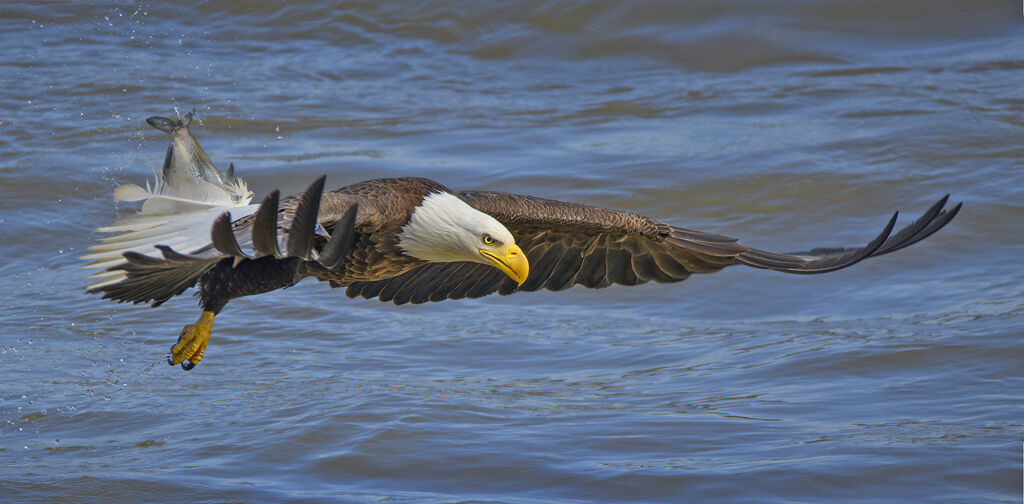
A bald eagle catches a fish. (Photograph by Greg Zanoni.),

