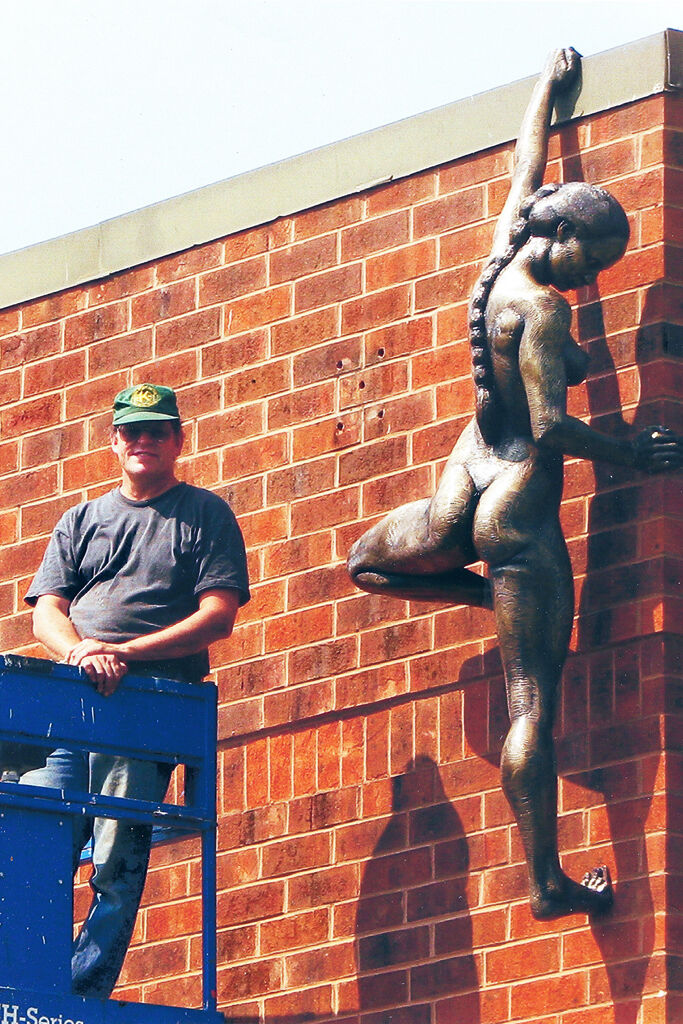
Frederick Morante is a famous sculptor. He has made pieces that multitudes of people have viewed and enjoyed. He has worked at Johnson Atelier since 1977 and just retired this January. He works in any media and can fabricate other artist’s ideas into monumental works. His own work focuses on figures and their relationship to the world. Shaking Morante’s big hand, one can feel the strength, experience and confidence, that these hands can shape metal into exquisite shapes and forms.
What inspired you to study art?
Once I discovered I was not fast enough to make the Olympics in swimming, I looked into my second passion, art. I was always making art in the classes from elementary through high school, but in junior college in San Diego things really took off. I learned drawing, sculpture and ceramics. After transferring to San Diego State, I learned bronze casting.
What is the main idea you are communicating with your art?
I relate to figures and faces. People interest me. I am an observer, I sit back and watch things develop. I am the third child, with two older sisters, so I knew to stand back and be quiet.
I always had a drive to draw and sculpt figures. I was and am interested in the “How” to produce the art, not the “Why?” The Why is the easy part!
Working on so many artists work at Johnson Atelier, can you name a few that really stand out?
The first famous artist I worked with was George Segal. The legend says that Segal was friends with Seward Johnson and a pallet of the plaster gauze material got wet. Seward asked Segal if he could use the material in any way. That was the story of how the plaster gauze pieces began.
I also helped enlarge an abstract piece for Georgia O’Keeffe. The piece ended up 15 feet tall.
As apprentices at Johnson Atelier we would sometimes visit famous artist’s studios and see exactly how they worked. These were things that you could never learn is school.
Who are your inspirations?
My inspirations are like sampling from a Pu Pu platter at a Chinese restaurant. I love Henry Moore for his semi-abstract sculpture that still embodies figures. I like of course the George Segal plaster bandage inspired works. Ernst Trova and his Falling Man sculptures are terrific. As we learned in college about Alexander Calder and his bent wire sculptures which made three dimensional pieces, from the thinnest of materials. Also I learned from my own family. I made an early sculpture for my Uncle Manny, who was a musician. I made a bent wire bass player sculpture for him that I was very happy with.
Which media are your favorites? Or most challenging?
I just love wax. There are many different kinds for different needs. The green wax I use for eventual casting needs. I love plaster. Both water clay plaster and plastalina are very good to work with. Now I am into plastics to, specifically 3D printing. I find this media to be both challenging and rewarding.
What fight/struggle do you have regarding your art?
I find that after all these years of experience that I still am learning from the materials. How best to utilize them, discovering what they will and will not do. What are their strengths, how the surfaces will turn out. For sculpture, I come up with a concept, then I decide on the materials and how to use them.
Now that you are retired for the Atelier how do you fill your days?
I have been retired now for two months. I love coming to work in my own studio instead of working on someone else pieces. In the old days of the Johnson Atelier we would work on our own work after hours in the studios. Now I can work on my own pieces right from the beginning of the day.
What are you working right now?
I am working on the maquettes or models for a series of 4 female figures. Sole or Sun, Vento or wind, Piovere or Rain and Nevicare or Snow. The names are in Italian as I studied in Italy when I first began as a sculptor and learned a lot there. The finished sizes can be anything. Making the model or maquette is where all the design work is done. The finished size depends on the collector. I works on large pieces like Unconditional Surrender, where the sailor is kissing the nurse. I also worked on The Awakening, where the large figure is coming out of the ground, also by Seward Johnson which stretches to 72 feet. I have no trepidation about working large or small.
What is most difficult about being an artist?
All the business part of it all. There should be a class in college about the business end of art. The promotion needed, the ability to turn a profit with the quoting, and what to do if you become wildly successful.
What do you find most fulfilling looking back at all the art you have created or worked on?
I enjoy the fact that I worked with and learned from very famous artists. I worked with Tom Otterness, with George Segal, John Newman, Phillip Grausman and Georgia O’Keefe. Some sculptors really relied on me and the team to figure out how to fabricate these large pieces. They relied on me and valued my expertise and know how. We were able to create masterpieces.
What is on the horizon?
I am looking forward to my new situation of being self-employed. I wish to be an instructor, a consultant, mentor and a teacher of the technical aspects of fabricating sculpture.
I will teach how to work with wax from the initial ideas, basic casting, chasing and finishing. Also how to work with copper and bronze powders, and finishing with patinas.
I can teach quite a bit and am still learning myself.