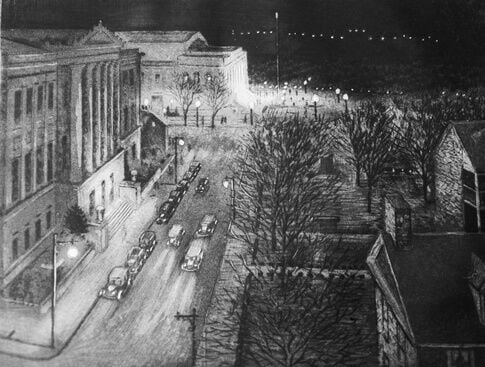
“Symphony Night,” an etching by artist George Bradshaw, whose work is on permanent display at Thomas Edison State College and on temporary display at The Trenton City Museum.
George Bradshaw exhibition on display at The Trenton City Museum
With the heart and sensibilities of an artist, the skills of a master draftsman, and the mind of an engineer or architect, George Armit Bradshaw (1880-1968) beautifully captured scenes of historic Trenton in pencil, pen, and ink during his long and productive life.
Born and educated in Trenton, the internationally renowned Bradshaw attended the Trenton School of Industrial Arts in the historic Kelsey Building on West State Street, which now houses the main offices for Thomas Edison State College. He later served for many years as an instructor at the institution.
How fitting, then, that 65 of Bradshaw’s original etchings are in a permanent collection on view in Prudence Hall in the Kelsey Building — the one with the distinctive Victorian-style clock jutting out over the sidewalk. The Bradshaw works were given to the college by Raymond L. Steen in memory of his wife, Mary MacPherson Steen, and originally dedicated during Trenton’s State Street Stroll in September 1986.
Among the etchings in this collection are two of the artist’s favorites: “The Water Power” and “The Three Gates,” a proof of which is in the permanent collection of the Metropolitan Museum of Art.
Lovingly overseen by Linda Soltis, Thomas Edison State College’s longtime communications and media outreach specialist, Prudence Hall is occasionally opened to the public for tours, where visitors can see the Bradshaw drawings and study their brilliant detail, which captures numerous Trenton landmarks. Soltis just ran a public tour in early November, and plans to host another in spring 2014. The curious can also view the room and its historic artworks by appointment.
“When I came to work at the college 27 years ago, one of my first jobs was to have the Bradshaw etchings rematted and reframed,” says Soltis, who was born in Trenton. “I just fell in love with his work. I love the way he documented this historic city, the incredible detail in his drawings.”
For example, Soltis says, Bradshaw’s luminous work “Memorial Building” (1958) is “so detailed, it looks like a (black and white) photograph, but there’s so much more to it.”
Several of Bradshaw’s prints and paintings are also currently on view at Ellarslie, the Trenton City Museum in Cadwalader Park, in the exhibit “Frank Applegate, George Bradshaw, and the School of Industrial Arts.” The exhibit, on the second floor of the museum, runs through Sunday, Feb. 9. Curated by Trenton Museum Society trustee Brenda Springsted, the exhibit focuses on a few of the school’s early teachers who achieved fame as artists in the first half of the 20th century.
Established in 1898, the School of Industrial Arts played a prominent part in the industrial success of Trenton, since the courses taught there enabled Trenton companies to hire skilled workers with training in a wide variety of fields.
The ceramic companies, especially, grew to depend on the school’s training to get talented employees. In fact, by 1911 a four-year program that taught science as well as art became compulsory for ceramics apprentices; classes were held in the evenings to accommodate the students’ work schedules. The school merged with Mercer County Community College in 1967.
Born in Trenton, Bradshaw was the son of a British potter and worked in several positions before starting in the School of Industrial Arts. Although he was also a fine painter, Bradshaw is primarily known for his etchings. He excelled in this field as both an illustrator and etcher of views in Trenton and other New Jersey locations.
Trenton was his major inspiration, especially during his time at the school, but he also traveled up the east coast from Virginia to Nova Scotia and into New England. Bradshaw was a member of the Brooklyn Society of Etchers, the Chicago Society of Etchers, and the North Shore Artists Association.
In addition to the substantial collection held by the Trenton Museum Society and TESC, Bradshaw’s works can be found in the permanent collections of the Library of Congress, the Newark Museum, the New York Public Library, the Vanderpoel Gallery in Chicago, the University of Nebraska, and many private collections.
In addition to Bradshaw’s reputation as a fine artist, he provided illustrations for “A History of Trenton 1629-1929,” “A Pictorial History of Agriculture in New Jersey,” and “A Pictorial History of Trenton.” The latter, with text by Hamilton Schuyler, can be found in the “Jerseyana” section of the State Library in Trenton.
Walking a visitor through the permanent collection in Prudence Hall, Soltis points out how Bradshaw’s technique evolved over the years. Such drawings as “The Water Power” (1915) and “Stable Yard” (1915) show Bradshaw’s raw, early promise and give a sense of nostalgia for a bygone time and lifestyle, not only in Trenton but also throughout cities in the still youthful United States.
Bradshaw’s skills obviously grew into such drawings as “Steeplejack” (1940), and a viewer wonders how Bradshaw executed the intense detail of the bricks and shingles as well as the tiny figure astride the steeple. “Little Suspension Bridge” (1943) is especially charming, since you can still see the bridge structure along Route 29 approaching Trenton. Unfortunately, many of the landmarks that Bradshaw captured are no longer there.
“His ‘Railroad Series,’ inspired by photographs of the 1880s, has such appeal that the etchings are considered the ‘piece de resistance’ in every collection,” says Soltis, who is an enthusiastic collector of Bradshaw’s drawings.
One of his most beloved works is “Symphony Night,” and happily one can still see, touch, and feel the grandeur of the Trenton War Memorial and theater. Depicted affectionately, the light from its inside lobby warms the stairs, the darkness of the Delaware River looms beyond, and the streetlights of the towns across the river in Pennsylvania glow in the distance.
Soltis takes a visitor up to the fifth floor of the Kelsey Building, which now is populated by TESC’s various administrative offices but was once home to the School of Industrial Arts’ artists’ studio. The skylight, which is still there, provided the artists with daylight to see and work with.
There on the fifth floor is a corner office where, if you can squeeze into the proper position, you can see the vantage point from which Bradshaw created “Symphony Night.” Study the drawing a little closer, and you can see the Old Barracks in the foreground, as well as a tiny sliver of the Kelsey Building.
“Bradshaw had originally intended to paint,” Soltis says. “Instead, he was guided to a career in etching by his teacher, Henry McBride, who told the young student, ‘Your natural medium is line.’”
Frank Applegate, George Bradshaw and the School of Industrial Arts, Ellarslie, Cadwalader Park, Trenton. Through Sunday, February 9. 609-989-3632 or ellarslie.org.
Drawings by George Bradshaw, Prudence Hall, Kelsey Building, Thomas Edison State College, 101 W. State St. By appointment. Phone: (609) 777-3083, Ext. 2065. On the Web: tesc.edu.
,

