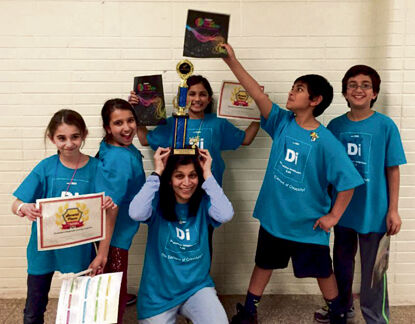
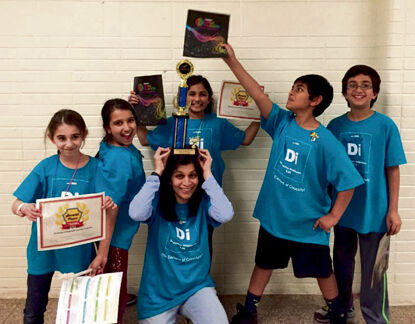
Since the late 1990s, Destination ImagiNation has been encouraging Robbinsville students to tap into their creative and practical talents alike to get some outside-the-classroom experience with team-building, problem-solving, on-the-spot thinking—not to mention a shot at taking home a trophy at the program’s Global Finals.
District Coordinator Rose McGlew first got involved with the program when her own children were still attending Sharon Elementary School years ago; now, after having served as a parent volunteer, appraiser (as the program prefers not to call them “judges”), and team manager, she’s been the district coordinator for the past two years. And with Robbinsville consistently churning out teams who dazzle the state competition’s appraisers enough to get an invitation to compete nationally, the program has become a huge deal throughout the town’s three schools.
So what exactly is Destination ImagiNation?
“It’s a creative problem-solving program,” McGlew said. “Every year, it gives kids choices of five or six different challenges they can choose to take on. They work on a team of five to seven children to come up with a creative solution to the challenge that they’ve chosen.”
Each school can host several teams, most of which students select themselves, as McGlew feels that students tend to know with whom they work best or who shares their vision of a creative solution.
“The way that we run it in New Jersey is that you form teams—no more than seven, no less than two; we try to aim for five to seven kids,” she said. “You form a team in your own school district, you compete at the state tournament in March and, usually, it’s the first- and second-place teams in each group for each challenge that get an invitation to attend Globals.”
The challenges range in scope and themes, with focuses on anything from community outreach to improvisational performances to structural or mechanical challenges. Some degree of theatrical and technical elements are always involved in the final presentation of a team’s solution, and all of the challenge’s components must be logically integrated into a skit.
Take, for example, Sharon Elementary School’s team The InCreatibles, whose second-place finish in this year’s state competition earned them an invitation to the 2016 Global Finals in Tennessee May 25-28. Their solution to the Musical Mash-Up had them create a 31-ounce flute from balsa wood—which had to be musically operative enough to be played for at least 30 seconds, woven into the context of a skit, and structurally sound enough to support a significant amount of weight.
“Our kids started to put all of the weights on their musical instrument, and they actually ran out of weights because it held so much,” McGlew said. “Their 31-ounce flute held more than 300 pounds.”
Last year, a team from Pond Road Middle School walked away from Global Finals with a first-place trophy for its Project Outreach challenge, where it took on a community service project benefiting the Pet Rescue of Mercer County.
Its victory embodied how top-ranking teams can be born of unusual circumstances. Last year’s Pond Road team didn’t raise the most money for their charity of choice, but it did exhibit the teamwork, self-assessment skills and dedication that the program aims to strengthen in the more than 19,000 students who participate in the program—and were thusly recognized for their subjective successes.
Indeed, appraisers score each team on a rubric measuring both a subjective and an objective scale, with more than just first-, second-, and third-place awards on the line at the elementary, middle school and high school levels. The daVinci Award recognizes achievement in technical aspects or a design component, the Renaissance Award goes to a team that demonstrates a solid team behind a remarkable presentation, and the not-always-given Spirit of DI Award is only bestowed upon a team that goes above and beyond—like a team that McGlew recently appraised who had to redo the entire video component of their presentation the night before the state tournament and didn’t utter a word about their dilemma.
McGlew believes that Robbinsville’s diversity is a significant component behind its students’ tradition of winning big at the state level and earning yearly invitations to the Global Finals.
“I think that our diverse demographic really helps bring a variety of skills in our students together,” she said. “We also don’t have kids who are just focused on building or are just focused on theater arts. We have such a community of wide-ranging skills; that helps our teams come together and approach all aspects of the challenge.”
With the no-interference rule that keeps parents, educators and team managers from directly assisting their children and students (though they are welcome to point them toward a resource that may yield the answer), it’s also an opportunity for each team to learn the value of struggling in their pursuit of a solution. It’s a growing experience McGlew feels many students don’t get to grapple with these days.
“Parents and adults are absolutely not allowed to be involved,” she said. “It is all student-driven. I don’t think kids get as much of that anymore. I think we, as adults, try to make everything easier for them. DI is really good for them—especially with our higher-level academic kids who don’t get that chance to struggle as much. It also allows kids from all academic abilities to showcase themselves in the best light and have success outside the classroom.”
As The InCreatibles prepared for the global compeition this month, it also sought help offsetting the costs of its trip to Tennessee. To raise funds, there will be a clothing drive May 7 at Sharon Elementary School. McGlew said the team needs as much community support as it can get because it is an expensive trip.
Find out more about Robbinsville’s Destination ImagiNation teams, visit their Facebook and Twitter @RobbinsvilleDI or their website.
,