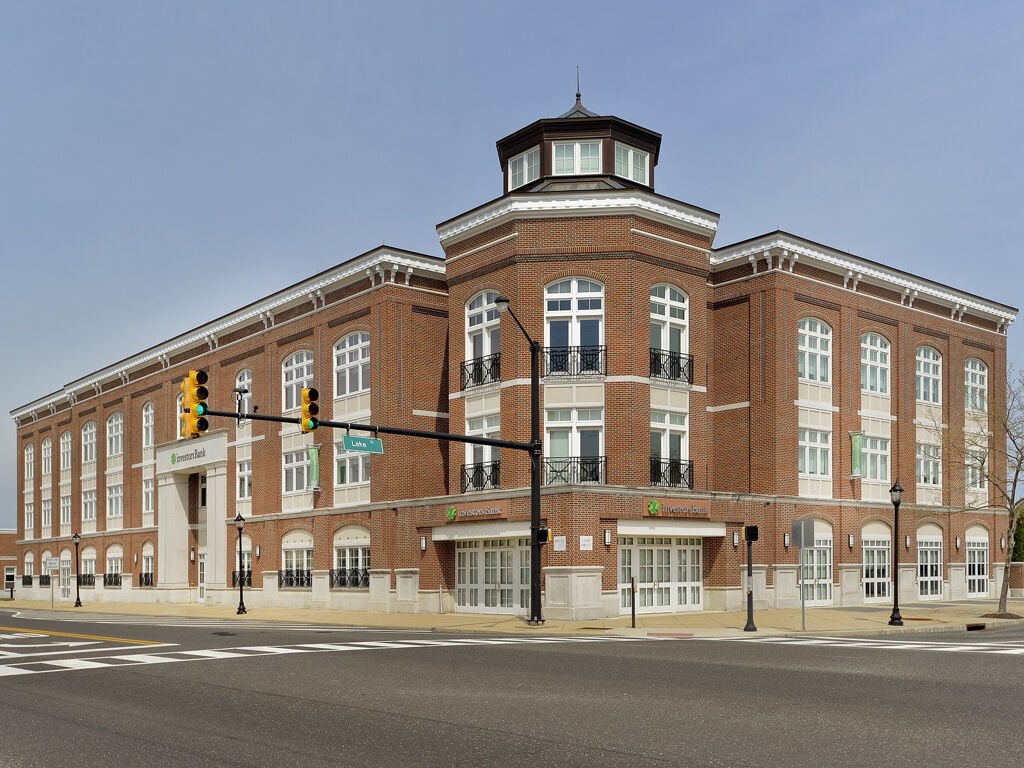
Robbinsville’s Town Hall is getting a major facelift—by moving out altogether. Municipal operations will be relocating to the former Roma Bank/Citizens Bank building, which officials believe will be a big improvement over the current facility.
The move, says Robbinsville Mayor Dave Fried, doesn’t only offer more space. It also will centralize government functions, bring the Robbinsville and Hightstown police departments under one roof, and offer much-needed public meeting space—all while saving money.
Instead of constructing a new police station, the township is opting for a long-term lease, a decision the mayor believes is both financially prudent and forward-thinking.
The bank building, which is the centerpiece commercial structure in the Robbinsville Town Center, is some 47,000 square feet, compared to the current municipal building (also on Route 33), which is only 15,000 square feet. The one-story building was built by the township in 2016, but only houses some township offices. Both the recreation and police departments are in other locations.
The three-story bank building, constructed in 2005, was originally occupied by Roma Bank. The location continued to serve as a banking facility following the acquisition of Roma by Investors Bank in 2013. In 2021, Investors Bank sold the property to Realty Management Systems for $20 million and subsequently leased it back on a long-term basis.
The township had originally planned to build a separate police/court building on Route 130 for Robbinsville and Hightstown, but rising construction costs and plummeting commercial office rents after the COVID-19 pandemic caused Fried to reconsider his options. Ultimately he and township council decided that the move to the bank building was the best plan.
Last November, Robbinsville Township signed a 10-year sublease agreement to relocate almost all municipal operations to the building.
* * *
Mayor Fried recently sat down with Robbinsville Advance editor Bill Sanservino to talk about a number of issues facing the township in 2025.
Over the next few months, The Advance will run excerpts from the interview in Q&A format. In this month’s article, Fried talks about the ambitious municipal building project.
Robbinsville Advance: Let’s talk about the plan to move the municipal offices into the old Investors/Roma Bank building on, and how you’re going to integrate the Robbinsville and Hightstown police departments into the building.
Dave Fried: First of all, I’m excited about this. I think being able to have both sides of the government, police, everybody in one place—is really going to be good for us from a public safety standpoint and also from a public standpoint.
Our whole mission, when you think about it, is that Robbinsville is trying to be customer service-oriented and trying to instill in everybody that they’re not taxpayers, they’re not ratepayers—they’re customers. They have choices, and just like anything else, you can choose where you’re going to live. In order for us to convince people that they want to choose Robbinsville; it has to be a great place to live.
I’ve always thought of residents as kind of like shareholders, and as CEO of my company, my ultimate value is how well I can increase the stock price of my company. That’s kind of like the, if you will, the report card that I get as CEO. A home value is sort of the report card that I get as mayor.
If I’m raising your property values, it’s because people want to live in Robbinsville. And demand creates higher home prices, and higher home prices for our residents become a good return on investment, because for most people, their home is the largest investment they’re ever going to make.
So, it’s kind of always the way that I’m thinking about those things. Open space is a big priority, making sure that we keep inventory under control, but also customer service.
When you look at our current municipal building, it was set up primarily so the public can do business with us in an easy fashion. You walk through that central hallway and you can hit every window with absolutely no error. You should be able to get your permit, pay your bills, pay your taxes and do everything from that one sort of central venue—except policing and court.
After we move, people will literally be able to do a one-stop shop. And from my perspective, if you’re having a challenge, I can pull everybody into a meeting relatively quickly. In terms of meeting space, I can have multiple meetings happening at the same time, like public meetings.
The schools are getting beat to hell because there’s no public space for them. So, we’ll have a couple of rooms.
And then, lastly, bringing our recreation department back to the municipal building is going to create more meeting space over where the rec department is currently.
Right now, the fire department building is also getting overused, because there’s not enough meeting space in town. So, Girl Scouts, Boy Scouts—everybody wants to have meeting space, and it’s either the firehouse or the schools right now. We need to create some more space to allow these things to happen.
It’s really not ideal for us, and from a safety point of view, also, to have the public constantly in the firehouse, because they’re living there and they have their own stuff going on. So, I’ve always got that little bit of conflict happening when I have a crisis and at the same time, the public is in the firehouse.
So, those are sort of what we’re thinking about on the macro level. It’s going to make us more efficient financially. It’s going to give us space for the next 20 years. We probably will never outgrow that building.
As we think about what we want to be able to do on a financial standpoint—building a new police station, which we would have had to do, would have wound up costing more than this entire building.
RA: This is more cost-effective than building a separate police/court building?
DF: The numbers that were coming in to build the police station were in the $20 million range, which is more than we’re going to spend with this. And if you just take a look at what’s happening in Hamilton and what they’re spending on their new building, you can get an idea of what I’m talking about. From a financial standpoint, this is going to set us up for a long period of time.
Also, no community in Mercer County has ever shared a police station and court with another town, so, the idea that we can share this with Hightstown has been a win for Hightstown and a win for Robbinsville.
We’re sharing those expenses. You know, I would imagine at some point we’re going to continue to share more resources. We’re already sharing fire services, and we’re going to be sharing a police station and court.
I imagine dispatch at some point is going to be very much on the table. And then, we go from there. Look at where we can continue to pool resources to save both communities money. So that’s the thought process behind it. And if we can do it, that means other towns can do it. So, I think you’ll start seeing some of that consolidation.
Who knows, maybe we can provide senior leadership for policing one day. We’re already doing automotive, so it’s just going to lead to more shared services that I think is going to continue to save us money.
We’re right on budget, which is amazing. And then once we get in, we’re going to find out, I think very quickly, that there’s going to be a very high demand for the building that we’re in now, which we own.
RA: Can you explain what’s going to happen with your current municipal building?
We’re going to be able to then sell the old municipal building, and that’s a much smaller, much easier-to-consume building than the building that we’re taking, which we’ve proven over the last few years nobody wanted.
Our current building, I think, is going to have a multitude of uses. But probably the fastest and best use is going to be medical. You know, we’ve already got a lot of interest. So, if we can sell our building and then reduce those bonds, this thing is going to wind up— between Hightstown in there sharing the cost and then us being able to sell our own building—we’re going to wind up saving a lot of money from where we would have been before.
RA: Why lease the building instead of buying it?
DF: It’s a great question. It’s a lease right now for 10 years. We couldn’t acquire the building, because originally, we were going to use condemnation. And if you use condemnation, the current lease that the bank had would have immediately expired and the town could have been liable for the delta between the value of that lease and what we were paying.
What ended up happening was the bank—originally, not the current bank—so Roma Bank ended up selling the building for a lot of money, and they were able to get a lot of money from the building because they inflated the price of the lease. So, they had a very, very high lease—at least twice what we’re paying.
Under our deal, the bank is actually absorbing the delta between our lease payments and what they’re actually paying the property owner. So, we’re only paying literally less than half of the actual value of the lease. That’s going to ultimately save our taxpayers money. Now, at the end of the lease, the mortgage will also be paid off.
Then we can condemn the building, and there’ll be no lease that we’ll be interfering with. I was afraid that we would get into tortious interference with the current owner, and we could be liable.
So, at the end of the deal, we’ll pay whatever the value is of the building. The true value. Appraised value. We’ll buy the building, and that person will no longer have a lease, so there will be no lease for us to interfere with, and we should be able to buy the building forever.
RA: Makes sense. I guess that the high lease cost affects the value of the building?
DF: Exactly. We couldn’t make it work.
RA: And I suppose it also gives you an out if it’s not working out after 10 years.
DF: Yes. We can walk away.
RA: Not that you’d want to. I’m sure there’s going to be a pretty large capital investment to convert part of it for the police station.
DF: Yes. Right now, we’re doing some stuff in renovation, but the reno for the building is so much less expensive than building a new police station. And it gives us space for quite some time. The generator that they originally built there is enormous. It’s literally like the size of a room. So, if there were ever an emergency, I’d be able to provide power for quite a number of people. The power center will be able to also provide internet service, because we’ll be up and running. So, there’s so many things we will be able to do by having that be our hub if, God forbid, anything ever really went wrong.
RA: What’s the timeline for getting in there? And, what’s the process?
DF: I think we’ll be in by the end of the year. I really do. It’s aggressive, but I think we can pull it off. And then we’ll slowly move out of our current building. This will definitely be the crown jewel for the next mayor.
RA: Who is crafting the plans for the configuration of the building? Did you hire an outside consultant?
DF: We have an outside engineering firm and an outside architect. And believe it or not, Paul (Paul Renaud, township attorney), internally has really been doing a fantastic job of leading that process. He and Bruce (Bruce Darvas, township business administrator) have really done a good job making sure that we’re on track.
RA: It sounds like it’s coming together.
DF: Again, this is one of those firsts. It’s the first time two towns are going to share a municipal building, court, police station—permanently. Right? If it works, I’m a genius. If this thing turns into something else, it’ll be horrible.
RA: I guess as they say, “You pays your money and you takes your chances.”
DF: Yeah. In this day and age. That’s what you have be able to save money.
RA: And think outside the box.
DF: Yeah. I mean, listen—if you think about it, all of a sudden, finally, after at least in my 20 years in office, balancing a budget has become in fashion again.
RA: Would you be able to—or would you want to— lease some of those offices to another company if there’s some unused portion of that building?
DF: I don’t think it would be practical at this point. You know, we have so many community groups that need space, and the schools are being so overused that if I had extra space, I’d create more meeting rooms. And then secondarily, from a security standpoint—now that we have police in there—we’ve really got to manage where the public can go. So having another business there would be very, very murky.
RA: I got to say, it’s a nice building, probably one of the nicest municipal buildings I have ever seen.
DF: We are very blessed. You know, we would never have been able to build a building like that. And that building was so well built. And then, B, if you would come to me 10 years ago and said, “Hey Dave, warehousing is going to be more valuable than office space, including A+ office space,” I would have laughed you out of the room. But this is where we are. Right? Warehouses leases are where offices used to be in terms of value at $300 a foot. And offices are now down to $100 a foot.