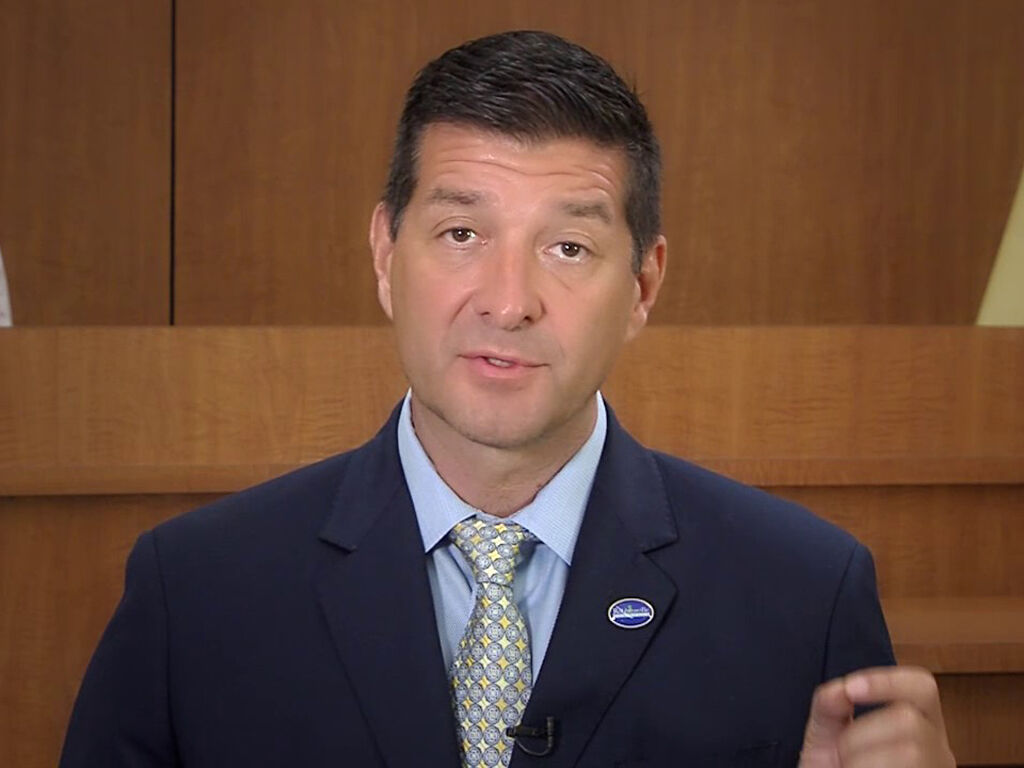
Mayor Dave Fried is preparing to close the chapter on more than two decades of public service as he finishes out final year in office.
Fried, who announced in April that he will not seek reelection, recently sat down with the Robbinsville Advance for a wide-ranging interview to discuss the township’s future and his own next steps.
Fried, Robbinsville’s first directly elected mayor, offered candid reflections on how the town has evolved, the challenges that remain, and what he hopes will come next.
The Robbinsville Advance will run the interview in two parts. The first half, edited for grammar and clarity, appears below in Q&A format. Th esecond half will appear in next month’s issue.
Commercial development
Robbinsville Advance: Robbinsville is getting pretty close to the point where there’s not a lot of developable residential space left—but how about commercial? What does the overall development picture look like?
Mayor Dave Fried: The good news is—budget-wise—Robbinsville is in really good shape. We’ve managed our budget well for quite some time. When we think about what’s new, one of the big things coming online is finally finishing Town Center South. That’s going to be a big financial win for the town.
There are going to be a few hundred senior units coming into Town Center South. They’re going to be absolutely, positively gorgeous. They won’t put any pressure on the school system, and it’s going to be a great ratable for us—55 and older. That will also drive some additional retail growth along Route 33. So that’s one of our big moves.
Secondly, we’re slowly trying to put together a plan to clean up Route 130. I’d really like to see Route 130 get a facelift—starting probably near where Russert’s Deli and the old banana factory used to be. We’d like to see something happen there and then work our way down the corridor.
And you’re starting to see it happen already. A new car dealership is coming in. The Jeep dealership came in. Workout World came in. I think you’re slowly seeing Route 130 get where we’d like it to go. I’d very much like to do something about the hotels on Route 130. They account for a large portion of the crime in Robbinsville, so I’d like to see that cleaned up.
Maybe we can do a better version of affordable housing there or some sort of urban-style housing. That’s high on our priority list.
There aren’t a whole lot of big sites left in Robbinsville. We’re getting very close to being built out. So, it’ll be a lot of little moves and some interesting cleanups that I think will wind up making the town and the corridor look significantly better.
On one side of Route 130, we’re constrained by the railroad tracks as you head south; on the other side, there are a lot of wetlands. So, none of these sites will ever produce anything very large. As you head toward East Windsor, we’ve got the remainder of the Sharbell (residential) project on Gordon Road. That’s going to include some apartments, some senior units, and a little bit of retail on the corner.
That wouldn’t have been our first choice to have that there, but we lost that fight in a lawsuit a couple of decades ago. So, we’re making the best of it. But that will pretty much finish up anything on Gordon Road.
Robbinsville Advance: On the retail side, it seems—at least in the Town Center area—the Foxmoor Shopping Center is almost full again, which I thought I’d never see. And it seems like there are a number of businesses in Town Center. If you look down Route 33 in Hamilton, there are a lot of vacant storefronts in the shopping centers, but not so much at this end.
Fried: We’ve been very fortunate to have a strong business community. And our residents really do patronize our businesses, which is great. We’ve got a lot of people who focus on shopping locally, and I think that helps.
Robbinsville Advance: And it doesn’t hurt having thousands of residents living in the area surrounding the retail. Putting the retail right in the middle of Town Center and also right next to Foxmoor was a good idea. Because people will shop locally—if it’s convenient enough.
Fried: Yeah, and we’re seeing a lot of draw right now from medical. We’re the closest viable medical destination for this area—places like Allentown and Upper Freehold. There aren’t a lot of retail opportunities out there. So, from a medical standpoint, we’re the closest point for them for a number of services. You’re starting to see Robbinsville do very, very well on the medical side too.
Robbinsville Advance: How about warehouses? I know there was a little bit of opposition coming from other towns on one of the projects you had out there. What’s coming now? What’s planned? Is there really anything left to build there?
Fried: Not a whole lot. I will tell you; we have a great relationship with the mayor of Allentown, Thomas Fritts (Fritts is the Associate Publisher for Community News Service, the company that publishes the Robbinsville Advance). I couldn’t be any happier.
Robbinsville Advance: It seems like you’ve done a good job working with the leaders of the surrounding communities.
Fried: Honestly, he’s easy to work with. He’s a smart guy. The mayor of Hamilton (Jeff Martin) is easy to work with too—he’s also a smart guy. When you have people who can put politics aside and actually want to get stuff done, it’s super easy to work with them.
Mayor Fritts is the same way—he just wants to get stuff done. When you get like-minded people who can let go of all the noise and just figure out how to work together, it’s great.
Honestly, I think every town in New Jersey should be nonpartisan. That would make life easier. Nobody really cares what side of the aisle I’m on. I don’t have to do anything to appease either party, and it just makes my life a whole lot easier.
It doesn’t matter which side of the aisle they’re on—I can work with them. I don’t even know where Thomas stands politically. Jeff is a Democrat, I’m a Republican, but we partner together on everything.
So being nonpartisan has really benefited Robbinsville. It’s made it easy for us to work with anyone.
Residential development and affordable housing
Robbinsville Advance: Let’s talk about the housing situation. How’s the open space program going? What about the Wittenborn property and other developable sites in town? (The Wittenborn Farm is a 15-acre tract located on Robbinsville-Allentown Road, near the border with Allentown).
Fried: Our open space program is probably the most aggressive in Mercer County. Wittenborn is our number one target for the next preservation project. Right now, they don’t want to sell, and it doesn’t seem like they’re developing, so we’ll just wait patiently for the opportunity.
There aren’t many large sites left for us to buy. A couple of little 8- to 10-house parcels are floating around, but nothing material.
We’re also noticing a decline in school-age population. I want to be smart and work with the school district, because if our school population continues to decline like it has in the past few years, it could negatively impact our state aid. We want to make sure we maintain our numbers.
That’s something that’s in the back of my mind. We want to be smart, so we’ve allowed some new housing to happen—just a couple of small developments. Whereas before, we were aggressively stopping everything we could.
Also, the houses in Robbinsville—especially the large ones—are extremely expensive now. The homes coming in are getting close to being positive ratables. When you get a $2 million house at our tax rate, they’re spending $60,000 a year. Even if they have two kids—it’s still a positive ratable.
In the old days, it didn’t work that way. If you sent your kids to school at $15,000 (per pupil cost) each and the homeowner paid $15,000 in taxes, you didn’t need to be a math genius to know we were losing money. But that’s shifting now with the larger homes and the rising prices.
That said, we don’t have a whole lot of stock left. What’s left will be some apartments, and of course whatever we have to do for affordable housing—and that’s pretty much it.
Robbinsville Advance: Let’s talk about affordable housing. More than half of Mercer County towns seemed to challenge the numbers proposed by the state for fewer units. But Robbinsville agreed with the state’s number. What are your thoughts overall on the situation and what the state did?
Fried: Well, I’ll tell you where I think the state is wrong, and I’ll also tell you where Robbinsville has been blessed.
We’ve done a really good job with affordable housing in Robbinsville. We went outside the box with the Mercer Mobile Home Park. We’ve done a bunch of creative things to get us to where we are. In terms of our number, we’re in great shape. I don’t have to fight, because we’re in compliance.
Now, that said, what I think really needs to happen going forward is: we need to stop fighting sprawl and start investing in our cities.
And this is going to be one of the most controversial things you’ll hear me say: regional credits should be allowed. Towns like Robbinsville should be allowed to invest in cities like Trenton, where you can actually create housing.
Why? Because you already have state aid, you have infrastructure, and you have fantastic real estate. Think about Trenton—it has all the bones to be fantastic. It’s got waterfront property. It’s got train access—35 to 40 minutes to New York City. Everything you need to be great exists there.
And here’s where I think we’ve made a huge mistake with affordable housing. We’ve allowed these nonprofits to operate rentals—and while that’s okay as a place to live, they don’t create community.
What we should be doing is using our money to expand homeownership. Because when people are invested in their community, they’ll defend their community. They’ll maintain it. They’ll open businesses. They’ll engage. But if they’re just renting, they don’t care.
We should be giving people a leg up and helping them create equity through affordable housing. Give them a great place to live and a reason to set down roots. That will change everything.
But until that day comes, no one is going to go out and defend a rental property.
Robbinsville Advance: Another big issue: if you look at the numbers assigned to Trenton, it’s all rehab units. The state didn’t give Trenton the requirement to build any new units. Why can’t some of the money that’s being spent on sprawl—on builder’s remedy lawsuits—go to help improve urban environments that need investment?
Fried: Exactly. Imagine if I were allowed to build a Robbinsville-quality block in Trenton. I could buy the land for next to nothing, build affordable housing, lottery it off, and let people own their homes.
Each one of those homes would then become a taxpayer, which gives Trenton a stronger tax base. That’s how you rebuild a city. It starts with people having a vested interest and owning something.
And let me tell you something—so much of the crime is driven by kids. But if you have equity in your home, you’ll make sure that kind of thing isn’t happening on your block. And eventually, block by block, Trenton could become something we’re all proud of.
There’s no reason it can’t be like Hoboken or Jersey City. None. It just needs a little lift to get there. I could buy a city block in Trenton for $100,000. I can’t even buy a residential lot in Robbinsville for that.
As for Robbinsville, we’re going to be okay. I think we’ll even be okay for the next round. We have a great relationship with Fair Share Housing Center. I might be the only Republican they actually like.
They let me think outside the box. That mobile home park—that had never been done before—and they embraced it. I’m grateful to them, and I think they really like the idea now. They’ve featured it in their magazine.
They took a chance on us, and we took a chance on them. And it worked. Now we both have a very trusting relationship. I understand what they want, they understand what I want.
We’ve always included affordable housing in our communities, even when we didn’t have to. They didn’t realize it at first, but we expected this need would eventually come.
Other towns, during the Christie years, stopped building. They thought it would all go away. We kept going. So, when the governor changed, they were behind the eight ball—but we weren’t. We just kept doing what we were doing.
Robbinsville Advance: And it takes thinking outside the box—like what you did with the mobile home park. It turned into a pretty solid success.
Fried: Super lucky, right? The residents really drove it. They kept coming to my meetings, complaining about the prior owner. Had that prior owner not been such a bad guy, we might not have considered doing it. Funny how that works—sometimes you try something outside the box, and it works.
Robbinsville Mayor Dave Fried.,

