Because of Albert Einstein’s longtime association with Princeton, Pi Day (with the first three digits of the mathematical constant, 3.14, translated as March 14) is usually a pretty big deal around here. The Einstein look-alike contest, the Pi Day tours, the pie-throwing, pi memorization and recitation, and of course the fooderies offering deals on pie.
In case you’re not an Archimedes fan, pi, represented by the Greek letter “p” (“π”), is the ratio of the circumference of a circle to its diameter, commonly approximated as 3.14159 — though you could take it a good deal further, since the number is wholly irrational and refuses to fall into a repeating pattern. (This was clearly known by Star Trek’s Mr. Spock when he used it to confound an evil computer.)
Einstein lived in Princeton for the last 21 ½ years of his life, during his residency at the Institute for Advanced Study, which, at its opening in 1933 was housed in Princeton University’s Fine Hall, home of the university mathematics department. The arrangement was only temporary, as IAS established its own campus, now located at 1 Einstein Drive, with the opening of Fuld Hall in 1939.
Einstein’s house still stands at 112 Mercer Street. In accordance with his wishes, the house was not turned into a museum following his death in 1955. A lot of his furniture and a number of his belongings are on display at the Historical Society of Princeton’s Updike Farmstead, located at 354 Quaker Road.
Though Einstein’s house continues to be owned by IAS, it remains a private residence, as is made abundantly clear by signage posted about the property. The house was registered as a U.S. National Historic Landmark in 1976, but there is no marker to advertise the fact. Its significance, however, remains an open secret, and tourists can often be seen taking selfies at the front gate.
Einstein still enjoys an unusual place in the popular consciousness for a physicist. His work on the theory of relativity yielded the most famous equation of all: E = mc2. He laid the foundation for modern quantum theory, and he was the recipient of a Nobel Prize. But he is just as well remembered by many who never set foot in a high school physics class for the iconic images of him lounging in fuzzy slippers or sticking out his tongue. For the public, he was the most human, and perhaps the most adorable, of rumpled brainiacs.
He was also a great music lover. His mother introduced him to the violin when he was 6; by 14, it had become a passion. “If I were not a physicist,” he later reflected, “I would probably be a musician. I often think in music. I live my daydreams in music. I see my life in terms of music… I get most joy in life out of music.”
He owned several instruments over the years, all of them nicknamed Lina (perhaps a feminine diminutive of “violin”). He traveled everywhere with his violin case. On Mercer Street, he would surprise trick-or-treaters with impromptu serenades, and he accompanied carolers at Christmas.
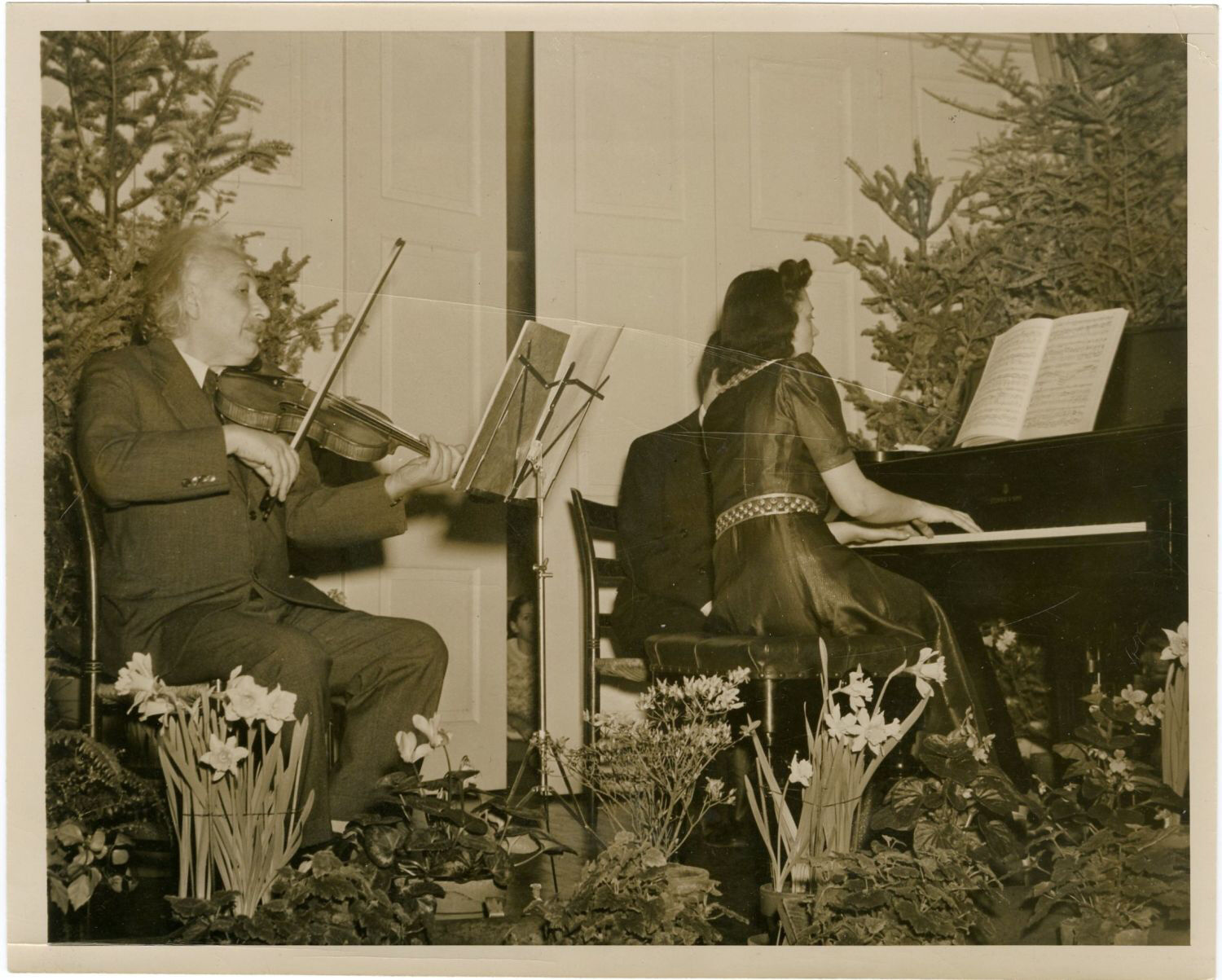
Wednesday nights were chamber music nights at the Einstein residence. For those occasions, most often Einstein was joined by violinist Nicholas Harsanyi, a pupil of Hungarian virtuoso Jenő Hubay. Harsanyi was in the United States on a teaching fellowship at Westminster Choir College when war broke out in Europe. He served in the U.S. Army and later became chair of the Westminster instrumental department. He was also conductor of the Princeton Chamber Orchestra, the Trenton Symphony Orchestra, and the Bach Aria Group, founded by Princeton philanthropist William H. Scheide.
Filling out the trio, on piano, was mathematician and physicist Valentine Bargmann, Einstein’s assistant at IAS, who in 1946 began a 30-year professorship at Princeton University. All three were displaced Europeans. (Bargmann and Einstein were born in Germany. Einstein was visiting the U.S. when Hitler came to power in 1933.) All three became U.S. citizens.
Despite Harsanyi’s wide experience (on top of everything else, he was a seasoned chamber musician who played with several professional ensembles), the Einstein trio was an amateur enterprise.
But even in Europe, Einstein had rubbed shoulders with some of the great musicians. He was friends with pianist Artur Schnabel, at the time perhaps the world’s most respected interpreter of Beethoven. The story goes that once, while the two were playing a Mozart sonata, Einstein missed a couple of entrances, causing Schnabel to remark, “For heaven’s sake, Albert, can’t you count?” (The comment has also been attributed to violinist Fritz Kreisler. It does seem more like something Kreisler might have said.)
He was close friends with violinist Adolf Busch and Busch’s son-in-law, pianist Rudolf Serkin, later founders of the Marlboro Music Festival. (Later still, Serkin became director of the Curtis Institute of Music in Philadelphia.)
Einstein also knew the Polish pianist Artur Balsam, yet another acquaintance cut off from Europe. When Balsam was asked how Einstein played, he quipped, “Relatively good.”
In 1934, Einstein made his American debut in New York, in a Fifth Avenue ballroom, at a benefit concert for displaced Jewish scientists. (Einstein himself was a Jew, and his books were burned in Germany.) In attendance was George Gershwin, and on the program was Bach’s Concerto for Two Violins in D minor and Mozart’s String Quartet No. 14 in G major. Later that year, Einstein was honored at Carnegie Hall. This time, composer Arnold Schoenberg was there.
In 1941, Einstein took his violin to Princeton’s Present Day Club to participate in a benefit, with the pianist Gaby Casadesus, to raise funds for the American Friends Service Committee for the purpose of helping refugee children in England. These were far from the only times Einstein exhibited a social conscience.
For another musical example, when Marian Anderson, the Black contralto conductor Arturo Toscanini lauded as “a voice one hears once in a hundred years,” was denied accommodations at the Nassau Inn following a recital at McCarter Theatre in 1937 — a recital Einstein attended — he took her into his home. Thereafter, she stayed at the Einstein residence whenever she happened to be in Princeton.
In 2018, one of Einstein’s violins sold at auction at Bonhams New York for $516,500 — five times the auction house’s estimate. The instrument was made in 1933 by Oscar H. Steger, a member of the Harrisburg Symphony Orchestra. Einstein gave the violin to Lawrence Wilson Hibbs, the son of Princeton University janitor Sylas Hibbs, who was just learning to play. It remained in the Hibbs family until the time of its auctioning.
Einstein’s wife, Elsa (née Löwenthal), claimed she fell in love with him because he played Mozart so beautifully. There is a recording circulating on the internet that’s purported to be of Einstein playing a Mozart sonata, but don’t believe it. It is a hoax, like too many other things on social media, shared without question, everyone so wanting to believe it’s Einstein playing. If there is an authentic recording out there, it has yet to come to light.
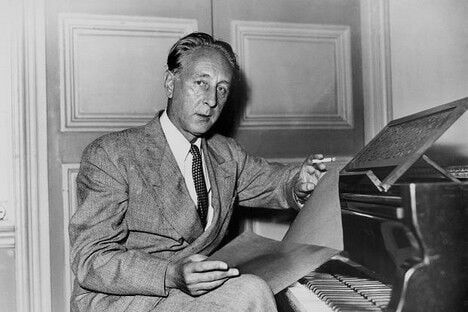
While Einstein’s musical tastes ran mostly to the 18th century, with Mozart holding pride of place (or Haydn, when he was playing string quartets), he did have one piece of music written for him by a contemporary composer. Einstein was not at all at home with music of the 20th century, but he liked and respected Bohuslav Martinů.
Martinů, who grew up in a church tower in the Bohemian town of Polička, located near the Moravian border, was an unlikely candidate to become one of the most important and distinctive of Czech composers. Like Einstein, he was attracted to the violin, but as someone who aspired to be a professional musician, he proved to be undistinguished in his studies at the Prague Conservatory. However, it was discovered he could transcribe a score with remarkable accuracy after having heard a musical work in concert only once.
He was in his early 30s when he finally arrived in Paris, but Martinů made up for lost time. There, he absorbed many influences — assimilating jazz, flirting with surrealism, internalizing neoclassicism. He also made some important contacts that would come in handy once he fled for the United States. (A “Field Mass” he composed for the Czech resistance was broadcast in occupied Czechoslovakia, putting him on the Nazi hit list.)
In the U.S., Martinů wrote many of his major works, including five of his six symphonies. Nevertheless, he was never fully at home here. His hope to return to Czechoslovakia following the war was dashed when the Communists seized control of the country in 1948. He would never see his homeland again.
A few months later, Martinů was named a professor of composition at Princeton University, where he remained until 1951. (He also taught at Mannes College of Music and the Berkshire Music School at Tanglewood, where he fell from a balcony and fractured his skull.) Among the works he composed during his Princeton period were “Three Czech Dances” for two pianos; the Sinfonia Concertante for violin, oboe, bassoon, cello, and orchestra; “Sinfonietta La Jolla”; the Concerto for Two Violins and Orchestra; and the Piano Trio No. 2.
In 1952, he became an American citizen. Even so, he returned to France in 1953. There he remained productive. But in 1955, he was back in the U.S. to teach at the Curtis Institute, a position he held for only one year. Grasping another opportunity to return to Europe, he accepted a post at the American Academy of Music in Rome. The year after that, he was offered accommodations in Switzerland, on the estate of conductor, patron, and billionaire businessman Paul Sacher. (Late in life, Sacher was assessed as the third richest man in the world.) Martinů died there in 1959 at the age of 68.
While Martinů’s music was performed by all the major American orchestras and generally well-received, especially by audiences, he never seemed to be able to gain any real traction or sense of permanence. Often, he found himself having to rely on the kindness of, if not exactly strangers, then those who understood his true value.
Part of the Martinů problem is surely that he was so prolific. He left 417 compositions in all, including six symphonies, 15 opera, 14 ballet scores, and a large body of orchestral, chamber, vocal, and instrumental works. For the uninitiated, getting one’s head around the composer’s output can be disorienting and overwhelming. Yet Martinů’s music is immediately appealing, generally easily digestible, and often a great deal of fun.
Some of the works have a strong Czech national flavor, revealing a spiritual descent from the line of Antonín Dvořák and Bedřich Smetana; others are evidently modernist, full of churning flywheels and motor rhythms, characteristic of a mechanized age; others still flirt with popular styles, especially jazz. He’s a unique mash-up of Bohemian, French, and American influences. His “modernism,” such as it is, is seldom at the expense of broadening passages of great lyrical beauty.
While Martinů’s comparative neglect has been long-standing, he seems to be building steam. Over the past year, there have been several performances of his works in New York and Philadelphia. Locally, Michelle Djokic’s Concordia Chamber Players have been staunch champions.
Surely some sort of apotheosis will be achieved this summer, when the sleeping giant of Czech music will finally get his own festival, as the subject at the 35th annual Bard Music Festival, “Martinů and His World,” to be held on the campus of Bard College in Annandale-on-Hudson, New York, August 8 through 17. Among the larger works to be presented will be the Symphonies Nos. 2 & 6, the oratorio “The Epic of Gilgamesh,” and the opera “Julietta.”
Einstein and Martinů were a remarkable fit. Both men were European refugees, driven out by Hitler, and now strangers in a strange land. They already had much in common, as refugees and academics. Interestingly, they also shared a habit of taking long solitary walks, becoming so wrapped up in their own heads that they frequently became oblivious to their surroundings and occasionally got lost.
The association was further strengthened by Einstein’s lifelong love of music and Martinů’s fascination with physics. But their conversations ranged far beyond their areas of expertise, into metaphysics and the wider world. Einstein gifted Martinů a signed copy of “The Evolution of Physics.” Martinů wrote Einstein a piece of music.
Einstein performed Martinů’s “Five Madrigal Stanzas” with pianist Robert Casadesus, Gaby’s husband (also refugees who spent the war years in Princeton) — and also a noted interpreter of Mozart — in a private recital.
By cosmic coincidence, Einstein was born on March 14, the day now associated with pi, in 1879. The first Pi Day was observed in 1988, not in Princeton, but at the San Francisco Exploratorium, which was founded by Frank Oppenheimer, younger brother of Einstein’s IAS colleague, J. Robert Oppenheimer. Physicist Larry Shaw, who worked at the museum as technical curator, conducted a mini-celebration, leading the staff around the circumference of one of the museum’s circular spaces before sitting down to enjoy fruit pies.
In 2009, the U.S. House of Representatives passed a non-binding resolution to recognize the date as National Pi Day. Ten years later, UNESCO expanded its scope even further, making Pi Day the International Day of Mathematics.
This year, Pi Day falls on a Friday. Its proximity to the weekend will allow Princeton to celebrate on Friday and Saturday.
Einstein once observed, “The difference between genius and stupidity is that genius has its limits.” Is all this hullabaloo about pi, a numerical sequence without limit, then, stupid?
In the borough of Princeton, where Einstein made his home, I suppose it’s all relative.