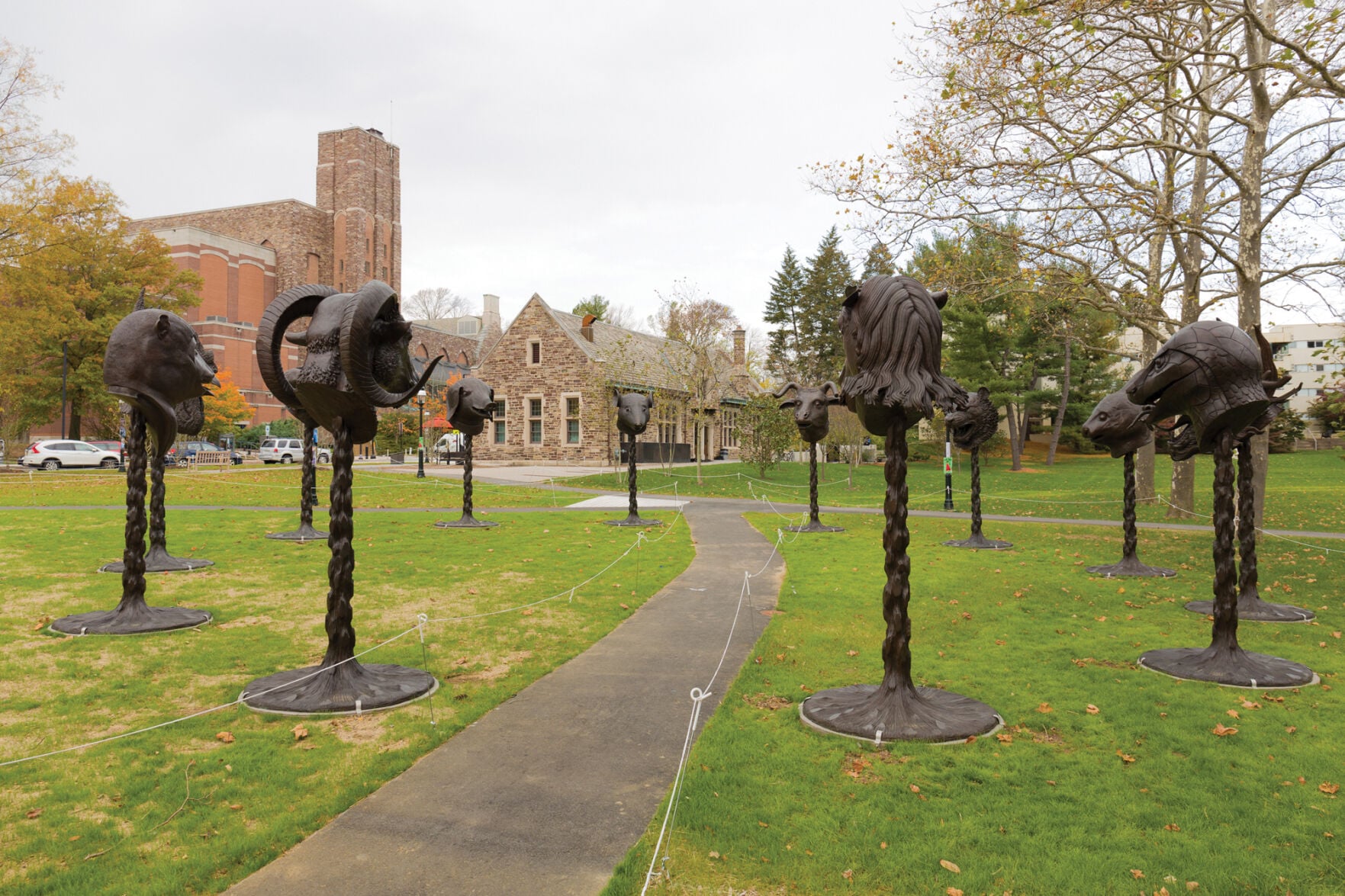
The dozen 10-foot-tall bronze animal figures that make up “Circle of Animals/Zodiac Heads” stare straight at those passing by the edge of the Princeton University campus near McCarter Theater and the Lewis Art Complex.
While the figures with their 800-pound heads and 200-pound bases seem members of a fixed flank of some fantastic army, they are there to mark things less tangible.
They are the shapes that announce the coming of spring with the Chinese New Year, which begins on February 1 and concludes February 15.
Created — or more accurately recreated — by Ai Weiwei, today’s most famous Chinese artist and political dissenter, the statues came to the Princeton University campus in August, 2012, and were first installed surrounding the fountain outside the Princeton School of Public and International Affairs.
They were part of a plan to bring the artist to Princeton University, where he would speak about his art and his struggles with the repressive Chinese government.
However, Ai was detained in China and unable to visit. And while he eventually became free to leave China and now lives Portugal, his statues still remain and offer the occasion to reflect on the Chinese calendar and the history of the figures.
As is commonly known, the Chinese zodiac is represented by 12 animals that give each year its name: rat, pig, horse, tiger, rabbit, dragon, snake, ram, rooster, dog, ox, and monkey. Each animal allegedly marks the personality of the individual born during a specific animal’s year, with some years being more propitious than others. This year is dedicated to the Tiger, an image denoting strength and courage,
The series of years has its roots in antiquity and is based on both lunar and solar calculations.
Instead of a future forever moving forward, the Asian system involves celestial and terrestrial patterns that shift, mix, and then repeat every 60 years. Each year in this cycle contains various energies or forces that affect life and are recorded with the animal names.
Since more than the Chinese people use this time calculation, the change of year is more appropriately called the Lunar New Year (or even the Spring Festival), which falls between the December solstice and the March equinox.
The connection to the year and the animal is a fanciful story. When the Buddha requested that animals honor him, only the 12 mentioned creatures stepped forward. To recognize them, the Buddha gave each animal a year that contains energy similar to that of the animal.
While the animals are familiar and mainly domestic, the inclusion of the dragon may surprise Westerners. Asian culture, however, sees the creature as a representation of the vital and regenerative force of life.
The story of how the zodiac animals in Princeton were fashioned is one filled with surprises.
Ai’s figures are both replicas and controversial reinterpretations of heads created for the 18th-century Chinese emperor Qianlong. His interest in exotic art inspired him to have the Chinese zodiac interpreted by a Jesuit Italian artist, Giuseppe Castiglione.
Castiglione was born in Milan in 1688 and studied art before joining the religious order that sent him to China in 1715. The Jesuit brother eventually came to Beijing, where the emperor was impressed with the foreigner’s talents and invited him to serve as an imperial artist. Castiglione accepted, adopted a Chinese name, and served four rulers. He died in 1766.
One of Castiglione’s court projects was the creation of an exotic garden and summer palace that mixed Asian and European designs. The artist, along with fellow Jesuit and architect Michel Benoit, created a water clock that featured the 12 heads that spouted water to designate different times of the day.
While Asian and European historians called the zodiac fountain garden one of the most beautiful places in the world, a twist of fate created a new chapter of the story.
In 1860, European forces, determined to benefit from Chinese trade, including opium, had launched the Second Opium War. French and English forces under the command of Lord Elgin (from the same family that removed the famous marbles friezes from Greece) invaded the capital city and plundered the palaces. The zodiac heads were seized and sent back to Europe as booty.
The plunder of the Summer Palace has been a sore point in the sometimes tense relationship between the West and China, which sees the heads as part of their national heritage.
Though seven of those original heads were returned to their homeland over the past 162 years, five still remain missing.
Against this backdrop of ancient, distant, and recent history are the stories involving Ai Weiwei.
The artist was born in China in 1957 to a prominent poet, who became imprisoned during China’s Anti-Rightist Movement in 1958. In his late teens and early 20s, Ai Weiwei attended the Beijing Film Academy and started an avant-garde arts group. After following a girlfriend to Philadelphia in 1981, Ai went to New York City and studied at Parsons School of Design and the Art Students League. His Western art influences were dada, conceptual art, Warhol, and Jasper Johns.
Ai returned to China in 1993 to attend to his ailing father. With China’s attempt to remake itself through capitalist-flavored initiatives and become a world cultural leader, Ai was able to establish himself as an artist, mixing traditions.
One of his rising star moments was in 2008 through his participation in the architectural design for internationally known Beijing Olympic stadium, known as the Bird’s Nest.
However, it was also at this time that he became a more and more outspoken critic of the Chinese government, especially after the Sichuan earthquake, also in 2008. That natural disaster was amplified by the deaths of thousands of children who needlessly perished in the collapse of poorly constructed schools. Those construction faults have been connected to poor government oversight and corruption.
When Ai continued to criticize the communist government and posted the names of the schools and the 5,000 dead or missing children on a blog that he had kept since 2006, his troubles with the Chinese government intensified.
The next few years saw increased harassment, physical intimidation, a leveling of his studios, accusations of tax evasion, and trials.
His response was a series of publicly executed art projects, including the 2008 German installation of thousands of student backpacks that commemorated the Chinese students who perished in the Sichuan earthquake.
Then there was 2010 Tate installation that involved hundreds of Chinese workers who used a combination of traditional craft making and mass production to create a million handmade and hand painted sunflower seed sculptures.
That was followed by the 2010 “Circle of Animals/Zodiac Heads,” which was touring internationally and appearing at prominent museums and locations, such as Princeton.
In the zodiac figures, Ai, mixes artistic ideas, history, personal experience, and technical skills that create a presence and controversy.
While the zodiac may seem like quaint reproductions of ancient figures that blend two traditions, they also provide an opportunity for philosophical reflection about the two cultures. Western tradition created the animal for an ideal landscape that was eventually destroyed by members of that same tradition, and the figures represent a Chinese cosmology of harmony that depends on that culture’s subjugation of the individual.
Yet there is another controversial story connected to the sculptures in Princeton. Since several of the original zodiac heads are missing, Ai created or imagined five new ones (dragon, snake, dog, sheep, and rooster). Since the set is not an accurate replica of the original set, some art commentators say it is a “fake” recreation.
Ai, however, addresses the issue as if he anticipates the criticism. “My work is always dealing with real or fake, authenticity and value, and how value relates to current political and social understandings and misunderstandings,” he says.
The Princeton heads, one of several sets in the United States, also have a story. They are owned by an anonymous university alumnus who loaned them to the university. The Princeton School of Public and International affairs funded the installation and involved the Princeton University Art Museum to provide oversight and expertise. And they involved New York-based Larry Warsh, who, in addition to being a former member of the Contemporary Arts Council of the Asia Society and the Contemporary Arts Committee of the China Institute, collaborated with Ai on several projects, including the creation of the zodiac heads and their 2010 exhibition in New York City.
And while that story continues to unfold like the celestial seasons, there is something about the heads that is consistent and basic. As Ai says, “It’s a work that everyone can understand, including children and people who are not in the art world.”
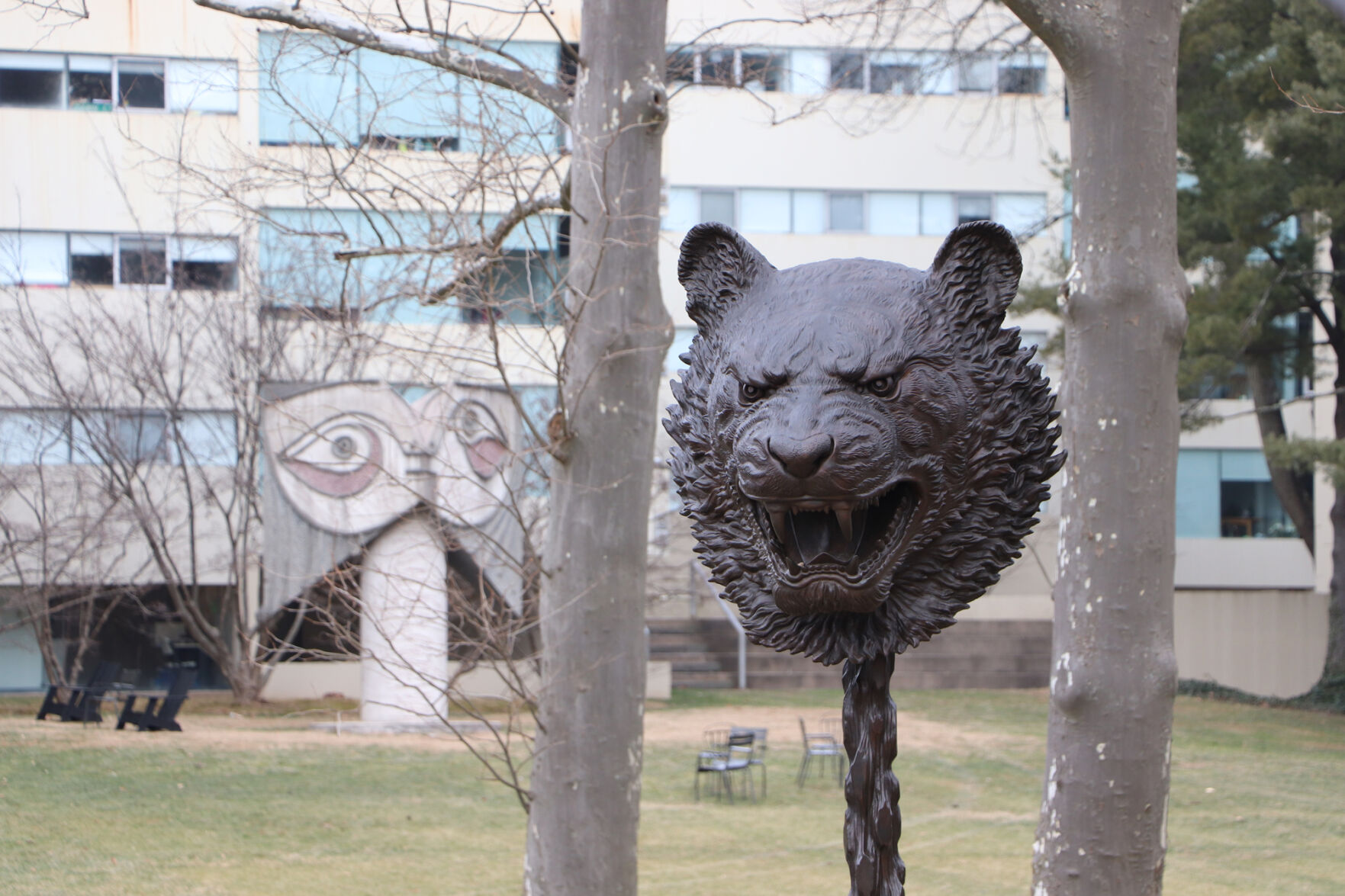
The Year of the Tiger starts February 1. Here, the tiger sculpture in Ai Weiwei’s ‘Circle of Animals/Zodiac Heads’ sits against a backdrop of Spelman Halls,with Carl Nesjar’s execution of Pablo Picasso’s ‘Head of a Woman’ looking on.,