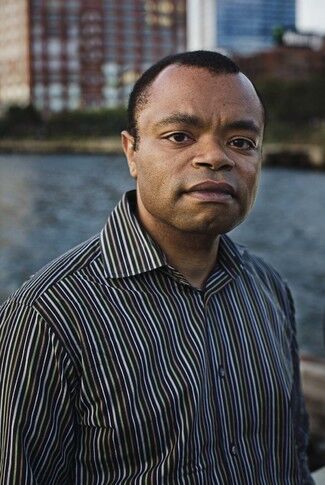
At the heart of Dexter Palmer’s second novel, Version Control, is an apparatus that may or may not be a means of time travel. Even the scientists who are conducting experiments on the time machine — or Causality Violation Device, as they like to call it — can’t determine for certain if it works.
But to call Palmer’s smart, sprawling novel of ideas a time-travel book would be selling it short. Like many works of speculative fiction, Version Control offers commentary and analysis on a wide range of topics: race, emerging technology, public relations, physics and even online dating.
Palmer was born in Virginia into a military family. His family eventually settled in Tampa, Florida. He holds a doctorate in English literature from Princeton University, and today he lives in Princeton. In addition to being a novelist, Palmer is also a test writer for ETS. The book, published by Pantheon, is available now in bookstores and online.
This interview has been edited for clarity and length.
Princeton Echo: Why a time-travel novel?
Dexter Palmer: I was interested in writing a story that was a little more accurate in terms of the scientific process than a fair amount of science fiction is. I was thinking about depicting the difficulty in doing scientific research. So often, experiments don’t work out the way you want to, or you have an idea that doesn’t turn out the way you want it to turn out.
I ended up with this idea that there would be a time-travel mechanism where it would be difficult, if not impossible, to see the effects.
PE: Time travel is treated quite differently in Version Control than it is in most works of fiction, reflecting many of the latest ideas about how it might work — or how it might never work. You tried to work within the constraints of real-life physics.
DP: There was one point when I was designing the experiments and I ended up just calling a friend of mine who’s a physicist, and we were trying to work out the way the experiments would work. And he said to me, “You know, time travel isn’t real. You can make it up.” And I thought, “My goodness, you’re right!” But still, I didn’t want it to be something like TARDIS in Dr. Who where you just jump into a booth and you’re in the 16th century or something like that.
PE: Science fiction novelists almost always use the genre to comment on our own time via a vision of the future, but because Version Control is set in the near future, your very astute commentary feels different — new.
DP: I can only talk about my own experience reading dystopian fiction, which is, if it’s really distant from the world we live in, there’s something that’s perhaps compelling about it, but perhaps it’s a bit of a relief that we don’t live in that world. If you can get closer to reality and then tweak it a little bit, then the reader might start to think that we’re on a timeline where this sort of thing could actually happen.
My first book (The Dream of Perpetual Motion) was set in alternate history of the 20th century — the 20th century as people might have imagined it in 1900. I wanted a change of pace. I thought it would be more of a challenge if this book was set adjacent to the real world.
The fact that it’s set in the near future made things a bit complicated. If you take seven years to write something, what the near future is changes quite a bit over that time.
PE: Version Control is a very plugged-in novel, well versed in the latest ideas in science, technology and even marketing. Is writing science fiction different today because readers have so much access to information?
DP: Yes, it’s similar to how a lot of thriller plots were ruined once cell phones came along. A science fictional future that didn’t take into account the extent of which the data gathered by other people largely determines how we are perceived would seem a little bit dated, I think. Perhaps a little bit fantastic even. The way that data determines identity has changed the way we think about our future.
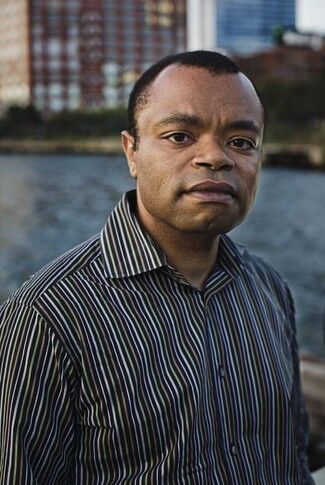
Author photo by Bill Wadman.
,