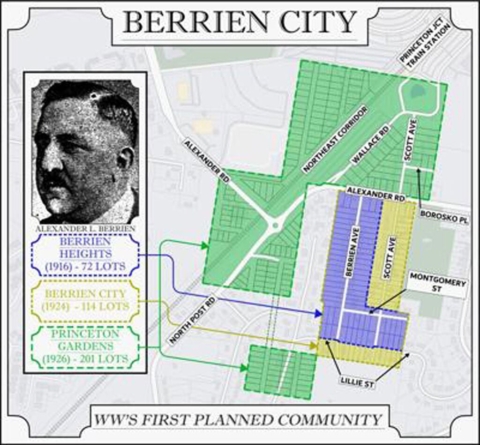
A historic marker recognizing the Berrien City neighborhood in West Windsor was expected to be dedicated May 2 as part of an ongoing effort to document the township’s early development.
The cast-metal marker was designed and funded through a collaboration between the Historical Society of West Windsor and members of the Berrien City Neighborhood Association, according to the Society’s website.
The dedication ceremony was set to include a ribbon-cutting, remarks from organizers and township representatives, and a display of historic photographs and maps. The event was open to the public.
The marker identifies Berrien City as one of the township’s earliest planned residential communities, dating to the 1910s, and is located within the Princeton Junction section of the township near the intersection of Alexander Road and Scott Avenue.
Berrien City, also known simply as Berrien, is an unincorporated community within West Windsor in Mercer County.
The neighborhood is located within within walking distance of the Princeton Junction train station and Princeton-Hightstown Road.
It is also located nearby West Windsor-Plainsboro High School South and the Windsor Plaza SHopping Center.
According to the Historical Society website, the neighborhood developed in three major stages during the 1910s and 1920s as West Windsor began to shift from a rural township to a more residential community.
The first phase began in 1916, when Scott Montgomery Berrien developed “Berrien Heights,” consisting of 72 lots of uniform size centered around Berrien Avenue and Montgomery Street.
In 1924, his son, Alexander Lawrence Berrien, introduced plans for an additional 42 lots. Together with the original development, the expanded neighborhood became known as “Berrien City.”
The 1924 expansion also introduced additional streets, including Lillie Street, Scott Avenue and Emil Street, which were named for members of the Berrien family.
A third phase followed in 1926, when real estate developer Michael McLaughlin proposed “Princeton Gardens,” a development of 201 lots on both sides of the nearby Northeast Corridor railroad tracks. Only a portion of those lots were ultimately developed, primarily on the southeast side of the tracks.
Princeton Gardens added Borosko Place, named after a local Hungarian family, and over time the three developments — Berrien Heights, Berrien City and Princeton Gardens — became collectively known as Berrien City.
The neighborhood’s proximity to the train station played a role in its early growth, offering residents access to transportation while supporting residential expansion in the area.
The development marked one of the township’s earliest examples of planned residential growth, with a defined street layout and modest homes that replaced farmland.
According to the Historical Society, many early homeowners purchased empty lots and built their own houses, often with the help of neighbors. Some homes were constructed using kit materials from companies such as Sears, Roebuck and Weyerhaeuser.
In some cases, homes incorporated leftover materials from the Pennsylvania Railroad, reflecting the area’s connection to the nearby rail line.
The neighborhood also developed a mix of residential and small-scale commercial activity over time.
Several families operated businesses out of their homes, and a small commercial presence emerged along Alexander Road.
Howard’s Luncheonette opened at 948 Alexander Road in the 1950s, replacing an earlier general store. From the 1940s through the 1970s, the Princeton Junction post office also operated out of that building.
The site later became home to an Italian restaurant, Galletta’s Galley, followed by Brother’s Pizza in the late 1980s or early 1990s. Nearby, Sal’s Shoe Repair Shop has operated as a longtime neighborhood business.
The area has also been home to community institutions tied to the Princeton Junction section of the township.
In 1926, residents formed the Berrien City Fire Company, now known as the Princeton Junction Volunteer Fire Company. The firehouse opened in 1931 at 952 Alexander Road.
During World War II, the building served as a civil defense station and, for a period, a local post office.
In 2010, the building was repurposed as the West Windsor Arts Center and is now operated by the West Windsor Arts Council.
The neighborhood has also been associated with several notable residents.
Among them is John Forbes Nash, a Nobel Prize-winning mathematician whose life was the subject of the book and film “A Beautiful Mind.” Nash lived in Berrien City from the 1970s until his death in 2015.
Actor Ethan Hawke also lived in the neighborhood for a period during the 1980s while attending High School South.
The Historical Society launched its signage initiative to identify and interpret locations of historical significance throughout the township. According to the organization’s website, the project focuses on installing permanent, cast-metal markers designed to provide long-term public access to local history.
The markers are funded through a combination of private donations and partnerships with local groups, with individual signs costing several thousand dollars to design, produce and install.
The Berrien City marker was developed with input and financial support from neighborhood residents, reflecting a joint effort between the Historical Society and the local community.
Additional markers have been installed at other locations throughout West Windsor as part of the ongoing program, with new sites identified through research and community interest.
The Berrien City marker represents the latest addition to that effort.